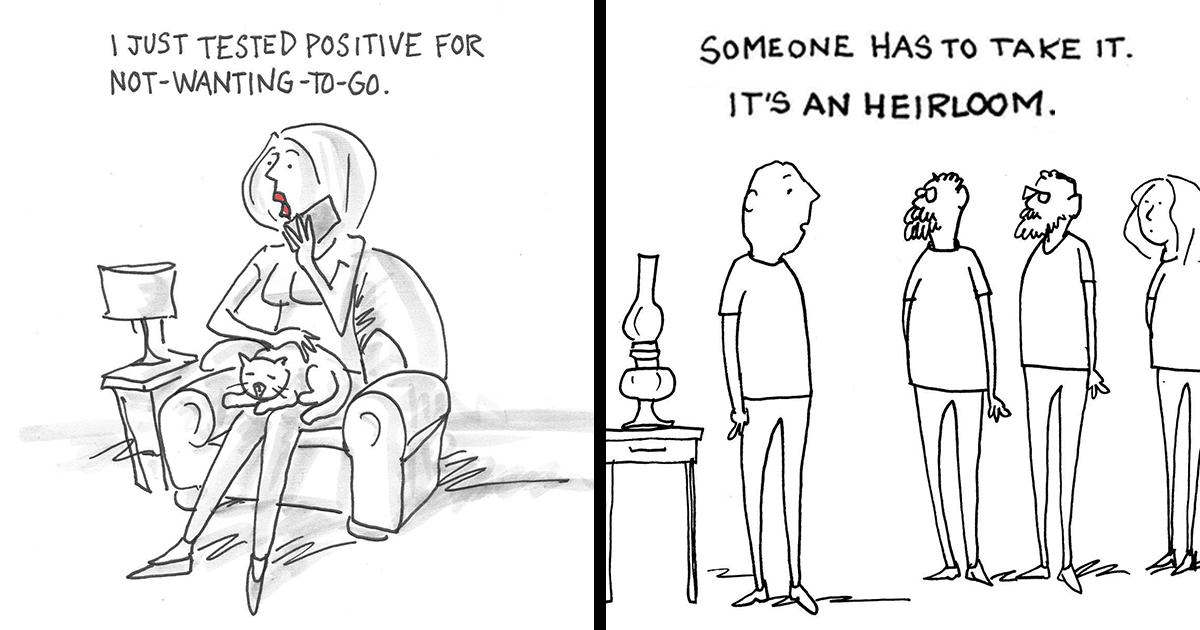
Some artists need a giant canvas, a dramatic soundtrack, and a mountain of symbolism to make a point. Dennis Goris needs a few lines, a sharp caption, and about three seconds of your attention before the joke lands squarely on your forehead like a cartoon anvil. That is part of the magic of his work. In a collection like 30 Funny Insightful Cartoons On Everyday Life And Politics By Dennis Goris, the humor arrives fast, but the aftertaste lingers. You laugh first, then you think, then you laugh again because, well, the truth is often absurdly overdressed.
Goris works in a tradition that is older than modern social media and somehow perfectly suited to it. Political and social cartoons have always thrived on compression. They shrink a messy public argument into one image, one idea, one sting. Goris understands that formula beautifully. His cartoons are minimal without feeling thin, pointed without becoming unreadable, and funny without acting like the joke is the whole point. That balance is why these cartoons feel less like throwaway internet gags and more like tiny editorials with excellent timing.
If you are scrolling through a set of 30 cartoons by Dennis Goris, expect a mix of everyday frustrations, media nonsense, political hypocrisy, public exhaustion, and the occasional reminder that modern life can feel like a group project where half the class has gone missing. His work does not ask readers to sit down for a lecture. It invites them into a joke and then politely locks the door behind them until they notice what the joke is actually saying.
Who Is Dennis Goris?
Dennis Goris is not a cartoonist who arrived by accident after doodling through one boring meeting too many, although one suspects he has improved several meetings with doodles. By profession, he has worked as a designer and creative director, running a branding and communications business and producing work for nonprofit and institutional clients. That background matters. It helps explain why his cartoons are so clean, so legible, and so efficient. He thinks like a communicator, not just an illustrator.
That design brain shows up everywhere in his cartoons. There is no wasted clutter. He knows how to direct the eye, simplify the setup, and make sure the visual and verbal punch line arrive together. In other words, he treats a cartoon the way a good creative director treats a campaign: every element has a job, and if it is not doing useful work, it gets cut.
That is one reason his cartoons about everyday life and politics feel immediate. They are built to communicate quickly, but they do not collapse after first contact. Instead, they reward readers who pause for a beat. The first read gives you the laugh. The second read gives you the critique.
Why These 30 Cartoons Work So Well
They turn ordinary frustrations into recognizable comedy
The strongest cartoons on everyday life do not need a giant scandal or a world leader making headlines. They can start with something smaller: stress, distraction, consumer habits, empty social rituals, public politeness hiding private irritation, or the weird emotional fatigue of reading too much news before breakfast. Goris is especially good at spotting those tiny modern absurdities and nudging them just far enough to expose how strange they already are.
That is a big reason these cartoons feel relatable. They are not trying to impress readers with complexity for its own sake. They are trying to capture the sensation of living in a world where people doomscroll through catastrophe, debate nonsense with total confidence, and act shocked when consequences finally show up at the door. In other words: normal life, but with better timing.
They use politics without becoming homework
Political cartoons can fail in two opposite ways. Some are so vague they say nothing. Others are so overloaded with references they feel like a pop quiz written by a very angry civics teacher. Goris usually avoids both traps. His best work takes current events, public figures, or policy debates and distills them into a single readable absurdity. You do not need a 400-page briefing book to understand the point. You just need a basic awareness that modern politics often behaves like satire that got out of hand.
That is especially important in a collection of 30 pieces. Readers want momentum. They want one sharp idea after another, not a forest of inside jokes that only three policy analysts can decode. Goris tends to build from broad public themes: hypocrisy, greed, cruelty dressed up as strength, media distraction, performative outrage, and the gap between what leaders say and what ordinary people experience. Those are themes with shelf life, which makes the cartoons feel timely without being disposable.
They know the power of minimalism
There is a particular bravery in drawing less. When a cartoonist strips away visual clutter, there is nowhere for a weak idea to hide. Goris often works with a sparse visual style that puts pressure on the concept itself. If the cartoon succeeds, it succeeds because the idea is strong. If it misses, there is no decorative fog to save it. Fortunately, his ideas usually know exactly where they are going.
This stripped-down approach also makes the satire feel sharper. A busy illustration can soften a joke by scattering attention. A simple image, by contrast, can hit like a dropped plate in a quiet room. Goris uses that effect well. He lets the concept do the heavy lifting, then uses the art to guide the impact, not smother it.
The Big Themes Running Through the Collection
1. Everyday life is ridiculous, and we all know it
One of the pleasures of Dennis Goris cartoons is that they often capture the tiny humiliations and contradictions people live with every day. That might include consumer culture that keeps selling convenience while making everyone more frazzled, public etiquette that masks private selfishness, or technology that promises connection while delivering a fresh basket of confusion. His work often suggests that modern adults are expected to function normally inside systems that are obviously not normal. That is fertile ground for comedy.
It also helps explain why readers respond so strongly. When a cartoon reflects something you have felt but never phrased, it creates a quick little jolt of recognition. You are not just seeing a joke. You are seeing your own private eye-roll illustrated by someone else.
2. Politics is not separate from ordinary life
Another strength of this collection is the way it treats politics not as a distant spectacle, but as something that leaks into groceries, work, school, healthcare, public safety, and emotional well-being. The best political cartoons do not merely mock powerful people as if they are characters floating in a vacuum. They show how public decisions create private consequences. Goris gets that. Even when the target is a politician, the real subject is often the ordinary person stuck dealing with the fallout.
That is why his cartoons can move so easily between national headlines and familiar daily frustrations. The border between the two is thinner than people like to admit. A tariff debate becomes a cost-of-living joke. A culture-war stunt becomes a family-level annoyance. A public lie becomes a private burden. Suddenly the cartoon is not “about politics” in some abstract sense. It is about the air everyone is already breathing.
3. Power loves costumes
A recurring feature of good satire is the exposure of disguises. Leaders present self-interest as patriotism. Corporations rebrand exploitation as innovation. Media drama dresses up noise as importance. Goris frequently pokes at those disguises. His cartoons suggest that much of public life depends on costumes, labels, slogans, and stagecraft. Pull back the curtain, and the whole show starts looking much less majestic and much more like a badly managed school play.
That theme is especially effective in one-panel work because the image itself can become the reveal. A label, a facial expression, a visual juxtaposition, or a blunt caption can collapse a whole public performance in seconds. It is the artistic equivalent of saying, “Oh, come on,” but with better line control.
4. Humor can carry anger without losing intelligence
Some cartoons are gentle observations. Others have more bite. Goris often leans into the second category, particularly when the subject involves injustice, hypocrisy, cruelty, or political manipulation. But the anger in his cartoons is usually shaped, not sprayed. The humor gives it structure. That matters, because satire is at its best when it directs frustration rather than merely venting it.
In that sense, these cartoons do more than entertain. They give readers a way to process the nonsense. Sometimes laughter is not a retreat from seriousness. Sometimes it is how seriousness becomes bearable enough to examine.
What Makes Dennis Goris Different From Other Cartoonists?
Plenty of artists are funny. Plenty are political. Plenty are observant. The tricky part is combining those qualities without sounding repetitive or smug. Dennis Goris stands out because he tends to work with economy. He does not over-explain the joke, and he does not bury the reader in cleverness for its own sake. His cartoons are typically accessible at a glance, which is harder to do than it looks.
He also seems comfortable moving between tones. One cartoon may feel like a dry observation about daily life. The next may hit harder, dealing with corruption, public cruelty, or the moral evasions of people in power. That range keeps a 30-cartoon collection lively. It prevents the reading experience from flattening into one emotional note.
And then there is the design discipline. Because of his professional background, his work often carries the clarity of a poster, the punch of a slogan, and the narrative efficiency of an ad campaign that escaped corporate captivity and decided to start telling the truth. That is a fun combination. Also slightly dangerous. Which is probably the point.
Why Political and Social Cartoons Still Matter
In a media world packed with hot takes, long threads, video clips, podcasts, and approximately 97 opinions per minute, it would be easy to assume cartoons are a quaint leftover from the newspaper age. That would be a mistake. Cartoons remain powerful precisely because they are compact. They force a point of view into visual form. They can be shared quickly, remembered easily, and argued about almost instantly. In the digital era, that is not a weakness. It is an advantage.
Collections like 30 Funny Insightful Cartoons On Everyday Life And Politics By Dennis Goris remind readers that satire still has real cultural muscle. A good cartoon can summarize a week’s worth of frustration faster than a five-minute monologue. It can freeze hypocrisy in place. It can spotlight moral absurdity. It can also invite readers in who might not sit down for a dense political essay. Humor opens the door; insight makes people stay.
Of course, cartoons are not neutral objects. They come with perspective, emphasis, and bias. That is true of all editorial art. But that is also why they matter. They are not pretending to be sterile. They are making an argument. The strongest cartoonists, including Goris, understand that persuasion and art are sharing the same cramped apartment. When they get along, the result can be memorable.
A Few Specific Qualities Readers Will Notice in These 30 Cartoons
- Fast readability: The joke is clear without feeling simplistic.
- Strong point of view: The cartoons know what they want to say.
- Topical range: Everyday habits, social absurdities, public figures, and cultural stress all show up.
- Minimal visual noise: The art supports the idea instead of drowning it.
- Memorable sting: The best cartoons linger because the final implication hits a little harder than the setup suggests.
If you are the kind of reader who likes your humor with a side of social observation, this collection delivers. If you prefer your politics sugar-coated, the cartoons may still work, but they probably will not whisper. Goris is not a wallpaper artist. He makes work that wants to be noticed, and sometimes challenged.
Final Thoughts
30 Funny Insightful Cartoons On Everyday Life And Politics By Dennis Goris is the kind of collection that proves a single panel can still punch above its weight. These cartoons are quick to scan, but not shallow. They are funny, but not empty. They are political, but not trapped in jargon. Most importantly, they understand a basic truth about modern life: sometimes the clearest way to describe reality is to exaggerate it only slightly.
Dennis Goris succeeds because he knows that humor is not just decoration. It is a delivery system. It helps difficult ideas travel faster. It lets criticism slip past defenses. It turns frustration into recognition. And in a culture that often feels too noisy, too divided, and too exhausted to process itself honestly, a smart cartoon can still cut through like very tidy lightning.
That is what makes these 30 cartoons worth reading. They do not merely entertain the eye for a moment. They expose the moment itself.
A Reader’s Experience With Dennis Goris’s Cartoons
Reading through a batch of Dennis Goris cartoons feels a little like opening your front door and finding that someone has taped your private thoughts to the porch, only they made them funnier and drew better faces. That is the odd little thrill of this kind of work. You start with amusement, but before long you realize you are not just consuming jokes. You are participating in a strange, compact form of public therapy. Not the expensive kind with a waiting list. More like the sketchbook version, where the diagnosis arrives in one panel and the co-pay is emotional recognition.
What makes the experience especially memorable is the rhythm. One cartoon may make you laugh because it captures an everyday irritation so perfectly that you feel seen. The next may land more heavily because it exposes a political absurdity you have been trying, unsuccessfully, to explain to other people for months. Then another slides in with a cleaner, quieter joke, and suddenly you are smiling again before the next sharp turn. That movement between humor, annoyance, recognition, and reflection is what keeps a 30-cartoon collection from becoming repetitive. It feels like walking through a gallery curated by your most observant friend, the one who notices everything and lets nobody off the hook.
There is also something satisfying about how little time each cartoon demands. We live in an age where every issue arrives wrapped in thirty tabs, twelve arguments, and one person insisting they have a podcast episode about it. Goris cuts through that clutter. He can say, with one image and a caption, what whole panels of television fail to say in twenty minutes. As a reader, that can feel refreshing. It can also feel mildly exposing, because the cartoon often reveals how ridiculous a situation was all along. You are not learning that the emperor has no clothes. You are being reminded that the emperor also launched a merch line.
On a personal level, cartoons like these can create a very specific kind of relief. They do not solve the world’s problems, obviously. A one-panel drawing cannot lower your grocery bill, fix a broken institution, or prevent a politician from saying something absurd before lunch. But it can do something smaller and still valuable: it can make you feel less alone in noticing the nonsense. That matters more than people sometimes admit. Shared laughter is not always escapism. Sometimes it is evidence that reality is still visible, that people are still capable of identifying hypocrisy, cruelty, vanity, and contradiction when they see it.
By the time you finish a set like this, you may not remember every single caption word for word. What you will remember is the sensation of clarity. You will remember how quickly a smart cartoon can slice through fog. You will remember that humor can still be intelligent, pointed, and useful. And if the collection really works, as Dennis Goris’s often does, you will leave feeling two things at once: entertained by how absurd the world is, and newly aware that absurdity is never just background noise. It shapes the headlines, the mood, and the everyday experience of being alive in public. That is a lot for a cartoon to carry. Goris carries it lightly, which is exactly why it lands.