Television can make storytelling look suspiciously easy. A character enters a coffee shop, delivers a perfectly timed complaint, triggers three escalating disasters, and somehow arrives at an emotional revelation before the credits roll. Meanwhile, the audience sits on the couch thinking, “I could write that.” This is usually said while struggling to compose a two-line restaurant review.
Behind even the breeziest sitcom episode is a complicated TV writing process involving showrunners, staff writers, producers, actors, editors, network executives, and enough rewritten documents to frighten a paper shredder. Modern writers’ rooms commonly employ several writers at different experience levels, although staffing varies according to a show’s length, budget, and episode order.
Not every production follows the traditional model, however. Some shows manufacture episodes in less than a week. Others begin with deliberately terrible drafts, stories donated by writers’ embarrassing families, scripts mailed in by fans, diagrams that resemble occult symbols, or actors who arrive on set without a single scripted line.
Here are six wonderfully strange screenwriting techniques that helped create some of television’s most memorable moments.
1. South Park Turns Procrastination Into a Production System
An Entire Animated Episode Can Be Made in Six Days
Most animated television shows require months of writing, recording, storyboarding, animation, editing, and post-production. South Park famously compresses that process into approximately six days. The frantic schedule was documented in 6 Days to Air, which followed Trey Parker, Matt Stone, and their production team as they developed an episode shortly before its broadcast deadline.
The process begins with a loose collection of current events, social irritations, character ideas, and jokes. Parker and the writers search for a story capable of connecting those ingredients. Once the central plot begins to work, Parker writes the script while artists, animators, editors, and voice performers prepare to move at absurd speed.
Because the show’s digital animation style is handled largely within one production operation, scenes can be revised almost until broadcast. A joke may be rewritten after its animation has already started. Dialogue can change during recording. Major news events can inspire material only days before viewers see it.
Why the Impossible Deadline Helps
The schedule is not merely an unfortunate side effect of production. It is part of the show’s creative identity. Parker and Stone have explained that short deadlines preserve spontaneity and allow South Park to respond to culture faster than most scripted entertainment.
There is also no time to become emotionally attached to a mediocre idea. If a storyline refuses to cooperate, the writers must repair it, replace it, or launch it into the sun. Perfectionism has little room to stretch its legs when a completed episode must be delivered within hours.
This approach would be disastrous for most programs. On South Park, creative panic is practically an executive producer.
2. A Legendary Simpsons Writer Started With a Bad Draft on Purpose
John Swartzwelder Made Writing Easier by Writing Worse
John Swartzwelder holds more individual writing credits on The Simpsons than any other writer, with 59 credited episodes. His work includes stories remembered for dense jokes, bizarre side characters, political satire, and Homer Simpson behaving like a man whose guardian angel resigned several years ago.
Swartzwelder’s most useful writing principle sounds like terrible advice: finish a lousy first draft as quickly as possible.
Instead of spending hours perfecting every line, he would move through the entire script, using placeholder dialogue and weak jokes whenever necessary. The objective was not to produce brilliance. It was to produce a complete object that could be improved.
The following day, he no longer had to confront the terrifying question, “How do I write this episode?” He only had to ask smaller questions: “How can I make this scene clearer? Can this joke be stranger? Does Homer need to fall through something?” Writing had become rewriting, which is usually less intimidating because the page is no longer empty.
The First Draft Is Construction Material
This method reveals an important truth about writing television scripts: early drafts are not performances. They are raw material. A clumsy scene can be repaired. A nonexistent scene cannot.
The traditional Simpsons process also involved substantial collaboration. Writers examined drafts together, suggested alternative jokes, reworked story logic, and tried to make one another laugh. Even an episode credited to one person could pass through many creative hands.
Swartzwelder’s strategy therefore produced exactly what a writers’ room needed: a complete structure that everyone could attack, polish, and overstuff with jokes. The secret was not magically writing a perfect script. It was giving perfectionism an early lunch break.
3. Seinfeld Turned Writers’ Awkward Lives Into Plot Inventory
Real Embarrassment Was More Valuable Than Sitcom Experience
Seinfeld became famous for extracting comedy from irritatingly small experiences: waiting for a restaurant table, losing a car in a parking garage, arguing about social etiquette, or discovering that someone eats candy with a knife and fork.
That focus influenced how stories were developed. Writers brought in unusual encounters, petty disputes, dating failures, strange relatives, and neighborhood characters. An incident that would normally ruin someone’s afternoon could become an A-story.
Spike Feresten’s experience with an intimidating New York soup vendor, for example, became “The Soup Nazi,” his first credited episode of the series. Feresten initially pitched several conventional ideas without success. The bizarre soup-shop story caught Jerry Seinfeld and Larry David’s attention because it contained specific behavior, recognizable tension, and a comic character who already seemed to belong on television.
One Writer Donated His Family’s Secret Holiday
Festivus also came from real life. Writer Dan O’Keefe’s father had created an unconventional family celebration years before “The Strike” introduced television audiences to an aluminum pole, grievances, and feats of strength. O’Keefe was reportedly reluctant to expose the tradition, but his fellow writers recognized that his private family oddity was sitcom treasure.
This anecdote-harvesting method worked because reality supplies details that writers might never invent. A generic “strict restaurant owner” is forgettable. A soup vendor with an elaborate ordering protocol feels real because some unfortunate customer has clearly been publicly humiliated by him.
The lesson is not that television writers must betray everyone they know. The lesson is that specificity creates comedy. Unfortunately for writers’ relatives, those two lessons can become difficult to distinguish.
4. Star Trek: The Next Generation Let Fans Send in Scripts
The Enterprise Had an Unusually Open Door
Major television productions generally avoid reading unsolicited scripts. Legal risks, overwhelming submission numbers, and limited staff time make open-door policies impractical. During part of its run, however, Star Trek: The Next Generation accepted outside submissions under a formal system.
That policy gave aspiring writers an extraordinary opportunity. Instead of merely writing a sample episode that might impress an agent someday, a fan could submit a story to the actual production. Script readers evaluated thousands of submissions, prepared coverage, and forwarded promising work to the show’s writing staff.
The system did not mean producers filmed whatever arrived beside the morning mail. Most submissions went nowhere, and promising ideas still required professional development. Yet the open policy created a route into television that would be almost unimaginable on a major contemporary series.
Fans Could Become Professional Star Trek Writers
Ronald D. Moore is the most famous success story associated with this pathway. After submitting material to the production, he eventually joined the staff and became an important writer on The Next Generation and Deep Space Nine. He later developed the acclaimed reimagining of Battlestar Galactica and worked on additional television dramas.
Outside submissions also contributed to notable Star Trek stories, demonstrating that professional-quality ideas do not always originate inside studio offices. Sometimes they are sitting in a fan’s apartment beside a stack of technical manuals and a concerningly accurate homemade Starfleet uniform.
The experiment showed how a strongly defined fictional universe can function as an informal writing school. Fans already understood the characters, rules, moral questions, and storytelling language. The submission process gave a few of them a chance to prove it professionally.
5. Rick and Morty Uses an Eight-Step Story Circle
Chaos Is Quietly Organized
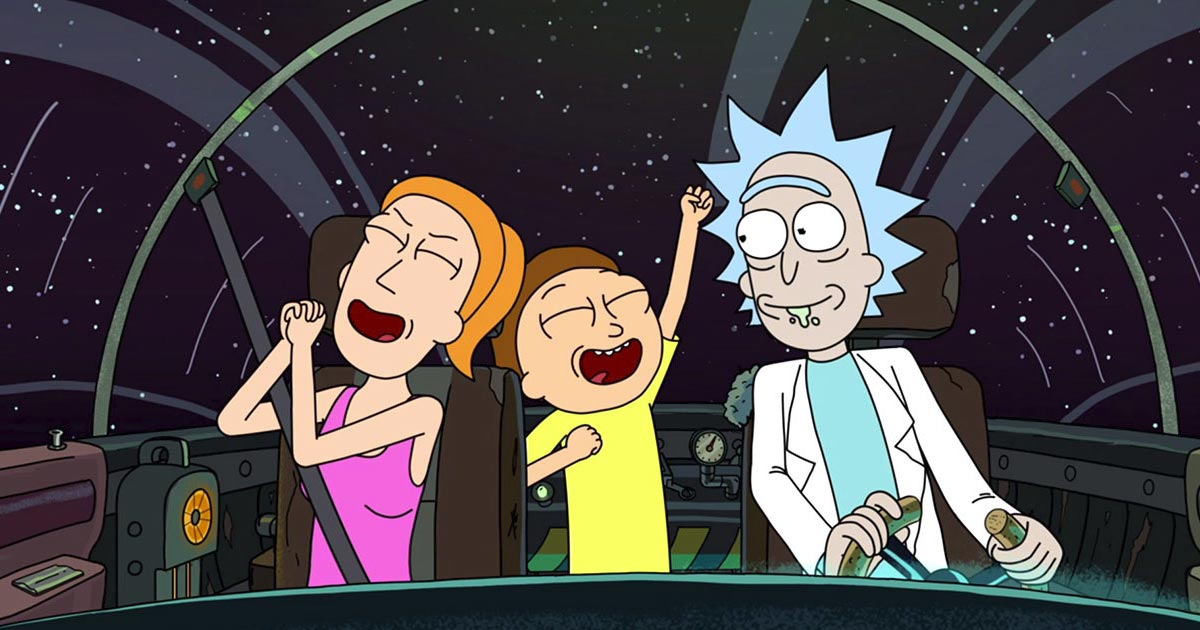
An episode of Rick and Morty may include alternate realities, parasitic memories, collapsing civilizations, talking animals, and at least one scientific device that should never be brought near a family therapist. Despite that chaos, many stories are developed with a highly organized structural tool.
Co-creator Dan Harmon adapted ideas associated with the hero’s journey into an eight-part framework commonly called the Story Circle. In simplified form, a character begins in a familiar situation, wants something, enters unfamiliar territory, adapts, obtains the desired thing, pays a price, returns, and emerges changed.
The circle does not dictate whether a story contains an alien parasite or a disagreement at a school dance. It identifies the emotional movement beneath the spectacle. Morty may travel through a portal, but structurally he is still leaving a comfort zone, confronting consequences, and returning with new knowledge or fresh psychological damage.
A Formula Does Not Have to Produce Formulaic Television
Story formulas are often criticized because audiences can recognize mechanical plotting. The Story Circle avoids some of that danger by describing change rather than prescribing specific events. Two episodes may follow the same structural path while sharing almost no surface similarities.
Harmon has also discussed the challenge of balancing episodic adventures with deeper character development. The structure gives writers a dependable foundation while leaving room for strange science-fiction premises, emotional surprises, and mythology.
In other words, the show’s multiverse may be infinite, but the writers still appreciate a good diagram.
6. Curb Your Enthusiasm Writes the Plot but Not the Dialogue
The Actors Know What Must Happen, Not Exactly What to Say
Curb Your Enthusiasm sounds unusually natural because much of its dialogue is improvised. The production does not simply gather actors, turn on cameras, and hope someone invents an episode. Larry David and his collaborators develop detailed story outlines explaining the characters’ motivations, important revelations, conflicts, and required outcomes.
What the actors often do not receive is conventional scripted dialogue. They enter a scene knowing its purpose, then discover the conversation while performing it. The original production concept deliberately combined structured stories with documentary-style filming so unexpected behavior could become part of the comedy.
This process creates verbal collisions that polished scripts sometimes remove. Actors interrupt, repeat themselves, choose strange words, misunderstand one another, and react with genuine surprise. Those imperfections make arguments feel less like exchanges constructed by a writer and more like social disasters accidentally captured by a camera crew.
Improvisation Moves the Writing Into Performance and Editing
The actors are effectively writing dialogue while performing, but the episode is shaped again during editing. Multiple takes may contain different jokes, rhythms, reactions, and conversational routes. Editors must identify the funniest pieces while preserving continuity and ensuring that the carefully designed plot remains understandable.
The method works because the cast understands the characters and because the underlying outline is strong. Without structure, improvisation can become several people enthusiastically driving to different states. With structure, it feels spontaneous while still delivering setups, reversals, callbacks, and conclusions.
Curb Your Enthusiasm therefore represents a peculiar compromise: the story is tightly engineered, but the sentences are allowed to misbehave.
What These Unusual TV Writing Methods Have in Common
These productions appear to use completely incompatible approaches. South Park races against the calendar, while Rick and Morty maps stories onto a repeatable structure. Swartzwelder completed rough drafts rapidly so they could be rewritten, while Curb Your Enthusiasm postponed much of its dialogue creation until the cameras were rolling.
Yet all six methods solve the same creative problem: writers need a system that keeps ideas moving.
A deadline prevents endless hesitation. A deliberately imperfect draft defeats the blank page. Real anecdotes supply specific behavior. Open submissions expand the pool of possible storytellers. A story circle protects narrative momentum. Improvised dialogue produces discoveries that no one could fully plan.
Great television writing is not always the result of waiting for inspiration. More often, it comes from designing conditions in which inspiration has no choice but to report for work.
Bonus Experience: What It Feels Like to Try These Methods
Imagine attempting to write one 30-minute television episode using each of these approaches. The differences become obvious almost immediately.
Start with the South Park method. Give yourself six days and announce that the finished episode must be delivered on the seventh. The first day feels exciting. You cover a whiteboard with current events, character conflicts, and jokes that seem brilliant because nobody has examined them yet. By the third day, your “simple” story has produced nine subplots, no ending, and a supporting character who has mysteriously become the protagonist.
The deadline forces decisions. You combine two characters, remove a location, and build the ending around the strongest remaining idea. Some choices are inelegant, but the story exists. You learn that speed does not automatically create quality; it creates commitment. You can improve a committed choice. You cannot improve an eternal maybe.
Next, try Swartzwelder’s rapid-draft strategy. Write the entire episode without stopping to perfect jokes. At first, the placeholder dialogue feels embarrassing. Soon, however, you discover that weak dialogue allows you to see the episode’s shape. A scene you were polishing for an hour turns out to be unnecessary. Had you perfected it, you would have built a beautiful staircase leading into a wall.
The Seinfeld approach changes how you observe daily life. Suddenly, an argument over a grocery-store checkout line looks like a cold open. A friend’s irrational rule about restaurant seating becomes a character trait. You begin taking notes during family gatherings, which improves your material while reducing the number of future invitations.
Writing a fan-style Star Trek episode creates a different challenge. You already love the fictional universe, but affection is not enough. You must understand what the characters would do, what ethical questions belong in the series, and which ideas merely imitate earlier episodes. Working inside established rules can be surprisingly liberating. The boundaries eliminate thousands of choices and direct your attention toward the choices that matter.
The Story Circle provides the cleanest planning experience. Once you identify what the main character wants and what price will be paid, scattered scenes begin forming a sequence. The circle cannot invent memorable dialogue or original characters, but it quickly reveals when a story contains activity without change.
Finally, try the Curb Your Enthusiasm method with several performers. Give them objectives instead of lines. One actor must conceal a mistake. Another must obtain an apology. A third must unknowingly make the situation worse. The first attempt may produce noise. The second may produce something unexpectedly alive. A performer pauses, misunderstands a phrase, or invents an insult that changes the scene’s rhythm.
The overall experience demonstrates that no single TV writing process is universally correct. The useful method is the one that exposes your current weakness. When you are overthinking, use a deadline. When you are stuck, write badly. When your plot feels generic, steal inspiration from real behavior. When your story wanders, add structure. When the dialogue feels polished but lifeless, invite unpredictability into the room.
Conclusion
Your favorite television shows may look effortless, but their scripts can emerge from production schedules, personal rituals, family secrets, fan submissions, geometric diagrams, and controlled improvisational chaos.
The strangest lesson is that disciplined structure and creative freedom are not enemies. The six-day deadline gives South Park permission to be topical. The Story Circle gives Rick and Morty room to become bizarre. Detailed outlines allow the cast of Curb Your Enthusiasm to improvise without losing the plot.
Every successful method creates boundaries. Inside those boundaries, writers can experiment, fail, rewrite, argue, and discover better ideas. Television magic may appear spontaneous on screen, but behind the scenes, it usually depends on a repeatable processand occasionally an aluminum pole.
Note: This article is based on documented creator interviews, television-industry reporting, guild resources, production documentaries, and official program histories. All descriptions have been independently paraphrased and expanded for originality, readability, and context.