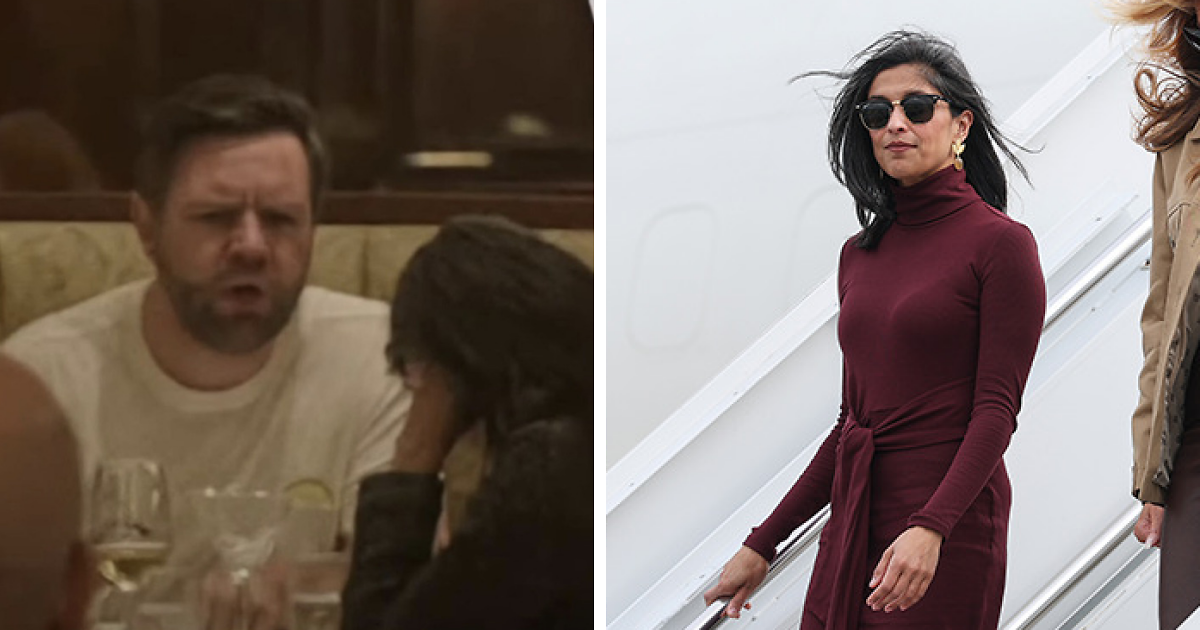
Political gossip travels fast. Political gossip with a blurry-looking restaurant photo, a viral hug, a missing wedding ring, and a vice president known for sarcastic online replies? That travels at rocket speed with a side of fries.
Vice President JD Vance recently found himself at the center of another internet storm after a viral image appeared to show him arguing with his wife, Second Lady Usha Vance, inside a restaurant. The post came wrapped in dramatic claims about a loud public dispute and was quickly connected to wider marriage rumors involving Usha’s wedding ring and Vance’s much-discussed hug with Erika Kirk, widow of conservative activist Charlie Kirk.
But the most important fact is also the least juicy one: the restaurant image has not been verified as a real photograph of a real argument. Multiple reports described the image as likely AI-generated or fake, and Vance responded not with a solemn press release, but with sarcasm. In other words, the internet brought a soap opera; Vance brought a punchline.
What Actually Happened With the Restaurant Photo?
The rumor began when an image circulated online showing a man resembling JD Vance in a white undershirt, appearing visibly upset across a restaurant table from a woman said to be Usha Vance. The caption claimed the couple had been arguing loudly enough to quiet the restaurant.
That claim lit up social media because it arrived at the perfect rumor-cycle moment. Usha had recently been seen without her wedding ring at public appearances. The internet had already been dissecting Vance’s onstage hug with Erika Kirk at a Turning Point USA event. Then came the restaurant image, and online speculation did what online speculation does best: it took one blurry-looking moment and tried to turn it into a full Netflix limited series.
Vance pushed back by mocking the premise. His response on X was sharply sarcastic: he joked that he always wears an undershirt when going out in public to fight loudly with his wife. The line worked because it did two things at once. It dismissed the claim and mocked the absurd theatricality of the rumor.
More importantly, fact-checking and reporting later cast serious doubt on the image itself. The image was described as fabricated or AI-generated, which makes the viral outrage less a story about a marriage and more a story about how easily synthetic media can hijack public attention.
Why Erika Kirk Became Part of the Rumor
The phrase “He wants Erika Kirk” did not appear out of nowhere. It grew from online reactions to a public moment between JD Vance and Erika Kirk during a Turning Point USA event at the University of Mississippi in October 2025.
Erika Kirk, who became a major public figure after the death of her husband Charlie Kirk, introduced Vance during the event. Their hug onstage was emotional, physically close, and instantly overanalyzed by social media users. Some viewers saw it as a normal gesture of grief, support, and friendship. Others treated it like forensic evidence in a romance investigation nobody officially opened.
Erika later addressed the uproar by explaining that she is physically affectionate and that the moment came after an emotional video tribute. She described touch as part of how she expresses warmth and blessing. Still, once a clip becomes meme material, nuance tends to leave the building wearing a hat and sunglasses.
The rumor grew because several storylines converged: Vance’s close political relationship with Charlie Kirk, Erika’s new leadership role at Turning Point USA, Usha’s occasional ringless appearances, and online fascination with the private lives of political couples. Put them all in the same social media blender and, yes, you get a smoothie that tastes mostly like speculation.
What JD Vance Has Said About His Marriage
Vance has publicly dismissed speculation that his marriage is in trouble. In an interview with NBC News, he said he and Usha “get a kick out of” the rumors and described their marriage as strong. He acknowledged that public life brings sacrifices and pressure, but he did not suggest that the gossip reflected reality.
His public posture has been consistent: laugh at the rumors, refuse to over-explain, and portray the attention as part of the strange cost of political life. That strategy can be effective because a long, emotional denial often feeds gossip. A joke, on the other hand, can puncture the balloon before it floats any higher.
Still, the rumors persisted because public marriages function differently from private marriages. When the spouse of a major political figure forgets a wedding ring, the internet does not say, “Ah, normal human behavior.” It says, “Enhance the image, consult the group chat, alert the amateur body-language experts.”
Usha Vance’s Response: Calm, Private, and Unbothered
Usha Vance has generally maintained a quieter public profile than her husband. A former litigator with degrees from Yale and Cambridge, she is not known for chasing attention. That makes the rumor cycle around her marriage especially strange: the less she says, the more some observers try to fill the silence with theories.
In a rare interview, Usha addressed the speculation with a tone that was more amused than alarmed. She said people like to “read the tea leaves” and build stories around whatever they can imagine. Regarding her wedding ring, she made the practical point many married people understand: sometimes she wears it, sometimes she does not. She has been to the gym, showered, cared for children, and lived an actual human life outside the internet’s magnifying glass.
Her response was useful because it refused to treat every online theory as a crisis. Not every missing ring is a coded message. Sometimes a ring is just on the dresser, minding its business.
The Wedding Ring Rumor: Why It Caught Fire
Wedding rings carry symbolic weight, especially for public figures. When Usha appeared at events without hers, commentators quickly connected the dots to marriage trouble. The problem is that some dots are not dots at all. They are random crumbs on the counter.
A spokesperson for Usha explained that she is a mother of three young children who does dishes, gives baths, and occasionally forgets her ring. That explanation is far less dramatic than a secret marital collapse, but it is also far more realistic. Anyone who has ever removed jewelry before showering, exercising, washing dishes, applying lotion, or wrestling a toddler into pajamas knows this is not exactly a national emergency.
The rumor endured because it fit a narrative already forming online. Once people believed there was tension because of the Erika Kirk hug, a missing ring seemed to confirm it. This is how confirmation bias works: first comes the theory, then comes the search for evidence, and suddenly everyday details are treated like clues in a political escape room.
The Bigger Story: AI Images and Political Misinformation
The restaurant-photo controversy is not only about JD and Usha Vance. It is also about how political misinformation now spreads in an era where images can be generated, altered, or miscaptioned within minutes.
An AI-generated image does not need to be perfect to be effective. It only needs to look plausible enough for people who already want to believe it. Add a provocative caption, a famous face, and an emotionally charged claim, and the post can travel far before anyone asks whether it is real.
This is especially dangerous in politics because people often share content based on tribal instinct. If the image embarrasses someone they dislike, they may click “share” before checking whether it is authentic. The truth limps behind while the fake image is already doing victory laps.
For readers, the lesson is simple: viral does not mean verified. A screenshot is not a source. A caption is not evidence. A stranger saying “apparently” is not the same as a credible eyewitness account. The internet is many things, but it is not a courtroom.
Why Public Marriages Become Political Theater
Political couples are often treated as symbols rather than people. A spouse’s expression, clothing, ring, handshake, or hug can be used to support a broader story about power, loyalty, religion, gender, family values, or hypocrisy.
JD and Usha Vance are particularly interesting to commentators because their marriage sits at the intersection of several public narratives. He is a Catholic conservative and prominent Republican figure. She was raised Hindu, built an elite legal career, and has been described as more private and professionally independent. Together, they complicate the simple political images people prefer to consume.
That complexity makes them magnets for interpretation. Supporters may see them as a strong family navigating public life. Critics may see tension between Vance’s political brand and the lived reality of his interfaith, multicultural marriage. Gossip accounts see clicks. Everyone brings their own lens, and the couple becomes a screen for projection.
JD Vance’s Public Image and the Sarcasm Strategy
Vance’s response to the restaurant rumor fits his broader communication style. He often uses sharp, combative, or sarcastic language to challenge critics. In this case, the joke about wearing an undershirt to fight publicly with his wife was designed to make the allegation look ridiculous.
That approach has advantages. It prevents him from seeming defensive. It gives supporters a quotable line. It shifts attention from the accusation to the absurdity of the accusation. In the attention economy, a good joke can outrun a denial.
But sarcasm has limits. It may satisfy supporters, but it does not always persuade skeptics. People who already believe the worst may interpret humor as evasion. That is why public figures face a difficult choice: answer too seriously and dignify the rumor, or joke too casually and risk seeming dismissive.
In this case, Vance appears to have chosen the second path. Given that the image itself was reportedly fake or AI-generated, the sarcastic route was probably the more effective political move.
How Readers Should Understand the “He Wants Erika Kirk” Claim
The claim that Vance “wants Erika Kirk” is not supported by verified evidence. It is a social media interpretation built from a public hug, a rumor cycle, and speculation about body language. That does not make it news in the traditional sense. It makes it a case study in how online audiences turn gestures into narratives.
There is a difference between reporting that people are speculating and reporting that the speculation is true. Responsible coverage should make that difference clear. The fact that rumors exist is real. The content of those rumors may still be baseless.
For publishers, this distinction matters. A headline can attract readers without presenting unverified claims as fact. Phrases like “amid rumors,” “online speculation,” and “allegedly” help, but they are not magic shields. The body of the article must still clearly explain what is verified, what is denied, and what remains unsupported.
Experience Section: What This Rumor Cycle Teaches About Modern Media
Anyone who has watched a political rumor unfold online has seen this pattern before. First, a provocative image appears. Then a caption gives people a ready-made conclusion. Next, social media users add jokes, outrage, theories, and supposed “analysis.” By the time fact-checkers arrive, the rumor has already become entertainment.
The JD Vance restaurant-photo episode feels familiar because it follows the modern internet script almost perfectly. A public figure people argue about? Check. A spouse who has become a subject of fascination? Check. A third person, Erika Kirk, already connected to a viral emotional moment? Check. A possibly AI-generated image that looks just believable enough on a small phone screen? Check. Add political tribalism and you have a rumor engine with premium fuel.
From a reader’s perspective, the experience can be confusing. One post says the photo proves a fight. Another says it is fake. Another says the issue is really about Vance’s marriage. Another says the marriage rumors are really about race, religion, and conservative politics. Suddenly, what started as one questionable image becomes a full cultural argument.
That is why digital literacy matters. Before reacting, readers should pause and ask basic questions: Who posted the image first? Is there original video? Has a credible outlet verified it? Is the person sharing it using careful language or pushing emotional certainty? Does the image show visual signs of AI generation? Are we looking at evidence, or are we looking at a story people want to be true?
There is also a human lesson here. Public figures deserve scrutiny, especially when they hold power. But their spouses and families often become targets of speculation that would feel invasive if it happened to anyone else. Usha Vance’s missing ring became a national conversation even though her explanation was ordinary. That says less about her marriage than it does about the public appetite for decoding women connected to powerful men.
For writers and editors, the experience offers another reminder: traffic should not outrun truth. A good article can cover viral rumors without amplifying falsehoods. It can explain why a story spread, identify what is confirmed, and avoid turning an unverified claim into a statement of fact. That is not boring. In today’s media environment, accuracy is practically rebellious.
The Vance rumor cycle may fade, but the pattern will not. AI images will keep improving. Political fandoms will keep fighting. Social media will keep rewarding dramatic claims. The best defense is not cynicism; it is patience. Wait for verification. Read past the caption. Treat viral certainty with suspicion. And remember: sometimes the biggest scandal in a photo is that the photo is not real.
Conclusion
The uproar over JD Vance, Usha Vance, Erika Kirk, and the alleged restaurant argument shows how quickly modern political gossip can mutate into a national talking point. The verified story is much narrower than the viral one: a questionable image spread online, Vance mocked the claim, Usha and JD have publicly brushed off marriage rumors, and the Erika Kirk hug remains a heavily interpreted public moment rather than proof of anything romantic.
In the end, the episode is less about one marriage and more about the machinery of online speculation. Public figures live under intense scrutiny, but audiences still have a responsibility to separate evidence from entertainment. A missing ring, a hug, and a fake-looking image may be enough to fuel a thousand posts, but they are not enough to rewrite reality.