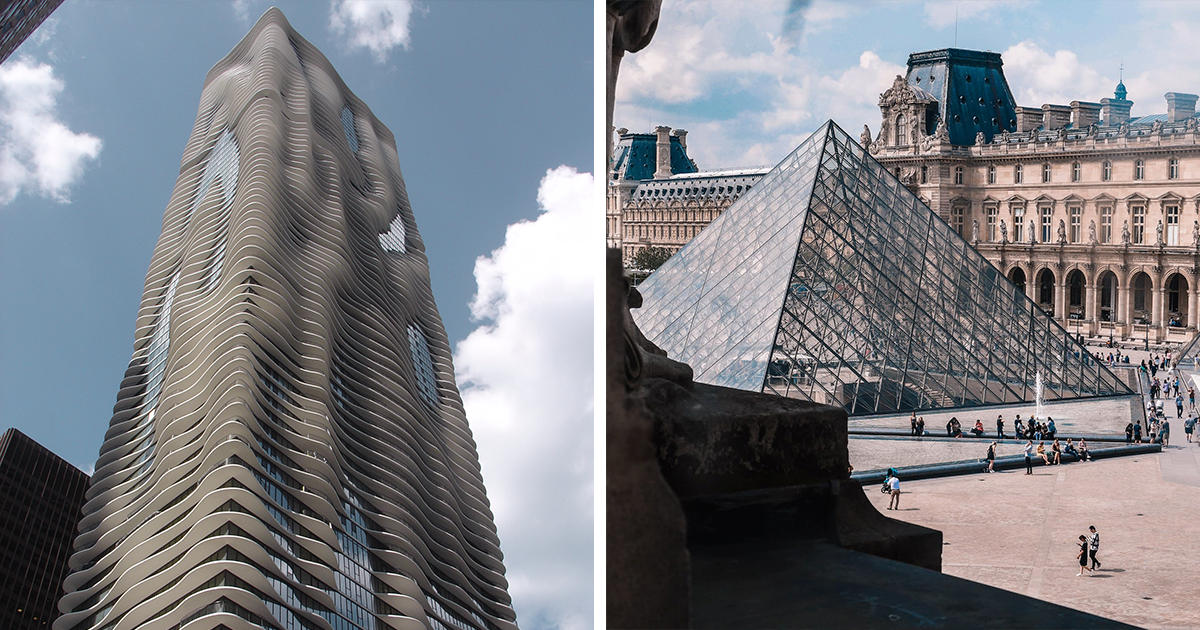
Some people leave behind photo albums. Famous architects leave behind skylines, monuments, museums, homes, churches, airports, libraries, and the occasional building that makes tourists stop mid-sidewalk and whisper, “Wait… how is that thing standing?”
Architecture is more than walls with a roof trying its best. It is history in concrete, philosophy in glass, culture in stone, and ambition wearing a hard hat. The most famous architects did not simply design buildings; they changed how people live, worship, study, travel, gather, remember, and stare dramatically at ceilings.
This list of 28 famous architects explores the designers whose iconic buildings shaped architectural history. From ancient Egypt to modern museums, from organic architecture to high-tech design, these visionaries left legacies that continue to influence cities around the world.
Why Famous Architects Still Matter
Great architecture survives trends because it answers a bigger question: how should humans experience space? A building can be practical, beautiful, symbolic, emotional, and stubbornly photogenic all at once. The architects below proved that design can change public life, private comfort, national identity, and even the way we think about nature.
Their work also reminds us that architecture is never just about the architect. Every legendary building is shaped by materials, money, engineering, politics, clients, climate, and sometimes a committee with opinions. Lots of opinions. Yet the strongest architects find a way to turn constraints into character.
28 Famous Architects and the Buildings That Made Their Names Last
1. Imhotep: The Ancient Master of Monumental Design
Long before architecture schools assigned impossible deadlines, Imhotep helped create one of history’s earliest architectural breakthroughs: the Step Pyramid of Djoser at Saqqara. As an Egyptian polymath, he blended engineering, religious symbolism, and royal ambition into a stone monument that reshaped ancient building traditions.
His legacy is enormous because the Step Pyramid helped move Egyptian architecture from mudbrick structures toward monumental stone construction. In other words, Imhotep did not just raise a pyramid; he raised the bar.
2. Ictinus: Classical Balance in the Parthenon
Ictinus is closely associated with the Parthenon in Athens, one of the most studied buildings in Western architecture. Designed with Callicrates and enriched by Phidias’s sculptural program, the Parthenon became a masterpiece of proportion, rhythm, and optical refinement.
Its influence can be seen in courthouses, museums, universities, and government buildings that still borrow classical columns when they want to look serious, timeless, and slightly intimidating.
3. Filippo Brunelleschi: The Dome That Changed Florence
Filippo Brunelleschi gave Florence its most famous crown: the dome of Santa Maria del Fiore. At the time, building such a massive dome without traditional wooden centering seemed nearly impossible. Brunelleschi answered with engineering brilliance, herringbone brickwork, and enough confidence to power a small city.
His work helped launch Renaissance architecture by reviving classical principles and pairing them with bold technical innovation. Florence’s skyline has been thanking him ever since.
4. Leon Battista Alberti: Architecture as Humanist Intelligence
Leon Battista Alberti was an architect, theorist, writer, and Renaissance overachiever of the highest order. His works, including the facade of Santa Maria Novella in Florence and Sant’Andrea in Mantua, translated classical harmony into elegant Renaissance design.
Alberti’s legacy also comes from his writing. He treated architecture as a learned art connected to mathematics, beauty, proportion, and civic life. Basically, he made buildings sound like they had read philosophy.
5. Michelangelo: Sculptural Power in Stone and Space
Michelangelo is best known as a sculptor and painter, but his architectural influence is equally formidable. His work on St. Peter’s Basilica in Rome and the Laurentian Library in Florence shows how architecture can feel muscular, dramatic, and emotionally charged.
He bent classical rules without breaking their dignity. His spaces often feel as if stone itself is stretching, turning, and preparing to deliver a dramatic monologue.
6. Andrea Palladio: The Architect of Elegant Order
Andrea Palladio’s villas and churches in northern Italy helped define architectural grace. Buildings like Villa Rotonda became models of symmetry, proportion, and classical clarity. His ideas spread through Europe and later shaped American architecture, especially plantation houses, civic buildings, and Thomas Jefferson’s designs.
Palladio’s influence is so broad that “Palladian” became a style. That is the architectural equivalent of becoming a verb, but with more columns.
7. Christopher Wren: Rebuilding London With Grandeur
After the Great Fire of London in 1666, Christopher Wren became central to the city’s architectural recovery. His masterpiece, St. Paul’s Cathedral, remains one of London’s defining landmarks, with a dome that confidently competes with the sky.
Wren designed dozens of churches and helped give London a renewed civic identity. His legacy is proof that rebuilding can be more than repair; it can become reinvention.
8. Thomas Jefferson: American Ideals in Brick and Classical Form
Thomas Jefferson was not only a statesman but also a serious architectural thinker. Monticello and the University of Virginia reveal his fascination with classical architecture, Enlightenment ideals, and carefully planned landscapes.
His buildings helped shape an American architectural language that connected democracy, education, order, and beauty. He also proved that a house can be both a home and a personal manifesto.
9. Antoni Gaudí: Nature, Faith, and Imagination in Barcelona
Antoni Gaudí’s buildings look as if nature, religion, ceramics, geometry, and a dream had a very productive meeting. His most famous work, the Sagrada Família in Barcelona, remains one of the world’s most recognizable architectural projects. Casa Batlló and Casa Milà show his love of curves, color, craft, and structural experimentation.
Gaudí’s legacy lies in his refusal to make buildings behave like boxes. He made architecture feel alive, growing, and occasionally ready to sing.
10. Louis Sullivan: The Father of the Modern Skyscraper
Louis Sullivan helped define the tall office building in the United States. His famous principle that “form follows function” became one of modern architecture’s most repeated ideas, sometimes used wisely and sometimes printed on office posters.
Buildings such as the Wainwright Building in St. Louis showed how skyscrapers could express height honestly rather than hide behind historical costumes. Sullivan’s influence also reached Frank Lloyd Wright, who worked in his office and carried forward a new vision of American design.
11. Daniel Burnham: Planning Cities With Big Ambition
Daniel Burnham helped shape the 1893 World’s Columbian Exposition in Chicago and later co-authored the Plan of Chicago. His work helped popularize the City Beautiful movement, which emphasized grand boulevards, civic spaces, parks, and monumental public buildings.
Burnham’s famous planning spirit can be summarized simply: think bigger. Then add a boulevard. Then make sure the boulevard looks like civilization got dressed for a formal dinner.
12. Frank Lloyd Wright: Organic Architecture and the American Home
Frank Lloyd Wright is one of the most famous architects in history because he changed the relationship between buildings and nature. Fallingwater in Pennsylvania appears to grow out of its rocky waterfall site, while the Solomon R. Guggenheim Museum in New York turns the museum visit into a spiraling spatial journey.
Wright’s Prairie houses, including Robie House, emphasized horizontal lines, open plans, and a close connection to landscape. His long career made organic architecture a lasting idea, not just a pretty phrase for brochures.
13. Le Corbusier: The Machine Age Meets Urban Vision
Le Corbusier was one of modernism’s most influential and debated figures. His Villa Savoye in France expressed his “five points” of architecture, including pilotis, roof gardens, open plans, horizontal windows, and free facades. Later, his work in Chandigarh, India, showed his ambitions at the urban scale.
His legacy is powerful because he reimagined housing, cities, furniture, and modern life. Not everyone loves his urban theories, but nobody can honestly say he thought small.
14. Walter Gropius: The Bauhaus and the Modern Design Revolution
Walter Gropius founded the Bauhaus, the school that helped reshape modern design, architecture, typography, furniture, and visual culture. The Bauhaus building in Dessau remains a landmark of functional clarity, industrial materials, and educational experimentation.
Gropius’s influence spread worldwide through teaching, migration, and practice. His legacy is visible anytime architecture tries to be simple, useful, modern, and allergic to unnecessary decoration.
15. Ludwig Mies van der Rohe: Less, But Better Dressed
Ludwig Mies van der Rohe mastered architectural reduction. The Barcelona Pavilion, Farnsworth House, Seagram Building, and S. R. Crown Hall demonstrate his devotion to structure, proportion, glass, steel, and open space.
His phrase “less is more” became a modernist slogan, although anyone who has priced a minimalist glass house knows that “less” can still send your wallet into witness protection. Mies’s legacy lives on in corporate towers, open-plan institutions, and the visual language of modern elegance.
16. Eileen Gray: Modernism With Intimacy and Independence
Eileen Gray created one of modernism’s most admired houses: E-1027 on the French Riviera. Her work balanced geometric clarity with comfort, flexibility, and human needs. She also designed iconic furniture that remains influential today.
For too long, Gray’s contribution was overshadowed by male contemporaries. Her rediscovery has strengthened architectural history by reminding us that modernism was not a one-man club, no matter how loudly some men arranged the chairs.
17. Alvar Aalto: Human Warmth in Modern Architecture
Alvar Aalto softened modernism with wood, light, curves, and sensitivity to landscape. Buildings such as the Paimio Sanatorium and Villa Mairea show his belief that architecture should support human well-being, not just look impressive in black-and-white photographs.
Aalto’s legacy is especially important in healthcare, education, libraries, and furniture design. He gave modern architecture a pulse, a texture, and a very Finnish sense of calm.
18. Louis Kahn: Monumental Silence and Sacred Light
Louis Kahn designed buildings that feel ancient and modern at the same time. The Salk Institute in California, the Kimbell Art Museum in Texas, and the National Assembly Building in Bangladesh reveal his mastery of light, mass, geometry, and silence.
Kahn’s work asks big questions: What does a wall want to be? How should light enter a room? Why does concrete suddenly feel poetic? His legacy is architecture with spiritual gravity.
19. Oscar Niemeyer: Curves, Concrete, and Brazilian Modernism
Oscar Niemeyer gave modern architecture a sensual curve. His work in Brasília, including the Cathedral of Brasília and government buildings, helped define Brazil’s futuristic capital. He used reinforced concrete not as a stiff material but as something fluid and expressive.
Niemeyer’s buildings remind us that modernism did not have to be all right angles and serious faces. Sometimes a curve can do the talking.
20. Eero Saarinen: Drama for Airports, Arches, and Corporate America
Eero Saarinen designed some of the most memorable structures of the mid-20th century, including the Gateway Arch in St. Louis, the TWA Flight Center at JFK Airport, and the General Motors Technical Center. His work combined structural daring with symbolic clarity.
Saarinen’s buildings often feel aerodynamic, optimistic, and theatrical. He understood that modern life needed not only function, but also a little cinematic entrance music.
21. I. M. Pei: Geometry, Light, and Cultural Precision
I. M. Pei brought crisp geometry and refined modernism to major cultural institutions. His East Building of the National Gallery of Art in Washington, D.C., transformed a difficult triangular site into a powerful composition of light, marble, and angular space. His Louvre Pyramid in Paris became one of the most famous museum interventions in the world.
Pei’s legacy is the art of making modern architecture converse with historic settings without whispering nervously in the corner.
22. Tadao Ando: Concrete, Stillness, and the Poetry of Light
Tadao Ando is known for precise concrete surfaces, quiet spaces, and the dramatic use of natural light. The Church of the Light in Osaka is a small building with a huge emotional presence, using a cross-shaped opening to transform daylight into spiritual architecture.
Ando’s legacy is proof that restraint can be powerful. His buildings do not shout. They wait calmly until you realize they have completely changed your breathing.
23. Frank Gehry: Sculptural Architecture in Motion
Frank Gehry pushed architecture toward sculptural freedom. The Guggenheim Museum Bilbao, Walt Disney Concert Hall in Los Angeles, and the Fondation Louis Vuitton in Paris show his love of movement, metallic surfaces, and complex forms.
Gehry’s buildings helped cities understand architecture as a cultural engine. Bilbao, in particular, became shorthand for the idea that a single building can transform a city’s global image. Not every city can order a “Bilbao effect” like takeout, but many have tried.
24. Norman Foster: High-Tech Architecture With Urban Confidence
Norman Foster’s buildings combine engineering clarity, environmental ambition, and sleek urban presence. The HSBC Building in Hong Kong, the Reichstag dome in Berlin, 30 St Mary Axe in London, and Apple Park in California show his ability to turn technology into architectural identity.
Foster’s legacy lies in making structure visible, performance important, and modern buildings feel both efficient and iconic.
25. Renzo Piano: Lightness, Craft, and Civic Generosity
Renzo Piano’s work ranges from the Centre Pompidou in Paris, designed with Richard Rogers, to The Shard in London and the Whitney Museum of American Art in New York. His buildings often balance technical sophistication with human scale.
Piano’s legacy is architecture that feels carefully tuned rather than aggressively announced. His best buildings act like good hosts: intelligent, generous, and unlikely to block the doorway while talking about themselves.
26. Rem Koolhaas: Complexity, Culture, and Urban Provocation
Rem Koolhaas is both an architect and a major architectural thinker. With OMA, he designed buildings such as the Seattle Central Library, Casa da Música in Porto, and CCTV Headquarters in Beijing. His writing has also deeply influenced how architects discuss cities, congestion, shopping, media, and modern life.
Koolhaas’s legacy is intellectual as much as physical. He makes architecture argue, question, and occasionally smirk.
27. Zaha Hadid: Fluid Forms and Radical Possibility
Zaha Hadid transformed architecture with dynamic forms that seemed to move even when standing still. Her major works include the MAXXI Museum in Rome, the Heydar Aliyev Center in Baku, the London Aquatics Centre, and the Guangzhou Opera House.
As the first woman to receive the Pritzker Architecture Prize, Hadid also became a symbol of possibility in a profession long dominated by men. Her legacy is not only formal innovation but also cultural momentum.
28. Maya Lin: Memory, Landscape, and the Power of Restraint
Maya Lin became internationally known for the Vietnam Veterans Memorial in Washington, D.C., designed when she was still a student. Its polished black granite walls, sunken form, and engraved names created a new kind of memorial: quiet, reflective, and deeply personal.
Lin’s legacy shows that architecture does not need height to be monumental. Sometimes the most powerful design lowers itself into the earth and lets memory speak.
What These Famous Architects Have in Common
The architects on this list worked in different centuries, countries, materials, and styles, but several themes connect them. First, they understood that buildings communicate. A cathedral can express faith. A museum can express movement. A memorial can express grief. A house can express a philosophy of daily life.
Second, they took risks. Brunelleschi trusted a dome that others doubted. Wright placed a house over a waterfall. Pei inserted a glass pyramid into the historic Louvre. Hadid pushed digital design and construction into fluid new territory. Risk does not guarantee greatness, but architecture without risk often becomes background noise with plumbing.
Third, they changed what future architects considered possible. That is the real measure of legacy. A famous architect is not only someone whose building appears on postcards. It is someone whose ideas become tools for the next generation.
Famous Buildings as Cultural Memory
Iconic buildings often become shorthand for entire cities or ideas. The Sagrada Família means Barcelona. Fallingwater means organic architecture. The Gateway Arch means St. Louis. The Vietnam Veterans Memorial means public memory transformed through design. These buildings become emotional landmarks as much as physical ones.
They also attract debate, because buildings live in public. People argue about cost, style, meaning, maintenance, and whether a new design looks like a spaceship parked in the wrong neighborhood. That debate is healthy. Architecture matters precisely because it cannot hide in a private drawer. It stands outside, in the rain, asking everyone for an opinion.
Experience Section: What Visiting Legacy Buildings Teaches You
Reading about famous architects is useful, but experiencing their buildings in person is a different education. Photographs flatten architecture into a single moment. Real buildings unfold through movement, sound, temperature, scale, and surprise. A picture of Fallingwater can show the terraces and waterfall, but it cannot fully capture the damp woodland air, the sound of rushing water, or the strange feeling that the house is both shelter and landscape.
One of the most valuable experiences related to these famous architects is learning to slow down. Many visitors walk into an iconic building, take a quick photo, and leave with proof but not memory. Architecture rewards patience. Stand in a corner. Look up. Notice how light enters. Watch how people move. Pay attention to where the architect compresses space and where the building suddenly opens. Great buildings often behave like music: they have rhythm, pauses, crescendos, and quiet notes you miss if you rush.
Another useful experience is comparing expectation with reality. Some buildings are larger than imagined; others are surprisingly intimate. The Vietnam Veterans Memorial, for example, is powerful not because it towers over visitors, but because it draws them downward into reflection. The Guggenheim Museum in New York is not just a spiral shape from the outside; inside, the ramp changes how visitors encounter art, people, and motion. Pei’s East Building is not only geometric; it turns a difficult site into a lesson on angles, light, and civic presence.
Traveling to architectural landmarks also teaches humility. Every famous building has a backstory filled with compromise, criticism, engineering problems, budget pressure, and public opinion. The finished structure may look inevitable, but it rarely was. Gaudí’s Sagrada Família became a multigenerational project. Gehry’s Bilbao required advanced technology and civic commitment. Brunelleschi’s dome demanded technical invention before modern construction equipment existed. Behind every graceful line is a mess of decisions, arguments, calculations, and probably at least one person asking, “Are we absolutely sure this will work?”
For students, designers, travelers, or curious readers, the best way to experience architectural legacy is to treat buildings as active teachers. Bring a notebook. Sketch badly; bad sketches still make you look carefully. Read the plan if one is available. Walk around the exterior before entering. Ask how the building meets the street, frames views, handles light, and guides emotion. Notice materials: stone feels different from glass, concrete, brick, timber, or steel. Materials are not just surfaces; they are part of the building’s voice.
Finally, legacy buildings teach that architecture shapes behavior. A library can invite exploration. A plaza can encourage gathering. A memorial can create silence. A home can support family life or make everyone afraid to touch the furniture. The famous architects in this article left long-lasting legacies because their buildings continue to affect people after the architects themselves are gone. That is architecture’s quiet magic: it outlives the meeting, the blueprint, the scaffolding, and sometimes even the culture that produced it.
Conclusion
The 28 famous architects above did more than design attractive structures. They changed how cities look, how people move, how cultures remember, and how future designers imagine possibility. Their legacy buildings prove that architecture is both practical and poetic. It keeps rain out, yes, but it also keeps history alive.
From Imhotep’s ancient stone innovation to Maya Lin’s deeply moving memorial, from Wright’s organic landscapes to Hadid’s fluid geometry, these architects remind us that buildings are never just background. They are stories we can walk through.