When people ask, “How was the Moon landing filmed?” they are usually asking two things at once. First, how did NASA capture those ghostly black-and-white images of Neil Armstrong stepping onto the lunar surface? Second, how did anyone manage to send moving pictures from a dusty, airless rock more than 200,000 miles away while using 1960s technology that had less computing glamour than a modern toaster?
The answer is both simpler and more impressive than the myths suggest. The Apollo 11 Moon landing was not “filmed” in one neat Hollywood sense. It was documented through several camera systems working together: a live television camera mounted on the lunar module, 16mm motion-picture film cameras inside the spacecraft, Hasselblad still cameras carried by the astronauts, and a special close-up camera for lunar soil. Each had a different job. Together, they created one of the most famous visual records in human history.
There was no director yelling “Cut!” There was no second take. There was only a fragile spacecraft called Eagle, two astronauts in bulky suits, a checklist full of chores, a TV signal that had to survive space, and a worldwide audience holding its breath.
The Moon Landing Was Captured With Multiple Cameras
Apollo 11 carried a surprisingly complete camera kit. NASA had to document the mission for science, engineering, public communication, and historical record. That meant one camera was never going to be enough. Think of it as a very expensive travel vlog, except the destination had no atmosphere, no bathrooms, and absolutely no chance of buying extra batteries at the gift shop.
The main systems included a black-and-white lunar television camera, two 16mm Maurer motion-picture cameras, several Hasselblad 500EL still cameras, a television camera in the command module, and a Kodak stereo close-up camera designed to photograph lunar soil and rocks from just inches away. The astronauts did not simply “film the Moon”; they gathered visual evidence from different angles, formats, and scientific purposes.
The live TV camera gave the world Armstrong’s first step. The 16mm cameras recorded motion sequences, including the descent toward the lunar surface. The Hasselblad cameras produced the sharp still photographs that later became posters, textbooks, museum displays, and dorm-room inspiration for generations of space dreamers.
The Live TV Camera: How the World Saw Armstrong’s First Step
The most famous footage from Apollo 11 came from the lunar television camera. This was a compact black-and-white camera built by Westinghouse and designed specifically for the Moon. It had to be light, rugged, low-power, and capable of working in conditions that would make an ordinary TV camera give up and apply for office work.
The camera was stored in the Modular Equipment Stowage Assembly, or MESA, on the side of the lunar module’s descent stage. When Armstrong began climbing down the ladder, he pulled a handle that opened the equipment bay. That action exposed the camera, which was mounted so it could capture his descent. Because of the way it was stowed, the camera was initially positioned upside down. Ground stations could electronically flip the image so viewers saw the scene correctly.
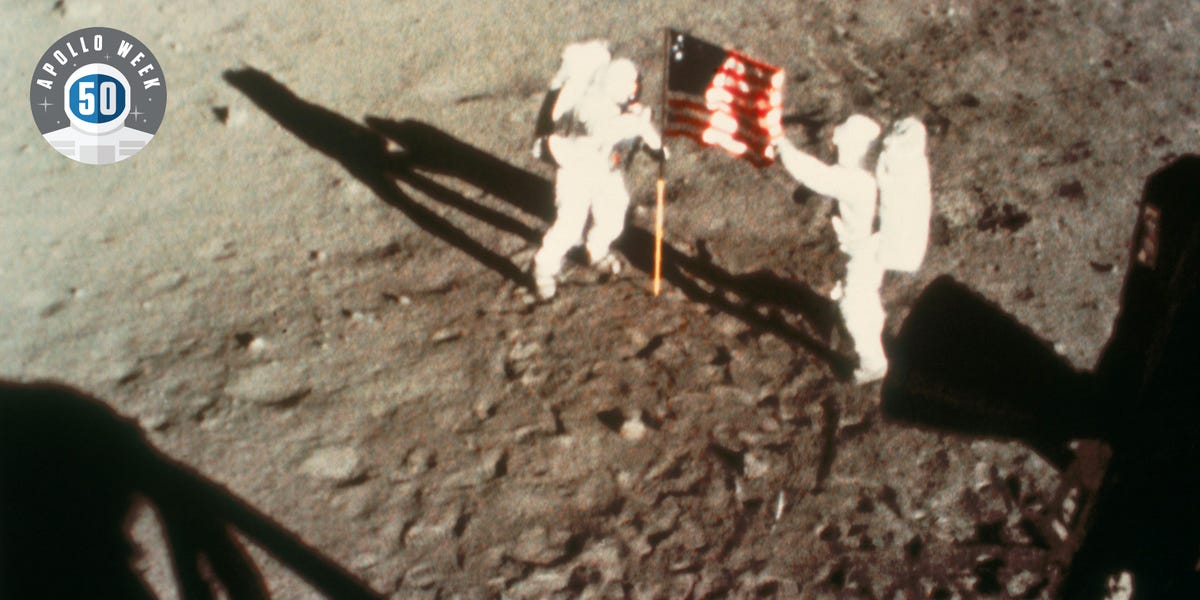
That is why the first moments of the broadcast looked strange and rough. The image was dim, contrasty, and ghostlike. But it worked. As Armstrong moved down the ladder, the camera transmitted his movements to Earth in real time. When he stepped onto the lunar surface at 02:56 UTC on July 21, 1969, millions of people watched a blurry but unmistakable human figure enter history.
Why Was the Footage So Grainy?
The Moon landing footage looks grainy because NASA had to work within severe technical limits. A standard television signal required too much bandwidth to transmit directly from the lunar surface. So the Apollo 11 camera used slow-scan television, often called SSTV. The lunar camera sent a lower-resolution signal at a slower frame rate than normal broadcast television.
Once the signal reached Earth, it had to be converted into a format that TV networks could broadcast. This conversion process reduced quality. In simple terms, the original lunar signal was like a delicate message written on thin paper, and the broadcast system had to photocopy it in a hurry while the whole planet was waiting. The result was not pretty by modern HD standards, but it was a miracle by 1969 standards.
The black-and-white image also helped conserve bandwidth and weight. Color cameras existed, and Apollo missions did use color TV in other settings, but the first lunar surface broadcast demanded equipment that could survive the Moon and fit within strict spacecraft limits. Apollo 11 chose reliability over glamour. The Moon was not ready for prime-time color, and honestly, it did not care.
How the Signal Traveled From the Moon to Living Rooms
The TV signal from the Moon did not float magically into American living rooms. It traveled from the lunar module to tracking stations on Earth. The key receiving sites included Goldstone in California, Honeysuckle Creek in Australia, and Parkes Observatory in Australia. NASA switched between signals to get the clearest possible picture during the moonwalk.
Goldstone initially received the signal, but Honeysuckle Creek soon provided a better view during Armstrong’s descent. Later, when the Moon rose high enough for the large Parkes dish to receive a strong signal, Parkes contributed to the broadcast. From there, the signal was converted, routed, and distributed to television networks around the world.
This is one of the most underrated parts of the Apollo 11 story. The footage was not just a camera achievement. It was a communications achievement. Engineers had to capture a weak signal from another world, process it quickly, and hand it off to broadcasters in time for a live global event. Today, we complain when a video call freezes for two seconds. In 1969, NASA streamed from the Moon.
The 16mm Camera That Filmed the Landing
The actual descent and landing of Eagle were captured by a 16mm Maurer Data Acquisition Camera mounted inside the lunar module. This camera pointed out Buzz Aldrin’s right-hand window. It recorded the approach to the Sea of Tranquility at about six frames per second using a wide-angle lens.
This 16mm landing film is the only visual record of Apollo 11’s final descent from the lunar module window. It shows the lunar surface gradually becoming clearer, craters sliding through the frame, and dust beginning to move as the descent engine approached the ground. It does not show exactly what Armstrong saw, because he was looking from a different window while manually guiding the lunar module away from a dangerous boulder field near West Crater.
That detail matters. The famous landing film is not a pilot’s-eye view from Armstrong’s faceplate. It is a camera view from Aldrin’s side of the cabin. Armstrong’s real view had to be reconstructed later using mission audio, trajectory data, and modern lunar imagery. The camera preserved a priceless record, but like all cameras, it captured only what it was pointed at.
Why the Landing Film Looks Like Time-Lapse
The landing film can look jerky because it was shot at a low frame rate. Running a film camera at fewer frames per second saved film and suited engineering documentation. NASA was not trying to create cinematic smoothness. The goal was to record useful visual data during a dangerous landing. If the footage feels like a silent science film from another planet, that is because it basically is.
Even so, the 16mm footage is dramatic. You can see why Armstrong took partial manual control and searched for a safer landing site. You can see the surface texture sharpen as Eagle descends. You can see dust begin to blow outward near touchdown. No orchestral soundtrack is needed. The suspense is built into the physics.
The Hasselblad Cameras: The Still Photos That Defined Apollo
If the live TV footage gave the world motion, the Hasselblad cameras gave the world icons. Apollo astronauts used modified Hasselblad 500EL cameras, including a silver Hasselblad Data Camera fitted with a Zeiss Biogon lens and a special Reseau plate. This glass plate placed small cross marks on each image, allowing scientists to measure distances and study scale in the photographs.
The cameras were mounted on the astronauts’ chests. This design kept their hands free, which was essential because spacesuit gloves were not exactly built for delicate finger ballet. Instead of raising a camera to the eye, astronauts aimed by turning their bodies. Imagine taking vacation photos while wearing a refrigerator, a motorcycle helmet, and mittens. Now imagine doing it on the Moon.
The results were extraordinary. Buzz Aldrin standing on the lunar surface, the boot print in the dust, the lunar module resting on its spidery legs, Earth hanging in black spacethese images came from practical engineering, astronaut training, and a lot of carefully planned exposure settings. They were beautiful because they were useful first.
Why So Many Famous Photos Show Buzz Aldrin
One funny fact about Apollo 11 photography is that many of the best-known lunar surface photos show Buzz Aldrin, not Neil Armstrong. That is because Armstrong was often the one holding and operating the Hasselblad camera. The photographer rarely appears in the album. It is the same reason the family member who takes all the vacation pictures ends up looking like they never went on vacation.
There are images of Armstrong on the Moon, including reflections in Aldrin’s visor and footage from other cameras, but the classic full-body astronaut portraits tend to feature Aldrin. This was not a publicity plot. It was simply how the tasks unfolded during a short, busy moonwalk.
The Close-Up Camera: Filming the Moon Like a Scientist
Apollo 11 also used a Kodak stereo close-up camera to photograph the lunar surface at very close range. This device captured paired images of soil and small rocks, giving scientists a three-dimensional look at the texture of the Moon’s surface. The camera had a built-in flash and was designed so an astronaut could simply place it on the ground and trigger it with a handle.
This may sound less glamorous than “one small step,” but it was scientifically valuable. The Moon’s surface was not just scenery; it was evidence. Researchers wanted to understand grain size, soil behavior, rock distribution, and surface structure. The close-up photographs helped turn the Moon from a distant symbol into a place that could be studied like a field site.
Was the Moon Landing Filmed Live or Recorded?
It was both. The first step and much of the moonwalk were broadcast live through the lunar TV camera. At the same time, other cameras recorded film that was brought back to Earth. The live broadcast did not require film to be developed before people could see it. That is an important point because one common misunderstanding claims newspapers could not have shown Moon landing images quickly because film processing would have taken days.
The explanation is simple: newspapers and TV stations could use images from the live video feed. The still Hasselblad photographs, on the other hand, were physical film and had to return with the astronauts. Once back on Earth, those film magazines were processed and studied. The live TV and the returned film were separate parts of the visual record.
Why the Original Live TV Tapes Became a Preservation Headache
Another complicated part of the Apollo 11 filming story is the fate of the original slow-scan television recordings. The raw SSTV signal was recorded on telemetry tapes, but the best-quality original tapes were later lost or erased and reused. That sounds unbelievable, but it reflects how institutions often treated data storage in an era before digital archiving became a cultural obsession.
Fortunately, the Moon landing was not lost. Broadcast recordings, converted video, kinescope films, 16mm film, still photographs, mission transcripts, and technical documentation all survived. NASA and partners later restored the available broadcast footage to improve clarity. The missing raw tapes are frustrating, but they do not erase the enormous amount of visual evidence that remains.
How NASA Planned the Shots Without a Film Crew
NASA did not leave the visuals to luck. Astronauts trained with the cameras before flight. Engineers studied lighting angles. Mission planners considered where the TV camera would be mounted, what it would show, and how much time astronauts could spend repositioning equipment. Every extra minute on the Moon mattered, and every extra pound of camera gear had to justify its trip.
The astronauts also had checklists for photography. They needed images of the landing gear, the surrounding terrain, experiments, sample collection, and general site conditions. Some shots were for public history, but many were for engineering and science. Was the lunar module stable? How deep were the footpads in the soil? What did the surface look like around the landing site? Cameras helped answer those questions.
The result was a documentary record made under pressure. Nobody could ask Armstrong to step down the ladder again because the lighting was better the first time. Nobody could send a production assistant to dust off the lens. Every frame had to happen in real mission time.
Why the Footage Still Feels Powerful
Modern viewers are used to ultra-high-definition video, drone shots, slow motion, color grading, and cameras so tiny they can ride on a cat’s collar. Apollo 11 footage is the opposite: low-resolution, flickering, awkward, and sometimes hard to read. Yet it remains powerful because it is real, immediate, and technically brave.
The roughness is part of the emotion. The black sky, the bright lunar dust, the white spacesuit, the ladder, the silence between wordseverything looks like a transmission from the edge of possibility. The footage does not feel polished because the event was not designed for polish. It was designed for survival, documentation, and proof.
Experience Notes: What the Moon Landing Teaches Modern Filmmakers, Creators, and Viewers
The story of how the Moon landing was filmed offers surprisingly practical lessons for anyone who creates visual content today. You do not need to be NASA, own a spacecraft, or have a communications dish in Australia to learn from Apollo 11. You just need to notice how carefully the mission balanced preparation, simplicity, redundancy, and purpose.
The first lesson is that the best camera is the one that can actually survive the job. Apollo 11 did not use the fanciest possible camera for every task. It used cameras that were reliable, light enough to fly, simple enough for astronauts to operate in pressure suits, and durable enough for brutal temperature swings. Modern creators often obsess over specs, but NASA’s approach reminds us that context matters more than bragging rights. A camera that works in the real environment beats a perfect camera sitting safely at home.
The second lesson is to plan the shot before the moment arrives. The Apollo 11 crew practiced camera use on Earth. Engineers knew where the TV camera would sit. Mission planners knew which photographs were needed. That preparation mattered because the astronauts had very little time on the surface. In everyday terms, whether you are filming a wedding, a product review, a documentary interview, or a once-in-a-lifetime family event, you should know your must-have shots before the pressure starts. Great visuals often look spontaneous, but they usually come from preparation wearing a casual hat.
The third lesson is that imperfection can still be historic. The Moon landing broadcast was not crisp. It was not colorful. It would not win a modern streaming-quality contest. But it communicated the essential truth of the moment: humans were walking on the Moon. Viewers did not need 4K resolution to understand that something extraordinary was happening. For creators, this is comforting. A meaningful story can survive grain, blur, and awkward framing. Content matters. Authenticity matters. The human moment matters most.
The fourth lesson is redundancy. Apollo 11 used live TV, motion-picture film, still photography, audio, transcripts, telemetry, and scientific notes. If one record was incomplete, another helped fill the gap. This is why historians can still reconstruct the mission in remarkable detail. For modern projects, the same idea applies. Back up your files. Capture alternate angles. Record clean audio. Save notes. The future will thank you, and so will your blood pressure.
Finally, Apollo 11 teaches viewers to look closely. The famous images are not just symbols; they are technical artifacts. The upside-down camera mount, the scan conversion, the chest-mounted Hasselblad, the low-frame-rate landing film, and the astronaut reflections all reveal how the record was made. Understanding the filming process does not make the Moon landing less magical. It makes it more magical. The wonder is not that the footage looks perfect. The wonder is that it exists at all.
Conclusion
So, how was the Moon landing filmed? Carefully, cleverly, and with a lot of engineering courage. Apollo 11 used a black-and-white Westinghouse TV camera to broadcast Armstrong’s first step live, a 16mm Maurer camera to record the descent and lunar surface activity, Hasselblad still cameras to capture iconic photographs, and a close-up stereo camera to document lunar soil for science.
The images were not created by movie magic. They were created by astronauts, engineers, radio dishes, film magazines, scan converters, checklists, and equipment built to function where no camera crew had ever worked before. The footage may be grainy, but the achievement behind it is crystal clear.
In the end, Apollo 11 was filmed not like a movie, but like a mission. That is why its images still matter. They are not polished scenes from a studio. They are visual proof of one of humanity’s boldest steps, recorded by machines that had one job: work perfectly, once, very far from home.