For decades, engineers and racing fans have repeated the same wonderfully unreasonable claim: a car with enough downforce could drive across a ceiling. In April 2025, the McMurtry Spéirling stopped treating that idea as a late-night physics puzzle. The electric fan car rolled onto a purpose-built platform, switched on its active aerodynamics, rotated through 180 degrees, and moved while hanging above the ground. Gravity had not been defeated. It had simply been outvoted by better engineering.
The Upside-Down Drive Was Real
The vehicle was the McMurtry Spéirling PURE Validation Prototype 1, a single-seat electric track car developed in Britain. McMurtry co-founder and managing director Thomas Yates drove it onto a specially constructed rotating rig at the company’s headquarters in Gloucestershire, England.
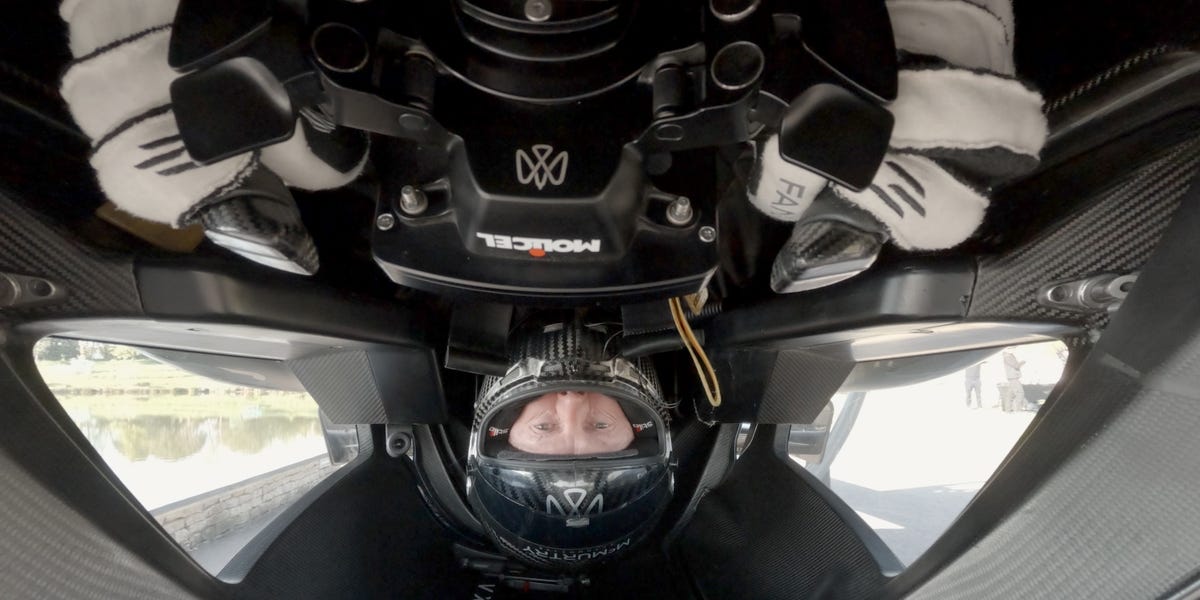
After the car’s fans generated sufficient downforce, the platform slowly turned upside down. The Spéirling remained attached to the metal surface, and Yates drove it forward while inverted before the rig returned to its normal position.
No magnetic rail, hidden cable, glue, or computer-generated trick held the car in place. Its tires stayed against the platform because the Spéirling generated a pressure-driven force greater than its own weight. In normal track driving, that force pushes the tires harder into the pavement. On the inverted platform, it prevented the car from becoming a spectacularly expensive ceiling ornament.
The test was deliberately controlled. The car did not race through a mile-long tunnel like something from a superhero movie. It traveled a short distance on a rotating structure. That makes the result less cinematic, but more useful as an engineering demonstration: the car supported itself, maintained tire contact, and transmitted driving force while upside down and moving at very low speed.
Why Normal Race-Car Aerodynamics Need Speed
Most performance cars create downforce by manipulating air that is already moving around the vehicle. Wings, splitters, diffusers, venturi tunnels, and carefully shaped floors produce pressure differences as the car travels forward.
A rear wing works somewhat like an airplane wing turned upside down. Instead of generating lift, it pushes the car toward the track. Underbody tunnels accelerate airflow beneath the chassis, reducing pressure and producing additional downforce.
The catch is that conventional aerodynamic performance depends heavily on speed. Downforce generally rises with the square of velocity. If speed doubles under similar conditions, an aerodynamic surface can theoretically generate about four times as much force. That is excellent at 150 mph. At zero mph, a conventional wing is mostly an expensive picnic table.
This is why people have long claimed that a Formula 1 car could theoretically drive upside down. Certain racing cars may produce more downforce than their own weight at high speed. However, they would need to enter an inverted section fast enough, maintain stable airflow, preserve the correct ride height, and avoid slowing below the point where downforce could support the vehicle.
A significant loss of speed would reduce conventional aerodynamic load. The result would not be a graceful descent. It would be a very fast reminder that gravity never takes a coffee break.
The Spéirling Creates Its Own Airflow
The McMurtry Spéirling approaches the problem differently. Electrically powered fans remove air from a sealed region beneath the chassis. Rather than waiting for forward motion to generate airflow, the car actively pumps air away from its underfloor.
Flexible skirts around the bottom of the vehicle help reduce leakage. This allows the fans to maintain lower pressure beneath the car than the atmospheric pressure acting on its upper surfaces. The resulting pressure difference pushes the car toward the driving surface.
McMurtry says the system can generate approximately 2,000 kilograms, or about 4,400 pounds, of downforce. Because the prototype weighs far less than that, the system has enough capacity to support the car while inverted and still press its tires against the platform.
The Physics: “Suction” Is a Pressure Difference
Describing the Spéirling as being sucked toward the road is convenient, but it is not a perfect technical explanation. The fans do not reach out and pull on the pavement. They lower the air pressure beneath the vehicle. Higher pressure on the other side then pushes the car toward the low-pressure region.
The basic relationship can be expressed simply:
Force = pressure difference × surface area.
A moderate pressure difference acting across a large underfloor area can produce an enormous total force. For the car to remain on a ceiling, that force must exceed the gravitational force pulling it downward.
Hanging there is only half the challenge. Driving requires tire grip. Tires generate acceleration, braking, and cornering forces through contact with the surface. The amount of usable force depends partly on the normal load pressing each tire against that surface.
While the Spéirling is inverted, its fan system must first overcome the car’s weight. It must then provide additional contact load so the driven wheels can transmit motor torque without slipping. That is what makes the demonstration more meaningful than simply attaching a stationary object to a ceiling with vacuum equipment.
The car had to maintain its pressure seal, support its structure, preserve tire contact, respond to steering and accelerator inputs, and move under its own power. Several branches of engineering had to cooperate at once. Physics may write the rules, but systems engineering makes sure everybody follows them.
The Engineering That Made It Possible
High-Speed Electric Fans
The Spéirling’s downforce fans can spin at approximately 23,000 rpm. Their main purpose is to extract air from beneath the vehicle, creating the low-pressure region responsible for its remarkable grip.
Because the fans are electrically driven, they can operate independently of the car’s road speed. Their output can also be controlled quickly and precisely. This gives the Spéirling strong aerodynamic loading before it begins moving, through slow corners, and during braking.
A Skirt-Sealed Underfloor
A powerful fan would accomplish little if outside air could flow freely under the car. The Spéirling therefore uses an extended skirt system positioned close to the driving surface. These skirts help enclose the low-pressure area and limit the amount of replacement air entering from the sides.
Maintaining that seal is one of the most difficult parts of fan-car design. The skirts must cope with road imperfections, suspension movement, steering inputs, vibration, debris, and changes in ride height. Even a small leak can reduce the available pressure difference.
Lightweight Carbon-Fiber Construction
Extra tire load could be created by making a car heavier, but that would also increase the mass that must be accelerated, stopped, and turned. Aerodynamic downforce provides additional tire loading without adding the same amount of permanent inertia.
The Spéirling’s compact proportions and carbon-fiber structure help it take advantage of this principle. It has the footprint of a small racing prototype rather than a conventional road-going hypercar. Less mass means the fan system has a larger force margin after overcoming gravity.
An Electric Powertrain
Electric propulsion contributes more than headline acceleration. Electric motors deliver torque with extremely fast response, while separate electrical systems can power the downforce fans independently.
Historic fan cars often relied on an auxiliary combustion engine or connected fan speed to the main powertrain. Modern electric controls allow airflow, traction, torque, braking, and vehicle balance to be coordinated through software.
Components Built for Enormous Loads
Generating 4,400 pounds of downforce is not useful if the suspension folds itself into modern art. The chassis, tires, wheel bearings, suspension links, fan mounts, and structural attachment points must tolerate loads several times greater than the car’s static weight.
Although the vehicle is light while parked, maximum fan output makes many components behave as though they are supporting a substantially heavier machine. Producing downforce is only the beginning. Controlling where that force goes is what keeps the driver facing forward and the wheels pointing approximately where engineering intended.
Why Fan Downforce Makes the Spéirling So Fast
The upside-down drive attracted worldwide attention, but ceiling travel is not the car’s primary mission. The real performance advantage appears during acceleration, braking, and cornering.
A tire can transmit only a limited amount of force before sliding. Increasing the load pressing the tire against the pavement generally allows it to produce more longitudinal or lateral force, although real tire behavior is more complicated than a simple linear formula.
By creating substantial load at any speed, the fan system allows the Spéirling to launch aggressively, brake later, and carry remarkable speed through slow and medium corners. A conventional race car gradually loses its aerodynamic assistance as it slows. The Spéirling can still produce significant downforce while crawling through the pit lane.
That capability helped former Formula 1 and IndyCar driver Max Chilton complete the Goodwood Festival of Speed hill climb in 39.08 seconds in 2022, setting the official outright record. The Spéirling has also recorded extraordinary acceleration figures and additional circuit achievements despite being smaller than many road cars.
It looks like a compact Batmobile, sounds like an industrial vacuum cleaner receiving terrible news, and changes direction with the urgency of a housefly avoiding a rolled-up magazine.
Reduced Dependence on Clean Air
Traditional race cars may lose downforce when closely following another vehicle. Turbulent wake, often called dirty air, disrupts airflow over wings and underbody surfaces.
A fan car creates much of its own pressure difference, making its aerodynamic performance less dependent on undisturbed external airflow. That does not make the system immune to surrounding conditions, but it may allow more consistent grip when following another car.
The disadvantages include energy consumption, noise, mechanical complexity, skirt wear, and vulnerability to debris. Engineers must also prevent a fan malfunction from causing an abrupt loss of downforce. The basic concept is simple enough to explain over lunch. Making it reliable is the part that consumes several years, a large budget, and probably an alarming quantity of coffee.
Fan Cars Have a Wild Racing History
The Chaparral 2J “Sucker Car”
McMurtry did not invent fan-generated downforce. In 1970, American engineer Jim Hall’s Chaparral 2J used two large rear fans powered by a separate engine. Sliding polycarbonate skirts helped seal the underfloor, allowing the fans to create downforce largely independent of speed.
The 2J was remarkably quick, although mechanical problems limited its results. Its movable aerodynamic equipment was prohibited after the 1970 Can-Am season. The car looked like a refrigerator had entered witness protection, but its engineering was decades ahead of its time.
The Brabham BT46B
In 1978, the Brabham BT46B brought fan-assisted ground effect to Formula 1. Its enormous rear fan was associated with cooling, but it also extracted air from beneath the car and generated tremendous grip.
Niki Lauda won the BT46B’s only race, the Swedish Grand Prix, before Brabham withdrew it amid regulatory and political pressure. The Spéirling applies the same fundamental pressure principle with modern electric motors, sensors, software, lightweight composites, and decades of aerodynamic knowledge.
What the Upside-Down Test Proved
The demonstration proved that a car can generate enough active aerodynamic force to exceed its own weight without depending on high road speed. It also showed that the Spéirling could maintain usable tire contact and move under its own power while inverted.
It did not prove that the car could immediately race through a miles-long ceiling tunnel. A longer inverted run would introduce difficult transitions, surface joints, thermal management, energy consumption, seal durability, emergency procedures, and fan-failure scenarios.
A full-size tunnel would also require an exceptionally smooth and strong ceiling. The surface would need to support concentrated dynamic loads while allowing the skirts to preserve their seal.
Engineering breakthroughs frequently begin with controlled experiments. The rotating rig reduced the challenge to its essential question: could the Spéirling create and control enough force to drive upside down? The answer was an unmistakable yes.
Could Ordinary Cars Use This Technology?
Family vehicles are unlikely to receive full-scale, ceiling-crawling fan systems. Daily drivers prioritize efficiency, comfort, durability, passenger space, cost, and quiet operation. A powerful suction system would use energy, generate noise, and encounter water, gravel, road salt, and other debris.
Few commuters require three-g cornering on the way to the supermarket. Even fewer want to explain the resulting condition of the groceries.
Smaller active-aerodynamic systems could nevertheless influence future vehicles. Temporary fan-generated downforce might improve emergency braking, stabilize specialized performance cars, or work with adaptive suspension and torque-vectoring systems.
The Spéirling also demonstrates that an electric vehicle does not have to imitate a gasoline car. Electrification allows independently controlled motors, unconventional packaging, and systems that would be difficult to integrate with a traditional powertrain. McMurtry used electricity not merely to replace an engine, but to create a new relationship between the vehicle and the road.
The Experience Behind the Headline: Trusting Engineering When the World Turns Over
Watching the demonstration creates a strange mental delay. The platform begins rotating, the car passes through 90 degrees, and every familiar instinct expects it to slide. It does not. The rig reaches 180 degrees, and the Spéirling remains attached to the underside like a toy placed on the wrong side of a shelf.
The visual simplicity makes the achievement more unsettling. There is no dramatic launch, explosion, or shower of sparks. The car merely stays where everyday experience says it should not. Physics continues operating normally, but the forces have been rearranged so effectively that normal suddenly looks impossible.
For Yates, the test required more than confidence in a computer model. The car was a highly valuable development prototype, the rotating rig was purpose-built, and a significant error could have destroyed years of engineering work. Even after calculations, component tests, rehearsals, and safety checks, somebody still had to sit in the cockpit while the horizon rotated away.
That is one of the most revealing aspects of advanced engineering. The final demonstration lasted only seconds, but those seconds depended on thousands of smaller decisions. Engineers had to estimate pressure losses, test fan performance, measure leakage, calculate structural loads, validate the skirts, inspect fasteners, plan shutdown procedures, and determine an acceptable safety margin.
The audience saw a car hanging from a ceiling. The engineering team saw a long chain of assumptions that all needed to remain correct at exactly the same time.
The transition through 90 degrees was particularly important. With the platform vertical, gravity attempted to pull the car sideways across the surface. The fan system had to generate enough normal force for tire friction to prevent that slide. The vehicle did not merely need to stick to the platform. It needed to stick firmly enough for its tires to resist gravity in a direction normally associated with acceleration or cornering.
The cockpit experience also changed as the rig rotated. The driver’s body was supported by the harness, gravity pulled loose objects toward the canopy, and the inner ear encountered a world that no longer matched years of driving experience. The controls remained in their usual locations, but “down” had moved.
Yates also noted an unexpectedly ordinary sensory change: as the car rotated beneath the platform, the bright cockpit moved into shadow. That small detail makes the event feel more human. Historic engineering moments are not always accompanied by orchestral music. Sometimes the machine turns upside down, the sunlight disappears, and the driver notices that the office has suddenly become rather dark.
For car enthusiasts, the test changes how performance is understood. Horsepower dominates most conversations because it is easy to advertise and compare. The Spéirling demonstrates that power is useful only when the tires can transfer it to a surface. Its defining feature is not simply how strongly its electric motors turn the wheels, but how forcefully its aerodynamic system presses those wheels against the track.
The upside-down drive is therefore more than a publicity trick. It is a lesson in systems thinking. Aerodynamics, electrical engineering, software, materials science, tire behavior, structural design, manufacturing, testing, and human courage all converged in one short movement across a ceiling.
The Spéirling did not ignore gravity. It brought a stronger and controllable force into the argumentand gravity, for a few remarkable seconds, had to accept second place.
Conclusion
The McMurtry Spéirling drove upside down because its fan-powered ground-effect system created more downforce than the vehicle’s weight without relying on forward speed. High-speed fans removed air from beneath a skirt-sealed floor, atmospheric pressure pushed the car toward the platform, and the remaining contact load gave the tires enough grip to move while inverted.
The achievement connects the radical fan cars of the 1970s with modern electric controls, advanced composites, and sophisticated aerodynamic analysis. More importantly, it demonstrates a different way to make a vehicle fast: not by adding mass or simply chasing horsepower, but by actively controlling the force between the tires and the surface.
Ceiling-driving family cars are unlikely to become the next transportation trend. Still, the engineering behind this upside-down machine could influence future performance and safety systemsand ensure that “stuck to the road” is no longer merely a figure of speech.
SEO Data