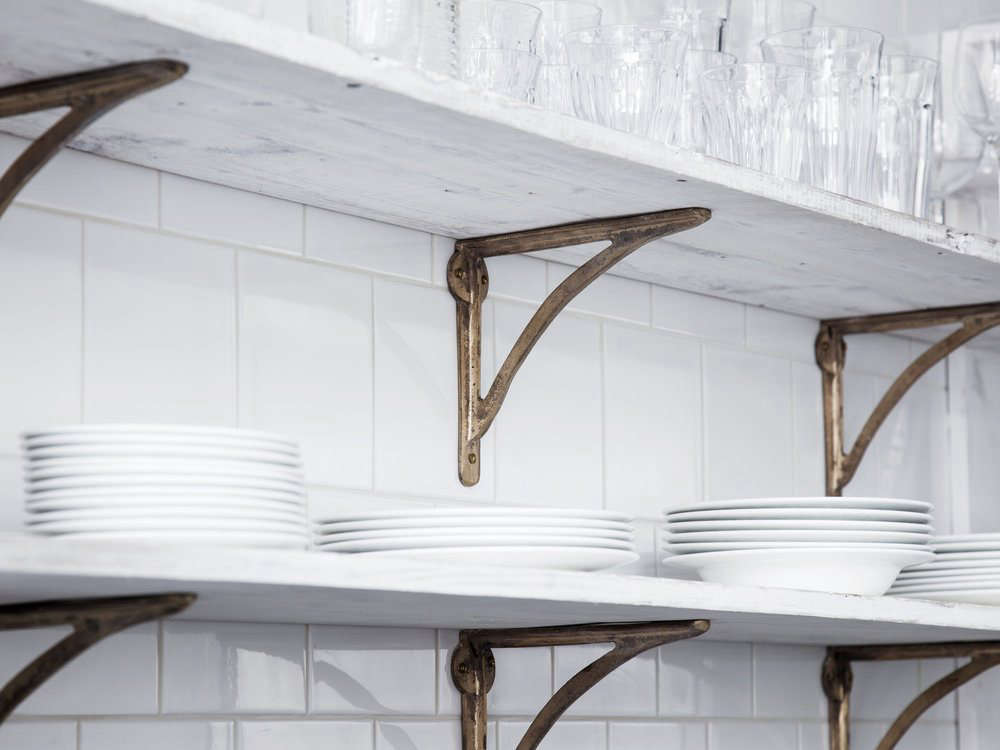
The Cast Bronze Strong Boy L Bracket is the kind of architectural hardware that refuses to disappear quietly beneath a shelf. Hand-cast, visibly substantial, and shaped with a straightforward industrial profile, it turns an ordinary plank of wood into a deliberate design feature. It supports the shelf, adds visual weight, and quietly announces that flimsy hardware was not invited to this renovation.
Archived product descriptions identify the Strong Boy as a solid-bronze bracket made for supporting shelves and small basins. The hardware is traditionally cast by hand in England, supplied with screws, and sold as an individual bracket rather than as a pair. Because each piece comes from a casting process, subtle differences in texture, color, patina, and surface detail are expected rather than treated as defects.
That combination of useful strength and handcrafted character explains why the bracket has appeared in kitchens, pantries, bathrooms, utility rooms, workshops, and period-inspired interiors. It is practical hardware, but it also has enough personality to become part of the room’s architecture.
What Is a Cast Bronze Strong Boy L Bracket?
An L bracket is a support with one section fixed vertically to a wall and another projecting horizontally beneath a shelf, counter, ledge, or basin. The two arms create a right angle that transfers downward pressure from the shelf into the wall structure.
The Strong Boy design follows this familiar principle but gives it more presence. Its generous proportions and uncomplicated form recall the brackets once used in hardworking pantries, commercial spaces, workshops, and service rooms. Instead of hiding the support, the design celebrates it.
The current maker’s product family includes an approximately eight-inch Strong Boy format, while historical American design listings describe the bronze version as suitable for shelves and small basins. Exact measurements, included fasteners, finish, and availability should always be checked with the current retailer before ordering, especially when the bracket will support stone, plumbing fixtures, or heavy storage.
What Makes the Bronze Version Different?
The defining feature is not merely a bronze-colored coating. The bracket is described as being made from solid cast bronze. That distinction matters because a plated or painted bracket may imitate the color of bronze without offering the same depth, aging behavior, weight, or tactile quality.
Bronze is a copper-based alloy traditionally associated with copper and tin, although the exact composition of modern bronze alloys can vary. In architectural hardware, it is valued for its warm brown color, substantial feel, durability, and ability to develop a natural patina over time.
Why Cast Bronze Has Lasting Appeal
It Develops Character Instead of Merely Looking Worn
Many factory finishes look their best on the day they leave the box. Unlacquered bronze often takes a different route. Exposure to air, moisture, skin oils, cleaning habits, and the surrounding environment gradually changes its surface.
The result may include darker brown areas, brighter points where the bracket is regularly touched, and subtle differences between pieces. In damp or exposed conditions, copper-based alloys can experience more pronounced color changes. This evolving finish is commonly called a patina.
For homeowners who prefer uniform hardware with identical color from one bracket to the next, that behavior may require an adjustment in expectations. For people who enjoy natural materials, it is one of the main attractions. Each bracket slowly becomes a record of its location and use.
Hand Casting Creates Useful Imperfection
Hand-cast architectural hardware should not be evaluated like injection-molded plastic. Slight variations in the edges, hole placement, texture, and finish can occur from one piece to another. Those differences provide visual evidence of the manufacturing process.
They also affect installation. Each bracket should be positioned, leveled, and marked individually. Using the first bracket as a drilling template for every other bracket can produce mismatched holes or a shelf that rocks like a café table with one short leg.
It Works With More Than One Interior Style
Although the Strong Boy bracket has historic and industrial associations, it is not restricted to a museum-like period interior. Bronze can bridge traditional and modern materials surprisingly well.
Against reclaimed oak, it feels rustic and established. Beneath a clean white shelf, it becomes a graphic architectural detail. Paired with soapstone, marble, handmade tile, plaster walls, or Shaker cabinetry, it adds warmth without becoming overly decorative.
Where the Strong Boy Bracket Works Best
Open Kitchen Shelving
Open kitchen shelves are one of the most natural applications. The visible bracket complements everyday materials such as oak, pine, walnut, painted wood, and honed stone. Bronze also coordinates easily with aged-brass faucets, dark cabinet pulls, copper cookware, and warm lighting.
For practical storage, place frequently used plates, bowls, mugs, and glassware on the lower shelves. Decorative ceramics, cookbooks, and less frequently used serving pieces can occupy higher positions. Keeping the display edited is important; even the finest bronze bracket cannot persuade twelve plastic food containers to look glamorous.
Pantry and Utility-Room Storage
The Strong Boy’s utilitarian profile feels especially appropriate in a pantry or utility room. It can support shelves for jars, baskets, folded linens, cleaning supplies, or kitchen equipment, provided the complete installation is designed for the expected load.
These rooms also allow the bracket’s honest construction to make sense visually. A handmade metal support beneath a thick timber shelf looks purposeful rather than ornamental for ornament’s sake.
Bathroom Shelves and Small Basins
Historical descriptions mention the bracket as suitable for small basins as well as shelves. In a bathroom, bronze can pair beautifully with marble, limestone, painted timber, polished plaster, or traditional ceramic fixtures.
A basin installation is more demanding than a decorative shelf. The wall structure must support the fixture, water, plumbing connections, and forces created when someone leans on the basin. Professional assessment and proper blocking are strongly recommended. A product description is not a substitute for structural planning, particularly when water and gravity have formed an alliance.
Bedside and Living-Room Shelves
A short timber shelf supported by one or two bronze brackets can replace a conventional nightstand in a compact bedroom. In a living room, a longer arrangement can display books, framed art, ceramics, or plants while preserving floor space.
The bracket is especially effective when repeated in a measured rhythm. Two may be enough for a short shelf, while a longer span can require additional support. The correct number depends on the shelf material, thickness, span, projected depth, fasteners, wall structure, and intended contents.
Planning a Shelf Around the Bracket
Match the Shelf Depth to the Projection
A shelf should not extend dramatically beyond the horizontal arm unless the system has been engineered for that overhang. As a general design principle, the bracket should support most of the shelf’s depth so that weight is not concentrated far in front of the support.
Measure the actual bracket after it arrives. Hand-cast hardware may vary slightly, and product dimensions can change between versions. Select the timber or stone only after confirming the real projection, wall plate, screw positions, and desired front overhang.
Choose a Shelf Material That Resists Sagging
Bracket strength is only one part of a shelving system. A long, thin shelf can bow between exceptionally strong supports. Solid wood, quality plywood with solid edging, and properly fabricated stone can all work, but each has different spanning limits.
Woodworking tests have shown that adding a solid front edge can significantly reduce sag in many shelf materials. Long shelves carrying books, dishes, or pantry goods generally need closer bracket spacing, thicker material, structural edging, or a combination of these measures.
Calculate the Real Load
Do not estimate a shelf’s load by lifting one object and declaring it “not that heavy.” Include the shelf itself, every stored item, future additions, and the possibility that somebody will place a heavy appliance on it later.
No universal load rating should be assumed for the bronze Strong Boy solely from ratings published for similar-looking cast-iron brackets. Capacity depends on the specific casting, fasteners, substrate, bracket spacing, installation quality, and load distribution. Request current technical guidance from the seller for any demanding application.
How to Install Cast Bronze Strong Boy L Brackets
1. Inspect Every Bracket
Unpack all brackets and examine the cast surfaces, mounting holes, orientation, and finish. Decide which face of each bracket should be most visible. Arrange the pieces before drilling so variations in patina appear balanced across the installation.
2. Locate Structural Support
Fastening into wood studs or purpose-installed blocking usually provides the most dependable support in a framed wall. Use a stud finder and verify the stud location rather than trusting a single electronic beep.
For masonry, tile, plaster, metal studs, or hollow walls, use fasteners specifically selected for the substrate and expected load. Decorative plastic drywall anchors are not an all-purpose answer to structural questions. When supporting a basin, stone shelf, or heavily loaded pantry shelf, consult a qualified installer.
3. Establish a Level Reference Line
Mark the desired shelf height with painter’s tape or a light pencil line. Use a long spirit level or laser level to create a consistent reference across the wall.
Remember that old walls are not always straight, square, or especially interested in cooperating. Check several points rather than assuming the floor, ceiling, backsplash, and countertop are perfectly parallel.
4. Mark Each Bracket Independently
Hold the first bracket against the wall, check that its vertical arm is plumb, and mark its holes. Repeat this procedure with every bracket. Do not transfer marks from one casting to another without checking the actual piece.
After marking the wall holes, position the shelf temporarily over the horizontal arms. Confirm the projection, overhang, spacing, and visual balance before making permanent holes.
5. Drill Appropriate Pilot Holes
Pilot holes help guide screws accurately and can reduce the risk of splitting wood framing. Choose a bit suited to the screw’s core diameter and the wall material. Tile and masonry require specialized bits and careful drilling methods.
Protect the bronze surface from the drill chuck and driver. A moment of impatience can produce a circular scratch that becomes the most noticeable detail in the roomat least to the person who installed it.
6. Secure and Recheck the Brackets
Tighten the fasteners gradually while checking for plumb and level. Avoid overtightening decorative screws, which can damage their heads or place unnecessary stress on the casting.
Lay the shelf on the supports and check it in both directions. Shim only when appropriate and never use a cosmetic shim to disguise a structurally loose connection.
7. Attach the Shelf
When the bracket includes holes for fastening the shelf from below, mark and drill shallow pilot holes into the board. Confirm screw length first so the tip does not emerge through the top surface.
After installation, apply weight gradually and observe the shelf, brackets, fasteners, and wall. Movement, cracking sounds, widening gaps, or visible deflection should be investigated immediately.
How to Care for a Bronze Bracket
For routine indoor care, begin with the gentlest method: remove loose dust using a soft, dry cloth. If additional cleaning is necessary, use a lightly dampened cloth and dry the surface promptly.
Avoid aggressive abrasives, wire brushes, scouring pads, chloride-containing cleaners, and untested metal polishes. Harsh cleaning can scratch the casting, strip intentional patination, or create uneven bright spots.
Before applying wax, polish, lacquer, or another coating, ask the manufacturer how the bracket was originally finished. Some owners want the bronze to darken naturally, while others prefer to preserve its initial appearance. Those are different maintenance goals and require different treatments.
In kitchens and bathrooms, wipe away standing water, soap residue, grease, and acidic splashes. Regular light cleaning is usually safer than allowing buildup to accumulate and then attacking it with the chemical equivalent of a pressure washer.
Practical Experience: What the Project Is Really Like
A typical Strong Boy installation begins with the realization that the bracket is visually heavier than it appeared in a product photograph. That is usually a good thing. Against a substantial oak or painted timber shelf, the scale feels reassuring and architectural. Beneath a thin piece of inexpensive board, however, the bracket can make the shelf look underdressed. The hardware often encourages a better choice of shelf material.
The next noticeable feature is the finish variation. Two hand-cast bronze brackets may not be identical twins. One can be slightly darker, smoother, or more irregular around an edge. Laying all the pieces on a table before installation makes it easier to arrange them intentionally. The most similar pair can frame a central shelf, while a more characterful casting can be placed where its surface catches the light.
Marking the holes independently is the step most likely to save frustration. It is tempting to trace one bracket onto cardboard and use the template repeatedly. With handmade castings, that shortcut can produce holes that are only slightly wrongwhich is the most annoying category of wrong. A large error tells you to stop. A tiny error waits until the screw is halfway in and then begins a personal argument with the bracket.
Installation also reveals how much the wall matters. A beautiful support fastened poorly is still a poor support. When the bracket lands over solid framing, the connection feels immediate and secure. When the chosen location falls between studs, the project becomes more complicated. For light display shelving, properly rated anchors may be suitable. For dishes, books, stone, or a basin, opening the wall and adding blocking may be the more responsible solution.
Once installed, the bracket changes how the shelf is styled. Because the support is visible, it creates a strong vertical and horizontal outline. Objects look best when they do not completely hide it. Leaving a little negative space around the bracket allows the craftsmanship to remain part of the composition.
In a kitchen, everyday ceramics tend to suit the bronze better than a collection of bright product packaging. White dishes, dark stoneware, wooden boards, glass jars, and a few cookbooks create a useful display without becoming theatrical. In a living room, books and pottery provide enough visual mass to balance the bracket. Lightweight trinkets alone can make the hardware appear oversized.
The bronze surface also becomes more interesting with use. Areas that are touched during cleaning may brighten, while recesses remain darker. This uneven aging usually enhances the bracket’s three-dimensional form. Owners who expect a permanently uniform brown finish may be surprised, but those who appreciate leather, natural stone, unfinished brass, and solid wood often enjoy the gradual change.
The most satisfying result is not simply a shelf that stays on the wall. It is the feeling that the support belongs to the room. The bracket connects the functional object to the architecture, making the shelf seem built in rather than temporarily attached. That effect is difficult to achieve with lightweight stamped hardware.
The main lesson from projects of this kind is to slow down during planning. Order the brackets before cutting expensive shelf material. Measure every casting. Verify the wall structure. Test the shelf height with painter’s tape. Place representative objects on a temporary surface to estimate the real load. These steps are not glamorous, but neither is reinstalling a shelf after it introduces itself to the floor.
Is the Cast Bronze Strong Boy L Bracket Worth Choosing?
The Cast Bronze Strong Boy L Bracket is best suited to a project where visible hardware is part of the design rather than something to conceal. Its appeal comes from solid material, handcrafted variation, traditional proportions, and a finish that can gain depth with age.
It may cost more than a basic steel support, and installation demands more attention than simply copying one drilling template across a wall. In return, it provides architectural presence that mass-produced utility brackets rarely achieve.
Used beneath a well-proportioned shelf and attached to suitable structure, the Strong Boy can bring warmth and permanence to kitchens, pantries, bathrooms, bedrooms, studies, and utility spaces. It performs an ordinary job with uncommon confidencewhich, for a bracket, is a rather impressive career.