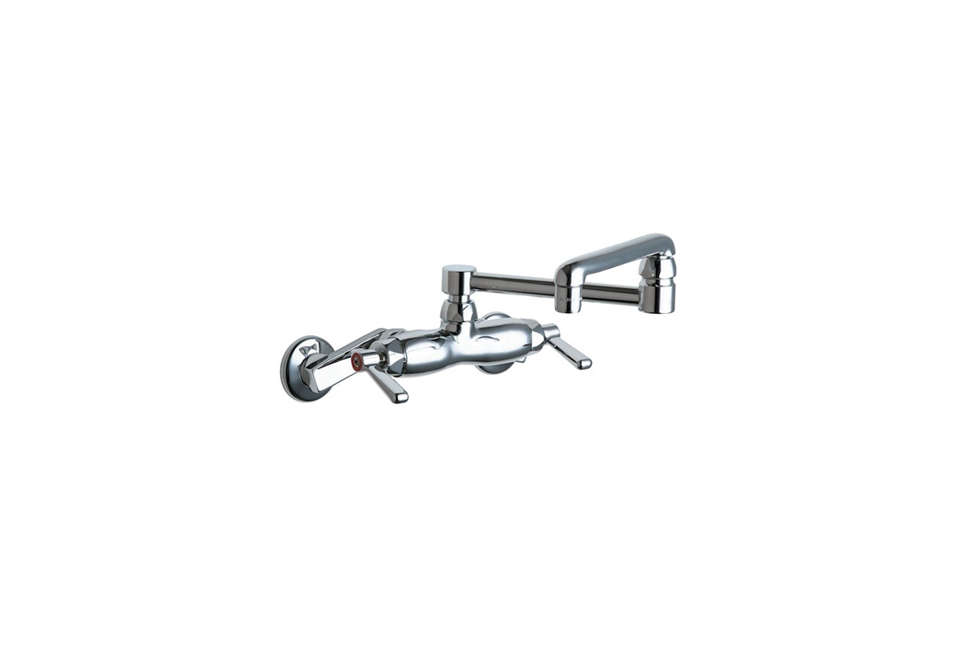
A kitchen faucet is usually expected to look attractive, deliver water, and avoid creating an indoor swimming pool. The Chicago Faucets wall mounted adjustable center kitchen faucet aims considerably higher. Designed with commercial kitchens, utility areas, institutional facilities, and demanding workspaces in mind, this fixture emphasizes reach, durability, repairability, and installation flexibility.
The model most commonly associated with this product name is the Chicago Faucets 445-DJ13ABCP. It combines a solid wall-mounted body with adjustable supply arms, two lever handles, and a 13-inch double-jointed swing spout. It is not trying to disguise itself as a delicate residential showpiece. It looks like it arrived ready to wash stockpots, fill containers, and survive a long shift without requesting a wellness break.
What Is the Chicago Faucets 445-DJ13ABCP?
The 445-DJ13ABCP is a two-handle, wall-mounted manual faucet for hot and cold water. Its 3-3/8-inch body connects to adjustable arms that accommodate supply centers from 3 inches to 8-3/8 inches. That broad adjustment range makes the faucet useful for replacement projects in which existing plumbing does not match a convenient modern standard.
The faucet includes a 13-inch center-to-center double-jointed swing spout, a pressure-compensating Softflo aerator rated at 2.2 gallons per minute, 2-3/8-inch vandal-resistant lever handles, and separate right- and left-hand Quaturn compression cartridges. The exposed surfaces have a polished chrome finish, while the main body is made from cast brass using Chicago Faucets’ low-lead ECAST construction.
Key Specifications at a Glance
| Model number | 445-DJ13ABCP |
|---|---|
| Mounting style | Exposed wall mount |
| Supply centers | Adjustable from 3 inches to 8-3/8 inches |
| Spout | 13-inch double-jointed swing spout |
| Flow rate | 2.2 GPM pressure-compensating Softflo aerator |
| Handles | Two 2-3/8-inch lever handles with hot and cold indexes |
| Cartridges | Rebuildable Quaturn compression cartridges |
| Inlets | 1/2-inch female NPT connections |
| Operating pressure | 20 to 125 PSI |
| Operating temperature | 40°F to 140°F |
| Finish | Polished chrome |
These specifications are based on the manufacturer’s model-specific sheet. Some third-party listings show slightly different minimum center measurements, which is a good reminder to use the current Chicago Faucets specification sheet as the final authority before rough-in or purchase.
Why Adjustable Centers Matter
The adjustable-center design is arguably the faucet’s most valuable feature. Wall-mounted faucets must line up with the hot and cold supply pipes coming through the wall. When those pipes are fixed at an unusual spacing, replacing an older faucet can become an expensive exercise involving opened walls, relocated plumbing, and language that should not be repeated near customers.
The offset supply arms on the 445 Series rotate to bridge a wide range of center-to-center distances. This allows the faucet body to remain level even when the wall connections are narrower or wider than a typical eight-inch configuration.
That flexibility is especially useful in older restaurants, schools, workshops, churches, apartment utility rooms, and renovated commercial properties. Plumbing installed several decades ago may be functional but not positioned according to the dimensions preferred by today’s fixture manufacturers. An adjustable wall-mount faucet can preserve the existing supply locations and reduce the amount of demolition required.
Installation instructions call for securing the supply arms to the piping, positioning them near the desired faucet location, flushing the lines, adjusting the arms to the required centers, confirming that the gaskets are correctly seated, and tightening the faucet body while keeping it level. Supply piping should also be securely anchored to the building structure so operating the faucet does not make the entire assembly wiggle.
The Double-Jointed Spout Is the Main Attraction
A conventional swing spout rotates around one base. The 13-inch double-jointed spout adds a second pivot, allowing the outlet to move through a much larger working area. It can reach toward different sections of a wide sink, swing over adjacent compartments, or fold back when more clearance is needed.
In a commercial prep sink, this can make tasks noticeably easier. A cook can rinse produce in one compartment, pivot the outlet toward another basin, and then move it aside to lower a large stockpot into the sink. In a utility room, the same reach helps with buckets, mop containers, trays, tools, and items that refuse to fit neatly beneath a short residential spout.
The extra joints do require thoughtful placement. Before installation, the user should check the sink width, backsplash depth, shelving, cabinets, and nearby equipment. A long articulated spout is wonderfully flexible until it swings directly into a shelf, at which point it becomes an unusually expensive chrome door knocker.
Distributor specifications consistently identify the faucet as a two-hole commercial wall-mount model with a 13-inch swivel or double-jointed spout and adjustable centers.
Commercial-Grade Brass Construction
The faucet body is built from cast brass rather than lightweight plastic or thin decorative metal. That construction contributes to its substantial feel and makes it suitable for environments where fixtures are used repeatedly throughout the day.
Chicago Faucets describes the model as an ECAST product with total lead content of no more than 0.25 percent by weighted average. It is listed as meeting NSF/ANSI/CAN 372 low-lead requirements and NSF/ANSI/CAN 61 requirements for drinking-water system components. The model is also listed to ASME A112.18.1/CSA B125.1 and ADA ANSI/ICC A117.1 standards. ADA labeling applies to the fixture’s operating characteristics; the complete sink installation must still be designed correctly to satisfy accessibility requirements.
The polished chrome finish is practical for kitchens and utility spaces because it is easy to wipe down and visually compatible with stainless-steel sinks. It will, however, display fingerprints, mineral spots, and dried splashes. Chrome has many virtues, but hiding evidence is not one of them.
Quaturn Cartridges and Lever Handles
The faucet uses separate right- and left-hand Quaturn compression cartridges. According to the manufacturer’s specification, the cartridges open and close through a 90-degree movement and are rebuildable. This service-oriented design is important in commercial environments, where replacing a cartridge or wear component is usually preferable to removing the entire faucet.
The two lever handles have secured red and blue index buttons for quick identification. Their 2-3/8-inch length provides more leverage than a small cross handle, which can make the faucet easier to operate with wet or soapy hands. The handles are also described as vandal resistant, a useful characteristic in schools, public facilities, shared workspaces, and other locations where plumbing fixtures are not always treated with the tenderness of a family heirloom.
The model-specific warranty includes a lifetime limited warranty on qualifying faucet components, a five-year limited cartridge warranty, and a one-year limited commercial finish warranty. Coverage is subject to the manufacturer’s terms, exclusions, proof-of-purchase requirements, and original-user limitations.
Flow Rate and Everyday Performance
The included pressure-compensating Softflo aerator is rated at 2.2 gallons per minute. Its purpose is to produce a controlled stream with less splashing than an unrestricted outlet while maintaining relatively consistent performance across the faucet’s approved pressure range.
A 2.2 GPM faucet is well suited to general washing, rinsing, and container-filling duties, but it is not the same as a high-flow service faucet or a pre-rinse spray valve. Buyers should match the outlet to the job. A bakery filling mixing bowls, a restaurant rinsing vegetables, and a maintenance room filling mop buckets may find the supplied aerator appropriate. A facility expecting rapid hose filling or specialized backflow protection may need a different outlet, vacuum breaker, or faucet configuration.
The rated operating range is 20 to 125 PSI and 40°F to 140°F. The manufacturer also notes that this particular configuration is not intended for sale in California under current California Energy Commission requirements. Buyers in California should select a compliant configuration and verify the applicable state listing before ordering.
Installation Considerations
Measure the Plumbing, Not the Old Faucet’s Shadow
Before ordering, measure the actual center-to-center distance between the hot and cold supply connections. Do not estimate based on stains, escutcheons, or the general emotional energy of the existing installation. Confirm that the spacing falls within the model’s adjustment range and that the wall connections use compatible threads.
Check Structural Support
A wall-mounted faucet transfers operating force into the supply piping. The pipes and fittings behind the wall must therefore be securely supported. Loose stub-outs can cause movement, leaks, damaged seals, and cracked wall finishes.
Flush the Supply Lines
Chicago Faucets instructs installers to flush the supply lines before connecting the faucet. After installation, the aerator should be removed and the faucet flushed for approximately one minute. This helps prevent construction debris, pipe scale, and sealing material from lodging in the cartridges or aerator.
Use a Qualified Installer
An experienced plumber can align the offset arms, apply an appropriate thread sealant, seat the gaskets, level the faucet body, and test every joint under pressure. Professional installation is especially sensible when the existing piping is old, corroded, loosely anchored, or concealed behind tile.
Where This Faucet Works Best
The Chicago Faucets wall mounted adjustable center kitchen faucet is best suited to users who value function, serviceability, and reach more than minimalist residential styling.
- Restaurant prep sinks: The articulated spout can reach multiple areas of a wide or compartmented sink.
- Bakeries and catering kitchens: Large bowls, trays, pans, and ingredient containers are easier to position beneath a wall-mounted faucet.
- Schools and institutions: Vandal-resistant handles and repairable components support frequent shared use.
- Workshops and utility rooms: The faucet can accommodate buckets, parts trays, tools, and cleaning equipment.
- Historic or renovated properties: Adjustable centers can work with nonstandard existing supply spacing.
- Serious home kitchens: Homeowners seeking a commercial appearance may appreciate it, provided their wall plumbing and local regulations are compatible.
Major industrial and restaurant-equipment distributors classify the model as a commercial kitchen, utility, or manual sink faucet rather than a conventional decorative residential fixture.
Potential Drawbacks
No faucet is ideal for every sink, and the 445-DJ13ABCP has several characteristics that should be considered before purchase.
- Commercial appearance: The exposed offset arms, large body, and articulated spout look purposeful rather than delicate.
- No pull-down sprayer: The double-jointed spout increases reach, but it does not provide the directional spray of a flexible hose head.
- Wall plumbing required: It cannot simply replace a deck-mounted faucet without relocating the water supplies.
- Professional installation may be needed: Uneven, unsupported, or deteriorated wall connections can complicate the job.
- Long spout needs clearance: Shelves, cabinets, windowsills, and backsplash accessories can interfere with its movement.
- California limitation: This exact 2.2 GPM configuration is identified by the manufacturer as not intended for sale in California.
- Chrome requires wiping: Water spots and fingerprints will be visible, particularly in hard-water areas.
Cleaning and Maintenance
Routine care is straightforward. The manufacturer recommends cleaning the surface with mild soap and warm water. Abrasive cleaners, harsh chemicals, and solvents should be avoided because they can damage the finish. A soft cloth is safer than an aggressive scouring pad.
Mineral deposits around the aerator should be addressed before they noticeably restrict flow. Remove the aerator carefully, clean or replace the screen and internal components, reinstall it, and check for leaks. In hard-water locations, periodic inspection can prevent a modest deposit from becoming a tiny limestone monument.
If a handle begins dripping or becomes difficult to operate, the rebuildable cartridge system allows the affected side to be serviced without replacing the entire faucet. Genuine model-compatible cartridges, seals, spout components, handles, and supply arms are listed individually by the manufacturer and commercial plumbing suppliers.
Buying Checklist
- Confirm that the required model number is 445-DJ13ABCP.
- Measure the hot and cold supply spacing precisely.
- Verify that 3 to 8-3/8 inches covers the existing centers.
- Check for 1/2-inch female NPT inlet compatibility.
- Measure the sink and surrounding area for the 13-inch articulated spout.
- Confirm that a 2.2 GPM aerated outlet suits the intended task.
- Review local plumbing, accessibility, backflow, and water-efficiency rules.
- Verify whether additional stops, adapters, drains, strainers, or vacuum-breaker components are needed.
- Check the seller’s return policy before ordering a commercial special-order fixture.
- Have a plumber inspect questionable wall piping before installation day.
Real-World Experience: Living With a Long-Reach Wall-Mounted Faucet
The following is a representative, experience-based scenario built around the faucet’s documented design and typical commercial sink workflows rather than a claim of personal product ownership.
Imagine the faucet installed above a wide two-compartment prep sink in a small neighborhood bakery. The previous fixture had a short conventional spout that reached the first basin reasonably well and treated the second basin as if it lived in another ZIP code. Filling a large bowl required holding it at an angle, while rinsing sheet pans involved a slow choreography of turning, tilting, splashing, and apologizing to the floor.
The most immediate improvement with the Chicago Faucets double-jointed spout would be coverage. The first pivot moves the spout across the sink, while the second lets the outlet extend farther or fold backward. Staff members could position the stream over either compartment without dragging a heavy container beneath a fixed outlet. When a tall stockpot needs to enter the sink, the spout can swing out of the way instead of challenging the pot to a wrestling match.
The lever handles would also feel familiar after a few uses. They provide enough surface area to operate with damp hands, and the red and blue indexes make the temperature controls obvious. The quarter-turn action means users do not have to rotate the handles repeatedly. In a busy kitchen, that small convenience becomes noticeable because the faucet may be opened and closed dozens or hundreds of times during a shift.
The 2.2 GPM aerated stream would likely work well for washing produce, rinsing mixing tools, and filling medium-size containers. It should feel more controlled than an open, full-flow outlet, especially when the sink is shallow. The tradeoff is speed: a very large stockpot will not fill as quickly as it would beneath a high-flow service faucet. That is not a defect so much as a reminder that flow rate must match the job.
Cleaning the fixture would require a little more attention than wiping a compact residential faucet. The body, supply arms, two spout joints, handles, and flanges create several surfaces where flour dust, soap residue, and water spots can settle. A soft cloth and mild soapy water should handle ordinary cleanup, but the articulated joints should be wiped regularly rather than ignored until they develop their own ecosystem.
After several months, the most appreciated feature might not be the shiny finish or even the spout reach. It could be the serviceable construction. If one side begins dripping, a technician can identify the corresponding cartridge and repair that portion of the faucet. In a business, avoiding a complete fixture replacement can mean less downtime, less disruption, and fewer emergency trips to the plumbing supplier.
The adjustable centers would matter most during installation rather than daily use. If the existing wall supplies are slightly unusual, the offset arms can compensate without moving the plumbing. Once everything is aligned, tightened, supported, and tested, users may forget that feature entirelywhich is exactly what a successful installation feature should accomplish.
The overall experience would be practical and unapologetically commercial. This faucet is not designed to provide touchless activation, digital temperature displays, magnetic spray docking, or mood lighting. It provides two handles, a long movable spout, a sturdy brass body, and components intended to be serviced. For a demanding work sink, that straightforward approach may be far more valuable than a catalog full of electronic tricks.
Final Verdict
The Chicago Faucets 445-DJ13ABCP is a strong candidate for commercial kitchens, utility sinks, institutional facilities, workshops, and renovation projects with nonstandard wall-supply spacing. Its greatest strengths are its broad adjustable-center range, long double-jointed spout, durable cast-brass body, repairable cartridges, and extensive availability of replacement components.
It is less appropriate for buyers who want a compact residential faucet, an integrated pull-down sprayer, hidden plumbing connections, or a model approved for every water-efficiency jurisdiction. The exact configuration should always be checked against local codes and the current manufacturer specification before purchase.
For the right sink, however, this faucet offers the kind of honest utility that commercial equipment does best. It reaches where it needs to reach, adjusts to plumbing that may not be perfectly spaced, and can be repaired rather than ceremonially carried to the dumpster after one worn component. That may not sound glamorous, but neither does a leaking faucet during the lunch rush.