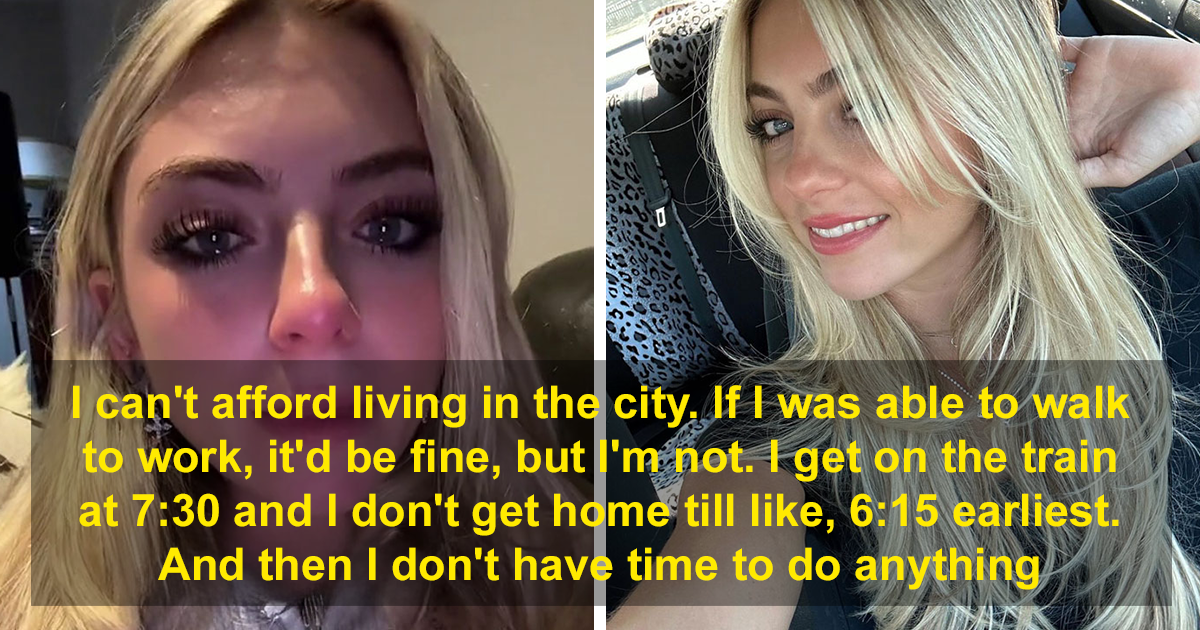
A recent college graduate cried on TikTok about her exhausting commute to her first 9-5 job, and the internet did what the internet does best: it turned one person’s tired, honest moment into a full-blown cultural referendum. Suddenly, a young woman’s after-work breakdown was no longer just about a train ride, a long day, and the sad dinner math of “Do I cook, shower, or collapse?” It became a debate about Gen Z, office culture, the cost of living, remote work, career expectations, and whether the traditional 40-hour workweek still makes sense in modern America.
The viral story centered on Brielle Asero, a 21-year-old recent college graduate who shared the emotional reality of starting an in-person office job after college. She explained that she was commuting from New Jersey into New York City, leaving early in the morning and not getting home until evening. Her complaint was not that she hated her job. In fact, she made it clear that the role itself was not the problem. The problem was the structure around it: the commute, the lack of time, the cost of living near work, and the feeling that life outside the office had been squeezed into a few exhausted crumbs after sunset.
That message hit a nerve because it was specific, emotional, and painfully familiar. Plenty of people have looked at the clock after getting home from work and thought, “Great, only enough time to microwave something questionable and stare at a wall.” Brielle simply said the quiet part into a phone camera.
Why This Viral 9-5 Commute Story Exploded Online
The phrase “college graduate complains over exhausting commute to her first 9-5 job and goes viral” sounds like internet bait, but the reaction was bigger than one video. It exploded because the clip sat at the intersection of three hot-button issues: Gen Z entering the workforce, rising urban living costs, and the post-pandemic fight over remote versus in-office work.
In the video, Brielle described the struggle of commuting into the city because she could not afford to live closer to her workplace. That detail mattered. It shifted the conversation from “young worker dislikes work” to “young worker is discovering that geography, rent, and office schedules can quietly eat an entire life.” In major metro areas, especially places like New York City, many entry-level workers face the same dilemma: live close to the office and surrender your paycheck to rent, or live farther away and donate your free time to transit.
Her frustration also felt recognizable because college life and office life run on very different clocks. College can be busy, stressful, and expensive, but it often includes flexible blocks of time. A student might have classes in the morning, a break in the afternoon, a late-night study session, and a nap squeezed somewhere in between like a secret government operation. A 9-5 office job is different. It has a fixed start, a fixed end, a commute on both sides, and usually the expectation that your brain will be available, polished, and semi-functional for eight straight hours.
What Brielle Asero Actually Complained About
One reason the internet argument became messy is that many people reduced her point to “Gen Z does not want to work.” That was not the full message. Brielle’s concern was about the total daily schedule. When a person works 9-5 but leaves home around 7:30 a.m. and gets home around 6:15 p.m. or later, the workday is not really eight hours. It is closer to eleven hours of being tied to work logistics. Add laundry, dinner, exercise, errands, social life, dating, family, and sleep, and suddenly the day looks like a suitcase packed by a raccoon.
She also acknowledged that other people have harder situations. Workers with children, pets, second jobs, caregiving responsibilities, chronic illness, or physically demanding work may have even less flexibility. That acknowledgment is important because the viral conversation was not really about whether one person had the hardest life in America. It was about whether a schedule can be normal and still be draining.
The Real Issue: Commute Time Is Work-Adjacent Time
Commuting is not usually paid time, but it absolutely takes energy. A long commute can make a 40-hour workweek feel much longer. Even when public transit is reliable, the worker still has to plan around train schedules, delays, crowded platforms, weather, and the mental gymnastics of getting from point A to point B without losing a shoe or a will to live.
Driving is not exactly a spa day either. Traffic, gas prices, parking, tolls, and the daily performance of pretending not to yell at other drivers can make commuting feel like a second job with worse benefits. No one puts “sat in traffic behind a landscaping truck for 47 minutes” on a résumé, but it still drains the same battery that was supposed to power dinner, exercise, or friendship.
Why So Many People Related to the Viral Video
The viral commute complaint resonated because it captured a truth many workers already know: full-time work is not just the hours listed in the job description. A job can be “9-5” on paper and “7:30-6:30” in real life. Once someone gets home, the remaining hours are often not free in a glamorous way. They are filled with chores, meals, bills, cleaning, tomorrow’s outfit, and the tiny administrative tasks that keep adult life from collapsing into a pile of unopened mail.
For new graduates, this can feel especially shocking. College may be stressful, but it comes with a sense of movement and variety. The first office job can feel like entering a time tunnel: wake up, commute, work, commute, eat, sleep, repeat. The weekend becomes less of a break and more of a two-day repair shop for the body and apartment.
People also related because the modern workplace is in transition. During the pandemic, millions of office workers experienced remote work and discovered that skipping the commute could return hours to their day. Even workers who prefer the office often want flexibility. The idea that every task must happen in a cubicle under fluorescent lights now feels outdated to many employees, especially when the same spreadsheet can be updated from a kitchen table, a coworking space, or a couch guarded by a judgmental cat.
The Gen Z Work-Life Balance Debate
The video became part of a larger Gen Z work-life balance debate. Some critics accused young workers of being soft, unrealistic, or allergic to adulthood. Others argued that Gen Z is simply more willing to say out loud what older generations were trained to swallow quietly with burnt office coffee.
There is a difference between laziness and questioning a system. Wanting time to cook, exercise, rest, date, see friends, or exist as a human being is not a radical manifesto. It is basic maintenance. A car gets scheduled oil changes; apparently, humans are expected to run forever on caffeine, calendar invites, and vibes.
Gen Z entered adulthood during a strange economic and cultural period. Many finished school during or after the pandemic, watched remote work become normal, saw housing costs climb, and then entered a workplace where some employers wanted everyone back in the office as if the last several years had been a collective hallucination. That context matters. A young worker questioning the 9-5 schedule is not necessarily rejecting ambition. She may be asking whether ambition should require sacrificing every weekday evening to transit and exhaustion.
Older Workers Were Divided Too
The reaction was not purely generational. Plenty of older workers criticized Brielle, but plenty defended her. Many people who had spent years commuting understood exactly what she meant. Some admitted they had built their lives around the same exhaustion and simply never had a platform to complain about it. Others pointed out that long commutes have always been brutal, but that does not mean every new generation must accept them without question.
The “I suffered, so you should too” argument is emotionally popular, but it is not exactly a business strategy. If a system burns people out, the smart response is not to pass the torch of misery like an Olympic flame. The smart response is to ask what can be improved.
The 40-Hour Workweek Was Not Handed Down From a Mountain
One reason the debate became so intense is that many people treat the 40-hour workweek as a natural law, like gravity or the certainty that someone will microwave fish in an office kitchen. But the 40-hour week is a labor standard shaped by history, politics, unions, and legislation. It was not designed around smartphones, dual-income households, modern rent, constant connectivity, or two-hour commutes from outer suburbs into expensive cities.
The Fair Labor Standards Act helped establish major wage and overtime protections in the United States, including overtime requirements for many workers after 40 hours in a workweek. That structure was a major improvement over earlier industrial labor conditions. But “better than the past” does not always mean “perfect for the present.” The workplace has changed dramatically. Technology has changed. Family life has changed. Housing patterns have changed. Yet many office schedules still behave as if the fax machine is warming up in the corner.
Commuting and the Hidden Cost of Entry-Level Jobs
Entry-level jobs often come with entry-level pay, but they may require workers to live near high-cost employment centers. That mismatch is a major reason Brielle’s video resonated. If a young graduate cannot afford to live near the office, commuting becomes the price of opportunity. The first job becomes both a career step and a daily endurance test.
The hidden cost is not only money. It is time, health, and social connection. A long commute can reduce sleep, limit exercise, increase stress, and make it harder to maintain relationships. It can also make ordinary self-care feel like a luxury. Cooking dinner after a long day sounds reasonable until you are standing in the kitchen at 7:15 p.m., staring at raw chicken like it personally betrayed you.
For many workers, the commute also changes how they experience the job itself. A good job can feel worse when wrapped in three hours of travel. A supportive manager can help, but even the best workplace culture cannot magically shorten a delayed train ride. Free snacks are nice, but they are not a substitute for getting home before dark.
Remote Work, Hybrid Work, and Why Flexibility Matters
The viral reaction to Brielle’s video was also fueled by the remote work debate. During the pandemic, many employees learned that they could do their jobs from home. Not every role can be remote, of course. Nurses, teachers, retail workers, restaurant staff, tradespeople, warehouse workers, and many others cannot simply “hop on Zoom” and call it a day. But for office jobs where remote work is possible, employees increasingly expect employers to justify why in-person attendance is necessary every single day.
Hybrid work has emerged as a practical middle ground. It allows employees to build relationships, receive mentorship, and collaborate in person while still saving commute time on some days. For young workers, this matters because the office can be valuable. First jobs often involve learning professional norms, making connections, and getting informal guidance. But being in the office five days a week is not the only way to learn those skills.
Research on hybrid work has found that flexible arrangements can improve satisfaction and retention without necessarily hurting performance. That does not mean every company should copy and paste the same policy. It does mean employers should stop treating flexibility as a rebellious employee demand and start treating it as a workforce design tool.
Why the Backlash Was So Loud
The backlash was loud because the video challenged a deeply rooted idea: adulthood is supposed to be exhausting, and complaining about it is a character flaw. Many people saw Brielle’s tears and projected their own beliefs onto them. Some saw entitlement. Others saw honesty. Some saw a young worker learning a difficult truth. Others saw a system that has normalized burnout so thoroughly that basic fatigue now looks like weakness.
Social media also rewards outrage. A nuanced statement like “commuting is structurally difficult for many workers, especially in expensive cities” will never travel as fast as “Gen Z can’t handle a job.” The internet loves a villain, and young women expressing emotion online are often assigned that role with alarming speed.
But the more useful interpretation is this: the video went viral because it exposed a gap between what employers consider a normal schedule and what workers experience as a livable day. Whether someone agrees with Brielle or not, millions of views suggest the topic is not trivial.
What Employers Can Learn From the Viral Commute Complaint
Smart employers should not dismiss this story as a TikTok tantrum. They should read it as workplace feedback delivered with mascara damage. If young employees are overwhelmed by long commutes and rigid schedules, organizations have several options beyond telling them to toughen up.
1. Offer Hybrid Schedules When Possible
If a job can be done remotely part of the week, hybrid scheduling can reduce commute fatigue while preserving in-person collaboration. Even one or two remote days can return hours of time to employees. That time can become sleep, exercise, meal prep, errands, or simply a quiet morning without sprinting for a train.
2. Create Staggered Start Times
Not every office needs everyone at a desk at exactly 9:00 a.m. Flexible start and end times can help employees avoid peak commute hours. A worker who starts at 8:00 and leaves at 4:00, or starts at 10:00 and leaves at 6:00, may experience a very different commute and a better quality of life.
3. Make Entry-Level Pay Match Location Reality
If companies require in-office work in expensive cities, compensation should reflect the cost of living and commuting. Entry-level workers cannot build stable careers if they are financially squeezed from every direction. A paycheck should not vanish into rent, train passes, coffee grabbed in survival mode, and the occasional emergency salad.
4. Train Managers to Notice Burnout Early
Burnout is easier to prevent than repair. Managers should look for signs of overload, especially among new graduates adjusting to full-time work. A first job is not just a job; it is a life transition. Clear expectations, realistic workloads, and supportive check-ins can make a major difference.
What New Graduates Can Learn From the Story
For new graduates, the lesson is not “avoid 9-5 jobs forever.” Traditional jobs can offer training, stability, mentorship, benefits, and a valuable career foundation. The lesson is to evaluate the full shape of a job before accepting it. Salary matters, but so do commute time, schedule flexibility, manager expectations, office location, growth opportunities, and the realistic cost of daily life.
Before accepting a role, ask practical questions. How many days are in office? Is there flexibility after training? What time do most people arrive and leave? Does the company support remote work during bad weather or transit disruptions? Are there commuter benefits? How often do entry-level employees work late? These questions are not rude. They are adult. Very adult, actually. Painfully adult. The kind of adult that owns a reusable water bottle and knows where the insurance card is.
New workers can also build systems that reduce weekday chaos. Meal prepping, planning outfits, grouping errands, protecting sleep, and scheduling social plans intentionally can help. But personal organization can only do so much. A color-coded planner cannot fully solve a three-hour commute. At some point, structural problems require structural solutions.
The Bigger Conversation: Is the 9-5 Still Working?
The viral video did not prove that the 9-5 is dead. Many people still prefer a predictable schedule. Some workers like separating office and home. Others enjoy the social rhythm of commuting and collaborating in person. The issue is not that every 9-5 job is bad. The issue is that one rigid model cannot serve every worker, every industry, and every life stage equally well.
The future of work is likely to be more customized. Some companies will keep traditional office schedules. Others will use hybrid models, compressed weeks, flexible hours, or remote-first teams. The best organizations will focus less on where a person’s chair is located and more on whether the work is getting done, employees are learning, customers are served, and people can remain healthy enough to stay.
Brielle’s viral commute complaint became a cultural lightning rod because it asked a simple question hiding inside a tearful video: after work, where does life fit? That question is not childish. It is one of the central workplace questions of our time.
Related Experiences: What the First 9-5 Commute Really Feels Like
Many people remember their first full-time job not by the job title, but by the routine. The alarm goes off earlier than seems morally acceptable. You dress in clothes that say “professional,” even if your soul is still wearing pajamas. You join a crowd of commuters who all look like they are silently negotiating with the universe. By the time you reach the office, you have already completed a small obstacle course, but the workday has not even started.
The first few weeks can be especially disorienting for recent graduates. In school, stress often arrives in waves: exams, deadlines, presentations, finals. In a 9-5 job, the rhythm is steadier but more relentless. Monday arrives, then Tuesday arrives with suspicious speed, and by Wednesday you are having deep emotional thoughts about leftovers. The adjustment is not only professional; it is physical. Your sleep schedule changes. Your meals change. Your social life changes. Even your laundry develops a personality and begins making demands.
A long commute intensifies that transition. For example, a new graduate commuting from a suburb into a major city may wake up at 6:00 a.m., leave by 7:00, arrive around 8:45, work until 5:00, and return home close to 7:00 p.m. On paper, the job is eight hours. In reality, the day belongs to work for nearly twelve. That leaves a narrow window for dinner, exercise, family, friends, chores, and rest. When people ask, “Why don’t you just go to the gym after work?” the honest answer may be, “Because my body has already resigned from the committee.”
Another common experience is the loss of spontaneity. In college, a friend might text, “Want to grab food?” and the answer could be yes. After starting a commuting job, the same invitation feels like a logistics puzzle. Where is the restaurant? Is it near the train? Will I miss the 8:12? Do I have clean clothes tomorrow? Can dinner be a granola bar? This is how adulthood turns into project management.
There is also the emotional side. New workers may feel guilty for being tired because they know having a job is a privilege. They may feel embarrassed for struggling because everyone else seems to be handling it. But many people are not handling it effortlessly; they are just performing competence in public. The viral reaction to Brielle’s video proved that behind many polished LinkedIn updates are people quietly wondering how anyone has time to cook vegetables.
The best advice from people who have survived the first-job commute is practical but compassionate. Protect sleep first. Keep easy food at home. Do not schedule every weekend minute. Use commute time intentionally if possible, but do not turn every train ride into a productivity contest. Sometimes the healthiest commute activity is staring out the window and letting your brain become soup. Most importantly, treat the first year as an adjustment period, not a final verdict on adulthood.
The experience gets easier for many people as they learn their limits, negotiate flexibility, move closer to work, change roles, or build routines. But the fact that people adapt does not mean the original problem is imaginary. Long commutes are hard. Starting a first 9-5 is hard. Wanting a life outside work is normal. And saying so should not require a viral video, though apparently it helps if the algorithm is in a dramatic mood.
Conclusion
The story of a college graduate complaining about an exhausting commute to her first 9-5 job went viral because it was not really just about one commute. It was about a generation entering work with new expectations, an economy where living near opportunity can be wildly expensive, and a workplace culture still deciding what lessons to keep from the remote-work era. Brielle Asero’s video sparked mockery, sympathy, debate, and reflection because it captured a common feeling: work may be necessary, but life should not be something squeezed into the tired leftovers of the day.
The best takeaway is not that young workers are fragile or that traditional jobs are evil. The better takeaway is that commute time, flexibility, pay, and well-being are connected. A job can be meaningful and still be exhausting. A worker can be grateful and still want change. And a viral TikTok can be messy, emotional, and surprisingly useful if it pushes employers and employees to ask better questions about how work actually fits into a human life.