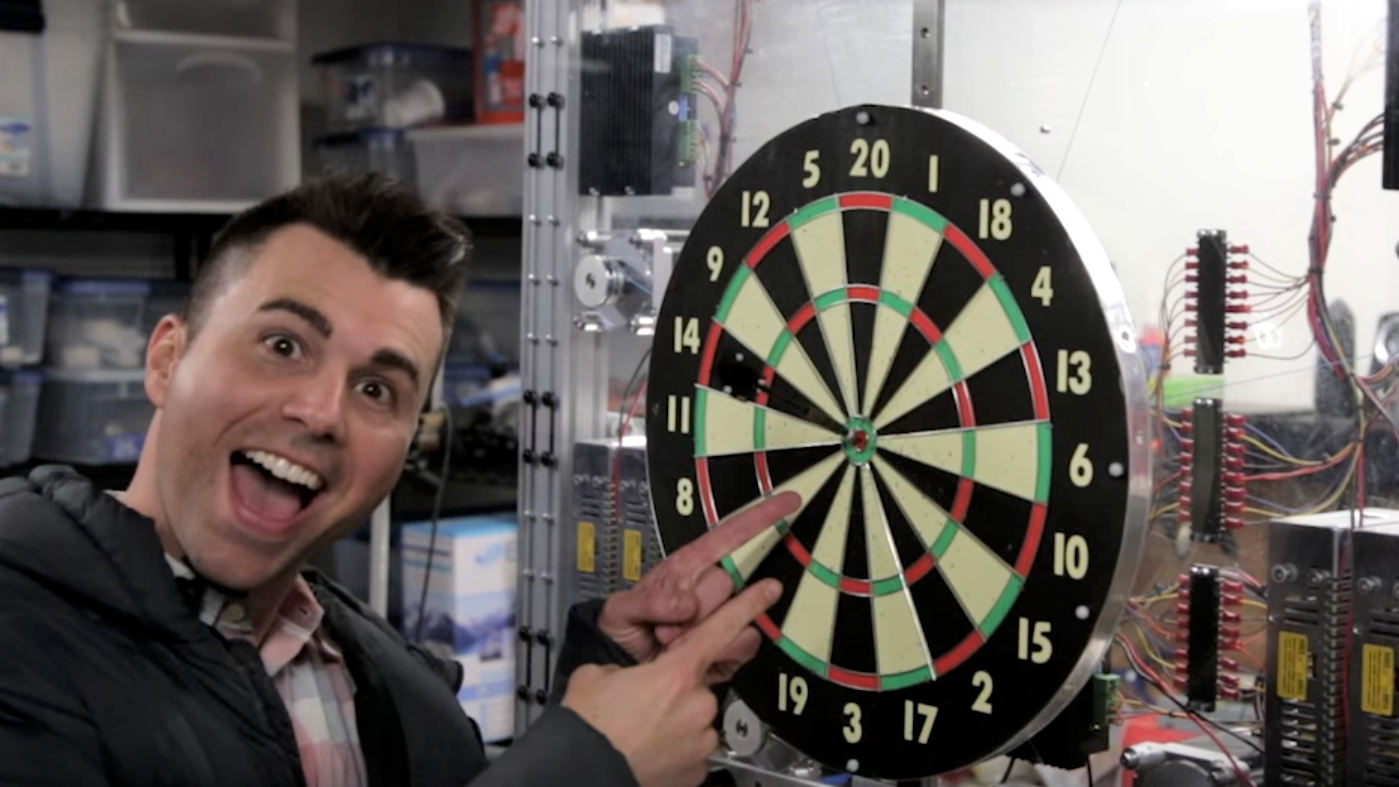
Some inventions make life easier. Some make life safer. And some exist because one very determined engineer looked at a dartboard and thought, “What if missing was simply not allowed?” That is the deliciously unnecessary genius behind the moving dartboard that watches your throw, predicts where the dart will land, and slides the bullseye into the dart’s path like a loyal golden retriever catching a tennis ball.
The idea sounds like a pub joke after nachos: build a dartboard that guarantees perfect bullseyes by moving itself at the last possible moment. But the engineering behind it is no joke. This smart dartboard combines motion capture, infrared tracking, trajectory prediction, fast motor control, and a whole lot of “this should be easier than it is” energy. The result is a robotic dartboard that turns ordinary throws into miracle shots and makes everyone in the room briefly believe they have the hand-eye coordination of a championship darts player.
At its heart, the automatic bullseye dartboard is a brilliant example of augmented skill. It does not make the thrower better. It makes the target more cooperative. And honestly, after years of dartboards just standing there judging us, perhaps they had it coming.
What Is the Automatic Bullseye Dartboard?
The automatic bullseye dartboard is a motion-tracking dartboard designed to move its center target into the predicted path of a thrown dart. Instead of expecting the player to hit the bullseye, the system calculates where the dart is heading and moves the dartboard so the bullseye arrives at the same point at the same time.
In normal darts, you stand at regulation distance, stare at the board, make a solemn promise to your ancestors, and then hit the wall two inches from the number 6. With this engineered setup, the dartboard becomes an active participant. It tracks the dart in flight, estimates the dart’s path, and shifts on a two-axis system before impact. The bullseye does not wait to be hit. It chases destiny.
The best-known version of this project was created by engineer and YouTuber Mark Rober, who spent years developing the build. The project became famous because it was both technically impressive and wonderfully ridiculous. It used high-speed infrared motion capture cameras, reflective markers on the dart, mathematical prediction, stepper motors, fishing line, and a control system fast enough to complete its work in the tiny fraction of a second between throw and impact.
How the Dartboard Watches Your Throw
The key challenge is simple to explain: the board must know where the dart is going before the dart gets there. That is harder than it sounds, because a dart is small, fast, spinning, and usually launched by a human who may or may not be pretending they “meant to aim there.”
Infrared Motion Tracking
To track the dart, the system uses infrared motion capture cameras. The dart is fitted with reflective markers, allowing the cameras to pick it out from the background. This is important because a dart flying through a room is not exactly a relaxed subject posing for a portrait. It is a sharp little missile crossing space quickly, and ordinary camera tracking would have to deal with lighting, shadows, walls, hands, and whatever questionable neon sign is glowing in the background.
Infrared tracking simplifies the scene. The cameras look for the reflective markers rather than trying to understand everything in the room. Once the system can identify the dart’s position over time, it can create a stream of location data. That data gives the computer enough information to calculate the dart’s direction, speed, and likely impact point.
Trajectory Prediction
A thrown dart does not travel in a perfectly straight line. Gravity pulls it downward, so the dart follows a curved path. To predict the final landing point, the system needs to model that path quickly. Horizontally, the path can often be estimated with a simpler line calculation. Vertically, the system must account for the dart’s parabolic drop.
This is where math becomes the quiet hero of the story. The computer uses the dart’s observed positions to project where it will cross the plane of the dartboard. In other words, it asks, “If this dart keeps going the way it is going, where will it hit?” Then, before anyone can say, “Nice try,” the board gets moving.
How the Dartboard Catches the Bullseye
Tracking the dart is only half the job. The dartboard must also move fast enough to intercept the dart. That means the system needs a physical platform that can shift left, right, up, and down with speed and precision.
Motors, Sliders, and Fishing Line
The famous build used stepper motors and a system of fishing line to pull the board into position. Stepper motors are useful in projects like this because they can be controlled in precise increments. Instead of simply spinning freely, they move step by step, allowing the controller to command very specific motion.
The board itself sits on a sliding mechanism, giving it controlled movement across two axes. When the computer predicts where the dart will land, it converts that location into motor commands. The motors pull and release the fishing line so the board shifts into place. It is a bit like a puppet show, except the puppet is a dartboard and the audience is yelling because suddenly Dave from accounting has hit three bullseyes in a row.
The Timing Problem
The entire process must happen extremely quickly. From the moment a dart leaves the hand to the moment it reaches the board, there is only a short window for tracking, calculation, and movement. The system must gather enough positional data, predict the landing point, send instructions to the motors, and move the board before the dart arrives.
This is what makes the project more than a novelty. A slow-moving dartboard would be funny once and then mostly useful as a wall decoration. A working automatic bullseye dartboard has to be fast, accurate, and repeatable. It has to react in real time, not after the dart has already made peace with the plaster.
Why the Bullseye Is Not Actually the Highest Score
Here is the twist that surprises many casual players: in standard darts, the bullseye is not the highest-scoring single target. The inner bullseye is worth 50 points, while the treble 20 is worth 60. That means a robotic board designed purely for maximum scoring might prefer to chase the treble 20, not the bullseye.
So why does the automatic dartboard focus on the bullseye? Because the bullseye is the cultural symbol of perfect aim. Nobody says, “Wow, you really treble-twentied that quarterly presentation.” We say “bullseye” because it means direct hit, perfect focus, and glorious center-target satisfaction. It is the word we use when a plan works, a joke lands, or a dartboard decides to cheat on our behalf.
Professional players often aim for treble 20 because it offers the highest single-dart score. Still, the bullseye carries emotional power. It is the tiny red brag button in the middle of the board. The automatic bullseye dartboard is not about optimizing tournament strategy. It is about giving players the joyful illusion of precision.
The Engineering Lessons Behind the Fun
The moving dartboard may look like a party trick, but it teaches serious engineering concepts in a memorable way. It brings together computer vision, sensor fusion, control systems, mechanical design, and real-time prediction. That combination is the same kind of thinking used in robotics, autonomous vehicles, sports analytics, industrial automation, and augmented reality systems.
Computer Vision Needs Clean Data
The project shows why engineers often simplify a visual problem before solving it. Instead of asking a camera to understand the entire room, the system tracks reflective markers. This reduces noise and improves reliability. In many real-world systems, the smartest solution is not always the most complicated algorithm. Sometimes it is a better marker, a cleaner signal, or a controlled environment.
Prediction Is Only Useful If It Arrives on Time
A perfect prediction delivered too late is useless. The dartboard’s computer does not have the luxury of thinking deeply for several seconds. It must calculate quickly enough for the motors to respond. This is a classic real-time engineering problem: accuracy matters, but latency matters just as much.
Mechanical Design Can Make or Break the Software
Even great code cannot save a slow, wobbly, or poorly balanced mechanism. The board needs to move smoothly and precisely. If the motor system overshoots, vibrates, or lags, the dart misses the bullseye. The project reminds us that software and hardware are not separate kingdoms. They are roommates, and if one leaves dirty dishes in the sink, everyone suffers.
Could You Build One at Home?
Technically, yes. Practically, you may want to apologize to your wallet first. A high-performance automatic bullseye dartboard requires motion capture, fast processing, precision mechanics, and careful calibration. The original concept used expensive motion capture equipment, which is not exactly the same as picking up a roll of duct tape and declaring yourself Tony Stark.
However, a simpler DIY version is possible for hobbyists who enjoy robotics and computer vision. A home builder might experiment with high-speed cameras, reflective tape, OpenCV-style tracking, stepper motors, linear rails, and a microcontroller. The challenge would be achieving enough speed and accuracy to make the board move before impact.
A safer beginner project would be a smart scoring dartboard or a practice board that tracks where darts land after impact. That still teaches useful skills without requiring the board to dodge around like a caffeinated Roomba. From there, an advanced maker could gradually work toward predictive tracking and controlled movement.
Why This Invention Went Viral
The automatic dartboard became popular because it sits at the perfect intersection of clever, funny, and absurdly overbuilt. People love machines that solve silly problems with serious engineering. There is something deeply entertaining about using motion capture and precision motors to improve bar darts, a game traditionally powered by confidence, questionable posture, and snacks.
It also taps into a universal fantasy: what if the world adjusted itself so we could not fail? Imagine a basketball hoop sliding under every shot, a golf hole chasing your putt, or a trash can sprinting across the room to catch your crumpled receipt. The moving dartboard is funny because it flips the usual challenge. Instead of training the human, it trains the target.
Real-World Applications Beyond Darts
While the project is playful, the technology behind it has broader applications. Motion capture is used in animation, sports science, physical therapy, biomechanics, robotics, and engineering research. Real-time tracking helps machines understand movement, predict outcomes, and respond automatically.
In sports training, similar ideas can help analyze throwing mechanics, swing paths, body position, or reaction time. In manufacturing, tracking systems can help robots locate parts and adjust their motion. In healthcare, motion analysis can support rehabilitation and gait assessment. In entertainment, motion capture turns human movement into digital performance.
The dartboard is not just a gadget. It is a tiny stage where modern automation performs a comedy routine. The punchline is a bullseye, but the setup is real engineering.
Experience Section: What It Feels Like to Use a Dartboard That Refuses to Let You Miss
Imagine walking into a bar where a dartboard is mounted on the wall like any other board. Nothing looks especially futuristic. There are no dramatic lasers, no smoke machine, no robot voice saying, “Target acquired.” Someone hands you a dart. You step to the line, raise your arm, and prepare to display your deeply average athletic ability.
You throw. The dart wobbles through the air with the elegance of a confused pigeon. Normally, this is the moment when everyone politely watches it land somewhere near the 11. But instead, the board twitches. It moves. Not wildly, not dramatically, but with just enough speed to look alive. A split second later, your dart lands dead center in the bullseye.
For one glorious moment, you believe. You stand taller. Your shoulders square. Somewhere in your brain, a tiny sports commentator screams, “Unbelievable scenes!” You look at your friends with the humble face of a person who has discovered a hidden gift late in life. Then you throw again, and the board catches another bullseye. Suspicion enters the room wearing sensible shoes.
The first experience with an automatic bullseye dartboard is a blend of delight and betrayal. It feels amazing to hit the target, even when you know the machine helped. That is the funny part: the emotional reward still works. Your eyes see the dart in the center. Your hand remembers throwing it. Your ego connects the dots in the most flattering way possible.
After a few throws, the experience changes. You stop focusing only on the score and start watching the technology. You notice how quickly the board reacts. You try to throw slightly left, slightly low, or with a different speed just to see whether the system can keep up. The game becomes less about darts and more about testing the robot’s patience.
Then comes the mischief. Someone wonders whether the board can be fooled. What if the dart is too slow? What if it is thrown from a strange angle? What if the throw is so terrible that the dart has legally left the concept of darts? This is where the machine reminds everyone that engineering has limits. The system works best when the dart is at least heading toward the board. If you throw like you are trying to assassinate a coat rack, no amount of motion capture can save you.
Using a dartboard like this also changes the mood of the room. Ordinary darts can become competitive quickly, especially when someone who “never plays” turns out to be suspiciously good. The automatic bullseye board makes the game social in a different way. Everyone laughs because the machine is the star. Beginners enjoy instant success. Good players enjoy trying to outsmart the system. Engineers in the room quietly begin redesigning the mechanism in their heads, because engineers cannot see a machine without mentally voiding its warranty.
There is also a strange lesson in confidence. When people see their darts hit the bullseye repeatedly, they begin to throw with less hesitation. The machine removes fear of failure, and the body relaxes. Of course, the player is not suddenly a professional. But the experience shows how much of casual performance is affected by nerves. Sometimes the best coach is a dartboard that lies kindly.
The best part is the reveal. If someone does not know the board moves, the first few throws feel like magic. The player celebrates. The crowd laughs. Then someone points out the shifting board, and the room erupts again. It is a prank, a science demonstration, and a sports fantasy rolled into one.
In the end, the automatic bullseye dartboard is memorable because it makes technology feel playful. It is not saving the world. It is saving your pride from another tragic 3-point dart. And sometimes, that is enough. Not every invention has to cure a disease or land on Mars. Some inventions earn their place in history by making a room full of adults cheer for a target that cheats beautifully.
Conclusion
The dartboard that watches your throw and catches perfect bullseyes is more than a viral maker project. It is a charming demonstration of what happens when serious engineering is aimed at a delightfully unserious problem. By combining infrared motion capture, trajectory prediction, stepper motors, and precise mechanical movement, the system turns missed shots into center hits and makes every player feel like a legend for at least three seconds.
It also proves that innovation does not always begin with a world-changing mission. Sometimes it begins with curiosity, stubbornness, and the question, “Could we make the target move instead?” The answer, as this robotic dartboard shows, is yes. And the result is a perfect bullseye for science, humor, and the beautiful art of overengineering.