Note: This article is based on verified public reporting and commentary surrounding David Letterman, President Donald Trump, Jimmy Kimmel, late-night television, political satire, and the continuing debate over free speech in American entertainment media.
Introduction: When an Insult Becomes a Standing Ovation
David Letterman has spent much of his career proving that comedy works best when it pokes the powerful, rattles the polished furniture, and occasionally leaves a few politicians wondering why they agreed to appear on television in the first place. So when President Donald Trump publicly attacked Letterman, calling him overrated and a “loser,” the former late-night host did not exactly retreat to a dimly lit room to rethink his life choices. Instead, Letterman treated the insult almost like a career achievement awardminus the trophy, plus a lot more all-caps energy.
The moment became more than another celebrity-versus-politician squabble. It revealed something larger about modern American culture: late-night comedy is no longer just a place for monologues, celebrity interviews, and awkward cooking segments where actors pretend they know how to whisk. It has become a highly visible battleground for free expression, media pressure, political ego, and the public’s appetite for satire.
The phrase “David Letterman was thrilled to be attacked by President Trump” sounds almost absurd at first. Most people do not wake up hoping the president criticizes their face, ratings, or career. But Letterman is not most people. For a comedian who built his legacy on irony, mockery, deadpan humor, and institutional skepticism, being singled out by a president he had criticized may have felt less like a wound and more like proof that the joke landed.
The Backstory: Letterman, Kimmel, and a Late-Night Firestorm
The dispute began in the broader controversy surrounding Jimmy Kimmel and ABC. After Kimmel’s show was temporarily pulled from the air following political backlash, many comedians, media critics, and public figures raised concerns about whether corporate networks were becoming too willing to bend under political pressure. David Letterman, who hosted late-night television for more than three decades, stepped into the conversation with the authority of someone who knows exactly how the sausage, the monologue, and the panicked network phone call are made.
At The Atlantic Festival, Letterman criticized the suspension and described the situation as a troubling example of “managed media.” His point was not simply that one host had been punished. His argument was that comedy aimed at political leaders has long been part of American television, and that presidents should be able to withstand jokes without government pressure hovering in the background like a humorless substitute teacher.
Letterman reminded audiences that during his own career, he mocked presidents from both parties. Jimmy Carter, Ronald Reagan, George H. W. Bush, Bill Clinton, George W. Bush, and Barack Obama all became material. Some jokes were sharp, some were silly, and some were probably written at 4:30 p.m. by exhausted writers fueled by coffee and fear. Yet Letterman said he was never pressured by a government agency for joking about presidents. That historical contrast was the heart of his criticism.
Trump’s Response: The Truth Social Attack
President Trump responded on Truth Social on September 19, 2025, with a post that attacked Letterman’s career, appearance, and relevance. Trump called him “very highly overrated,” claimed his ratings were never very good, said he “looks like hell,” and ended with “LOSER!!!” It was classic Trumpian messaging: short, personal, aggressive, and designed to dominate the next news cycle.
For many public figures, that kind of attack would be deeply unpleasant. For Letterman, it appeared to function like a perfectly wrapped gift from the Department of Accidental Validation. Instead of treating the insult as a disaster, Letterman leaned into it. In later remarks, he joked that being singled out by the president made him feel as though his work was complete. That response captured the strange comedy of the whole exchange: Trump meant the attack as a dismissal, while Letterman framed it as confirmation that criticism still had power.
Why Letterman’s Reaction Felt So On-Brand
To understand why Letterman seemed pleased, you have to understand his comic identity. Letterman was never the glossy, always-smiling host who made television feel like a velvet couch. He was the guy who treated the format itself as suspicious. His comedy often came from discomfort, irony, anti-showbiz attitude, and the sense that the whole machine was slightly ridiculous.
Letterman’s genius was that he could host a network television show while acting like he was standing just outside the building, looking in through the window, asking why everyone was wearing so much makeup. He made awkwardness funny. He turned throwaway bits into art. He could interview Hollywood royalty and still make the moment feel like someone had misplaced the instruction manual.
That is why Trump’s insult did not land in the usual way. Letterman has never depended on looking perfectly polished or being universally loved. In fact, a personal attack from a powerful political figure fits neatly into the Letterman universe: absurd, uncomfortable, slightly mean, and begging for a comeback.
The Bigger Issue: Comedy, Power, and Political Pressure
The Letterman-Trump clash matters because it sits inside a much larger debate about comedy and power. In a healthy democracy, comedians mock leaders. Sometimes the jokes are brilliant. Sometimes they are lazy. Sometimes they are unfair. Sometimes they are so accurate that the target immediately claims nobody watches the show. But the basic tradition is clear: political leaders are public figures, and public figures are fair game for satire.
Letterman’s criticism centered on the idea that a president should not act as if every late-night joke is a national emergency. The presidency is one of the most powerful offices in the world. Late-night hosts, by comparison, sit behind desks and read jokes from cards. If the desk becomes a threat to the throne, the problem may not be the desk.
What worried many observers was not simply Trump’s personal insult. Politicians insult entertainers all the time. The deeper concern was whether political pressure, regulatory power, affiliate pressure, and corporate caution could combine to make broadcasters less willing to air critical comedy. That is the environment in which Letterman’s comments resonated.
Letterman’s Long History With Trump
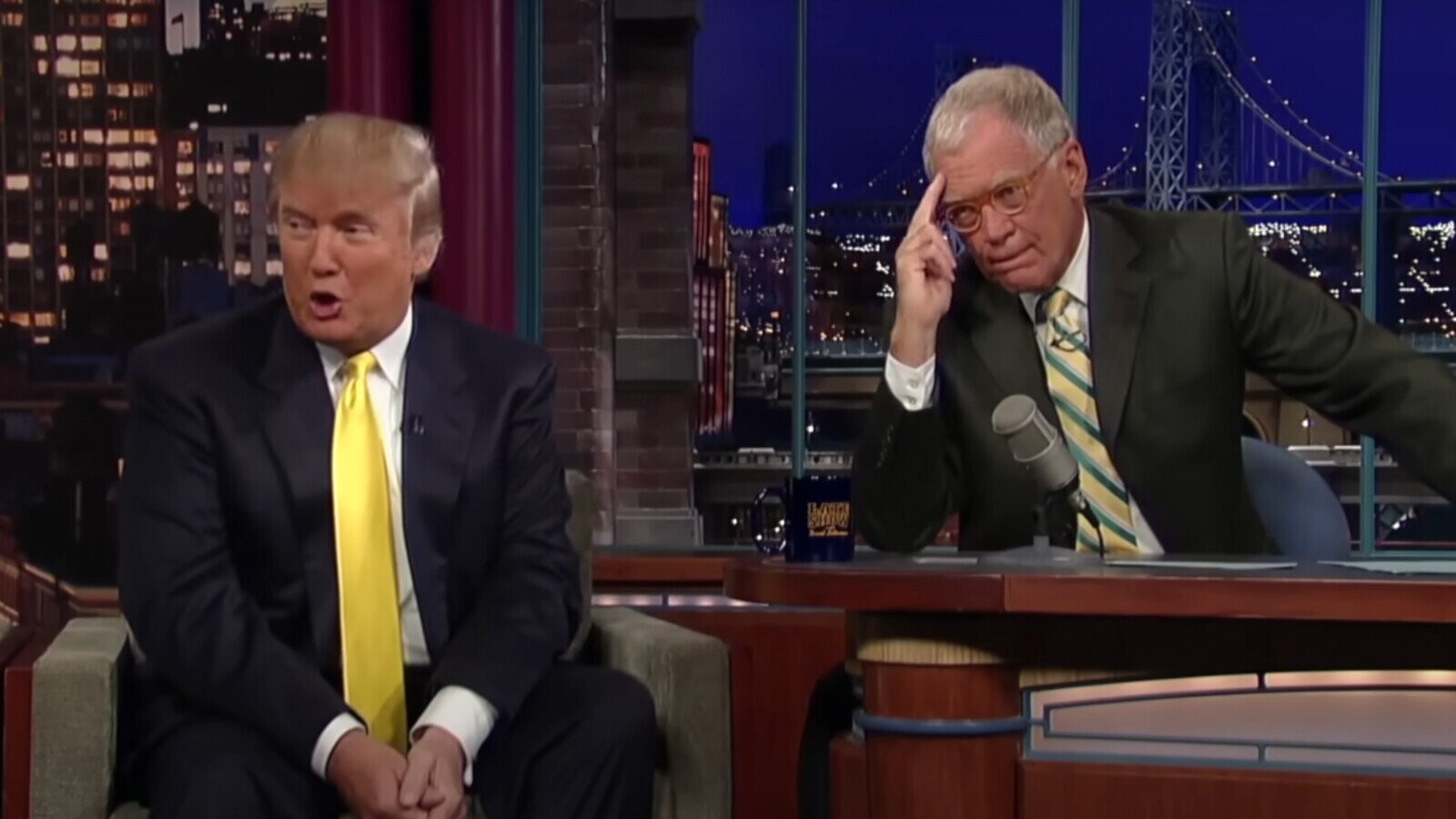
Letterman and Trump have a complicated television history. Long before Trump became president, he was a familiar guest in the late-night ecosystem. He appeared on talk shows as a businessman, celebrity, tabloid figure, and master of self-promotion. Letterman interviewed him more than once, often treating him as both a guest and a walking punchline in a suit.
In earlier years, Trump’s presence on late-night television was part of the entertainment machine. He could be teased about wealth, hair, casinos, buildings, ego, and branding. The stakes felt lower. The jokes were about celebrity excess, not constitutional anxiety. But once Trump entered presidential politics, the relationship changed. The same qualities that once made him a comic target became part of a much more serious national debate.
Letterman has since expressed regret about how lightly Trump was sometimes treated in the entertainment world. That regret helps explain the sharper tone of his recent criticism. He does not see Trump merely as a former guest or a colorful television personality. He sees him as a political figure whose behavior, in Letterman’s view, deserves direct scrutiny.
Why Late-Night Hosts Became Political Lightning Rods
Late-night television has always had political content, but the balance has changed dramatically. Johnny Carson could make presidents nervous with a raised eyebrow. Jay Leno leaned heavily on topical jokes. Jon Stewart turned political media criticism into a genre of its own. Stephen Colbert, Jimmy Kimmel, Seth Meyers, and others have pushed late-night comedy further into explicit political commentary.
This shift did not happen in a vacuum. Audiences changed. Media habits changed. Social platforms turned monologues into shareable clips. Political polarization made every joke feel like a team sport. A punchline that once disappeared after midnight can now circulate for days, stripped of context and served with outrage sauce.
For politicians, that creates temptation. A late-night joke can be framed as bias, disrespect, misinformation, or proof of elite hostility. For comedians, the temptation runs the other way: when a powerful figure attacks, the attention can make the joke bigger. Letterman’s “thrilled” response belongs to that second category. The attack made the critique louder.
The Irony of Calling Letterman “Overrated”
Calling David Letterman “overrated” is certainly an opinion, but it is a difficult one to square with television history. Letterman helped reshape late-night comedy by making it weirder, more self-aware, and more unpredictable. His influence can be seen in generations of hosts, writers, and comedians who borrowed his irony, his love of anti-climax, and his willingness to let a bit get strange enough that the audience wondered whether the wheels had come off.
Ratings are only one way to measure a television figure. Influence is another. Letterman’s shows produced famous interviews, beloved recurring segments, oddball remote pieces, and a comic attitude that helped modernize the form. He was not just a host; he was a signal that television could laugh at itself while still being television.
That is why the insult had a boomerang effect. It reminded people of Letterman’s place in the culture. In attempting to dismiss him, Trump revived a conversation about why Letterman mattered in the first place. For a retired comedian, that is not a bad day at the officeespecially when he no longer has to sit through a network notes meeting afterward.
Jimmy Kimmel, Stephen Colbert, Seth Meyers, and the Comedy Chain Reaction
Letterman’s defense of Jimmy Kimmel also connected to his support for other late-night hosts, including Stephen Colbert and Seth Meyers. Colbert’s version of The Late Show became one of television’s most visible platforms for anti-Trump commentary. Meyers, who inherited NBC’s Late Night franchise that Letterman once launched, has also become known for detailed political segments that criticize Trump and his allies.
When Trump has targeted these hosts, Letterman has responded with a mix of anger, sarcasm, and old-school comic loyalty. He praised Meyers’ work and expressed pride in the show that once belonged to him. He criticized CBS over Colbert’s cancellation and questioned whether the stated financial reasons told the whole story. Whether one agrees with Letterman or not, his position is consistent: comedians should not lose their platforms because powerful people dislike being mocked.
That stance is not just about protecting comedians. It is about protecting a public space where powerful figures can be criticized without every joke becoming a corporate survival test.
Public Reaction: Why the Story Spread
The story spread because it had everything the internet loves: a famous comedian, a president, a personal insult, free speech concerns, and the irresistible phrase “LOSER!!!” It also had generational contrast. Trump and Letterman are both older media figures who understand television, fame, and public combat. Their exchange felt like a collision between two different versions of American celebrity: the comic skeptic and the political showman.
For Letterman fans, his response felt satisfying because it turned the insult inside out. For Trump supporters, the post likely landed as another example of Trump punching back against entertainers who criticize him. For media observers, the exchange became another data point in the ongoing battle over whether late-night comedy is entertainment, activism, propaganda, or some messy combination of all three.
The truth is that late-night comedy has always been messy. That is part of its charm. It is written quickly, performed under pressure, and designed to react to events while they are still warm. Sometimes it clarifies the moment. Sometimes it oversimplifies. Sometimes it misses. But when it is working, it reminds the audience that power should never become too comfortable.
Analysis: Why Being Attacked Can Help a Comedian
In comedy, a strong reaction can be useful. Silence is often worse than outrage. If a joke disappears into the air, it may have failed. If the target responds angrily, the comedian can argue that the joke found its destination. That is the basic reason Letterman could treat Trump’s attack as a win.
There is also a branding advantage. Letterman no longer hosts a nightly network show. He does not need ratings in the way current hosts do. He does not have to protect a fragile time slot or please affiliates. That freedom allows him to speak with less caution. When Trump attacked him, Letterman had little to lose and plenty of comic material to gain.
For active hosts, the calculation is more complicated. Kimmel, Colbert, Meyers, and others operate inside large media companies with advertisers, affiliates, executives, contracts, and legal departments. They may be personally bold, but they work within institutions that can become cautious when political pressure rises. Letterman’s retired status gives him the luxury of saying the quiet part loudly, then walking away without asking whether the 11:35 p.m. ad inventory is safe.
Experience Section: What This Moment Teaches Writers, Comedians, and Viewers
There is a practical lesson in this story for anyone who creates public content, whether that content is comedy, commentary, journalism, essays, podcasts, or even a tiny blog that gets twelve readers and one angry uncle. When you criticize powerful people, you should understand your purpose before the backlash arrives. If the goal is attention alone, controversy can become addictive and hollow. But if the goal is to make a clear point, backlash can sometimes reveal that the point mattered.
Letterman’s reaction offers a useful example of emotional positioning. He did not respond like someone begging to be liked. He responded like someone who understood the role he was playing. That is important for creators. Public criticism feels less destabilizing when you know what your work stands for. If you write satire, some people will call it disrespectful. If you report uncomfortable facts, some people will call it biased. If you make jokes about politics, someone will insist comedy was better when it only discussed airline food. Spoiler alert: people complained then, too.
For comedians, the experience is especially relevant. Comedy has always lived near the edge of discomfort. The challenge is not simply to offend or avoid offense. The challenge is to know why the joke exists. A joke that punches up at power can feel necessary. A joke that punches down at the vulnerable can feel cruel. A joke that exposes hypocrisy can travel farther than a lecture because laughter lowers the drawbridge before the argument enters the castle.
For viewers, the Letterman-Trump exchange is a reminder to watch media with both humor and judgment. A comedian is not automatically right because a politician is angry. A politician is not automatically wrong because a comedian is funny. The audience still has to think. Was the criticism fair? Was the response proportional? Did the joke reveal something true, or did it simply generate heat? In an age of instant outrage, those questions are more valuable than another round of digital yelling.
For writers and publishers, the story also shows why context matters. The headline is catchy because it sounds counterintuitive: why would anyone be thrilled to be attacked by the president? But the deeper answer is about validation, platform, and power. Letterman’s satisfaction came from the idea that being attacked proved he had irritated the right nerve. In public commentary, that can happen. A strong response from the subject may show that the critique reached beyond the choir.
Still, there is a caution here. Not every attack is useful, and not every controversy is noble. Creators should not romanticize conflict for its own sake. The healthiest approach is to build work that can survive scrutiny. Be accurate. Be fair. Be sharp. Be funny if humor fits. And when criticism comes, separate the useful feedback from the noise. Letterman’s advantage is that his career gave him decades of practice. Most people do not start with that armor. They build it one public reaction at a time.
The best takeaway may be this: free expression is not only about the right to speak. It is also about the cultural confidence to let others speak, joke, criticize, and respond without immediately reaching for punishment. Letterman’s grin in the face of insult is funny, but the issue underneath it is serious. A society that cannot tolerate jokes about leaders is a society with very nervous leaders. And nervous leaders, as every comedian knows, are usually where the material is.
Conclusion: The Joke Landed Because the Target Reacted
David Letterman being “thrilled” by President Trump’s attack makes perfect sense once you understand the comedy logic behind it. Trump meant to belittle him. Letterman treated the insult as evidence. In doing so, he turned a personal attack into a larger statement about satire, political pressure, and the role of comedy in American public life.
The controversy also reminds us that late-night television is not just background noise for people folding laundry at midnight. It remains a cultural arena where jokes can become arguments, monologues can become news, and retired hosts can still walk into the conversation like they never really left.
Whether you admire Letterman, support Trump, prefer Kimmel, miss Carson, or believe all late-night hosts should be replaced by calm aquarium footage, one fact remains: political comedy works because power reacts. And when power reacts loudly enough, the comedian does not always need a punchline. Sometimes the response is the punchline.