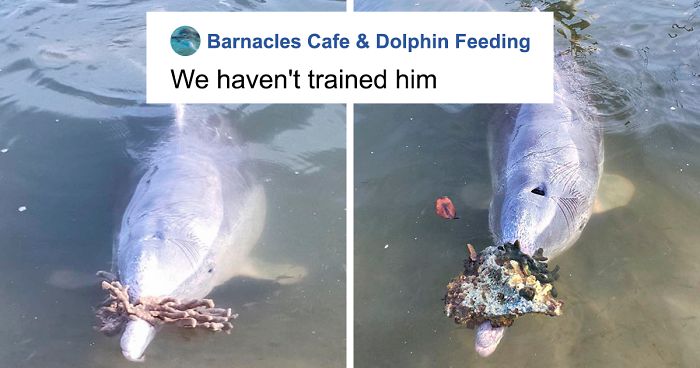
Some animals chase balls. Some animals knock coffee mugs off tables with the confidence of tiny villains. And then there is Mystique, a wild Australian humpback dolphin who apparently looked at human civilization and thought, “These land mammals seem emotionally fragile. Perhaps a seashell will help.”
The story of Mystique, the gift-giving dolphin from Tin Can Bay in Queensland, Australia, has become one of those rare animal tales that feels almost too charming to be real. But the details are grounded in actual reporting: Mystique, a male dolphin known to volunteers at the Barnacles Dolphin Centre, developed a habit of bringing objects from the ocean floor to the people who fed and observed him. Bottles, shells, coral fragments, bits of timber, and other found items became his version of a gift basketminus the tissue paper and questionable cheese spread.
What makes the story especially fascinating is not simply that a dolphin carried objects to shore. Dolphins are intelligent, curious, and social animals. The interesting part is the pattern: Mystique seemed to notice that humans reacted with excitement when he presented something unusual. Over time, the behavior became more frequent, especially during periods when fewer visitors came to the center. Whether he was seeking attention, reinforcing a learned routine, exploring a social exchange, or simply enjoying the commotion, Mystique created a tiny underwater delivery service with better customer satisfaction than most online retailers.
The Famous Dolphin Behind the Gift-Giving Story
Mystique is not a trained circus performer or a character from a children’s book, though he sounds suspiciously qualified for both. He is a wild Australian humpback dolphin associated with Tin Can Bay’s long-running dolphin feeding program. The local dolphins are not captive animals; they come and go from the surrounding waterways. Volunteers and visitors observe them under controlled conditions, and the center has become known for its careful interactions with the local pod.
According to public reports, Mystique stood out from the group because he regularly brought items to volunteers. While other dolphins might swim alongside him or participate in feeding visits, Mystique became the one with the signature move. If dolphins had business cards, his would read: “Mystique: Marine Mammal, Social Strategist, Collector of Weird Stuff.”
The objects he brought were not always glamorous. A shell might feel poetic. A coral piece sounds like ocean jewelry. But a bottle? That is less “treasure of the sea” and more “please clean your room, humans.” Still, the items fascinated volunteers because they showed a repeated, deliberate behavior. Mystique would carry something on his rostrum, or beak-like snout, approach the humans, and present it. The humans reacted. Sometimes food followed. Attention definitely followed. A habit was born.
Why Would a Dolphin Bring Gifts to Humans?
The honest answer is: we cannot climb into Mystique’s mind and read his dolphin diary. There is no tiny waterproof notebook where he has written, “Dear diary, today I brought the bipeds a stick. They screamed happily. Mission successful.”
However, animal behavior gives us several reasonable explanations. Dolphins are highly social mammals. They communicate with whistles, clicks, body movements, touch, and coordinated behavior. They learn from experience, respond to rewards, and notice patterns in their environment. If a dolphin discovers that presenting an object leads to attention, praise, or food, it is not surprising that the behavior might repeat.
1. The reward connection
One simple explanation is reinforcement. If Mystique brought an object and then received attention or food afterward, he may have learned that the object presentation was worth repeating. That does not make the behavior less impressive. In fact, it shows that dolphins can connect actions with outcomes in flexible ways.
Humans do this constantly. We bring coffee to a meeting and suddenly become “the thoughtful one.” We tell one good joke at dinner and then spend the next six years trying to recreate the magic. Mystique may have discovered his own version of applause: bring a shell, get a reaction.
2. Social curiosity
Dolphins are curious animals. They investigate objects, people, boats, and changes in their environment. Mystique may have been experimenting with human response. What happens if he brings a shell? What about a bottle? What about a very dramatic piece of wood? Humans, being humans, probably reacted with delighted chaos every time, which may have made the game even more interesting.
3. A search for interaction
During periods when visitors were limited, reports noted that Mystique’s gift-bringing became more noticeable. That detail led many people to wonder whether the dolphin missed the usual level of human interaction. It is tempting to frame this as pure affection, and maybe there is some social attachment involved. But it is also possible that a changed routine encouraged him to seek the familiar attention he had come to expect.
Either way, the story highlights how quickly intelligent animals can adapt when their social environment changes. Mystique did not file a complaint with management. He brought a rock.
Dolphin Intelligence: More Than a Cute Trick
The internet loves animal stories because they let us see personality in unexpected places. But with dolphins, the science backs up a lot of the fascination. Dolphins are known for complex communication, social bonds, problem-solving, and echolocation. They can use sound to locate objects, identify prey, navigate murky water, and understand their surroundings in ways humans can barely imagine.
That matters because Mystique’s habit is not just “cute dolphin does cute thing.” It fits into a broader picture of dolphins as observant, socially aware animals. A creature that can recognize patterns, respond to human behavior, and repeat a successful action is not operating on autopilot. Mystique may not understand “gift” in the Hallmark-card sense, but he appears to understand interaction. And interaction is powerful.
In human terms, gift-giving carries emotional meaning. We give gifts to express affection, gratitude, apology, celebration, or the desperate realization that we forgot someone’s birthday until 4:47 p.m. Dolphins do not share our cultural traditions, but they do live in social systems where behavior, attention, and response matter. Mystique’s actions sit in that fascinating gray area between learned behavior and social communication.
The Ocean Floor Treasure Chest: What Mystique Brought In
Reports and social posts about Mystique have described a variety of items: shells, coral, bottles, pieces of wood, and other objects found in the water. Some were natural. Some were human-made. That mix adds another layer to the story.
When people imagine a dolphin bringing gifts, they picture a polished seashell glowing like something from a mermaid’s vanity. But the ocean floor also holds the leftovers of human carelessness. A bottle carried by a dolphin can be adorable at first glance, but it is also a floating reminder that our trash does not vanish when it hits the water. It becomes part of someone else’s home.
That is why the story works on two levels. On one level, it is delightful: a dolphin brings humans ocean objects because humans react like toddlers receiving cupcakes. On another level, it is uncomfortable: some of those “gifts” are evidence that people have treated the ocean like a junk drawer.
Why This Story Went Viral
The story of Mystique spread widely because it has all the ingredients of a perfect internet animal tale. First, it features a charismatic animal. Second, the behavior seems almost human. Third, it gives people a comforting idea at a time when many wanted good news: maybe, somewhere in the world, a dolphin was still showing up with presents.
But the strongest reason is emotional. People love signs of connection across species. A dog leaning against your leg, a cat choosing your lap over a perfectly good expensive bed, a crow leaving shiny objects, a horse recognizing a familiar personthese moments make the world feel less lonely. Mystique’s habit gives people that same feeling, except with more seawater and fewer furniture scratches.
The image is irresistible: a wild dolphin rises from the water, balances a strange object on his snout, and offers it to humans who respond with joy. It feels like a tiny bridge between worlds. One side breathes air with lungs and pays taxes. The other side echolocates fish and has never once worried about an email subject line.
The Important Conservation Lesson
As charming as Mystique’s story is, it should not be misunderstood as an invitation to feed, touch, chase, or interact with wild dolphins. Wildlife experts consistently warn that feeding wild dolphins can change their behavior in dangerous ways. Dolphins that learn to expect food from people may approach boats, fishing lines, or swimmers, putting themselves and humans at risk.
The safest way to appreciate dolphins is from a respectful distance, following local wildlife rules and choosing responsible viewing programs. In many places, feeding wild dolphins is illegal. Even where special programs exist, they are regulated for a reason. Wild animals are not pets, performers, or ocean-themed vending machines that dispense cuteness when paid in fish.
Mystique’s behavior is memorable precisely because it is unusual. It should inspire wonder, not imitation. The best response is not to train dolphins to bring more objects. It is to protect the waters they live in, reduce pollution, support responsible conservation, and let wild animals remain wild.
What Mystique Teaches Us About Human-Animal Bonds
Mystique’s story is funny, sweet, and slightly ridiculous in the best way. But underneath the humor is a serious idea: animals notice us. They respond to our behavior. They adapt to the patterns we create around them. When people consistently react to an animal in a certain way, that animal may learn from it.
That means human responsibility matters. Our reactions are not neutral. If we reward unsafe behavior, animals may repeat it. If we crowd wildlife for photos, they may become stressed or habituated. If we pollute their environment, they may literally bring the evidence back to us on their noses like a disappointed teacher returning a failed assignment.
At the same time, stories like Mystique’s remind us why people care about wildlife in the first place. Conservation often begins with emotion. A person reads about a dolphin bringing gifts and suddenly the ocean feels less abstract. It becomes a neighborhood. It becomes a home full of intelligent lives, strange habits, and relationships we are only beginning to understand.
Related Experiences: When the Ocean Gives You a Story
Anyone who has spent time near dolphins knows that even a brief encounter can stay with you for years. You do not need to touch them or feed them to feel the magic. Sometimes it happens from a boat deck, a pier, or a quiet beach when a fin cuts through the water and everyone suddenly becomes silent. Even the loud uncle with the snack bag pauses. That is how you know nature has entered the chat.
Imagine standing at the edge of a calm bay early in the morning. The water is soft gray, the air smells like salt, and the world has not fully started making noise yet. Then a dolphin surfaces. Not in a dramatic movie-trailer leap, but in a smooth, practiced motion that makes human swimming look like a plumbing emergency. A breath, a ripple, a flash of curved backand then it disappears. For a moment, everyone nearby shares the same expression: wide eyes, small smile, no useful vocabulary.
That is the emotional space Mystique’s story lives in. It captures the feeling that wildlife encounters are not just things we watch; they are moments that rearrange our attention. A dolphin bringing a shell or a bottle is charming because it feels personal. It turns observation into exchange. The human receives an object, but really, the “gift” is the reminder that another intelligent creature is paying attention.
People who visit responsible dolphin-viewing areas often describe the experience as surprisingly humbling. You arrive expecting entertainment, but the dolphins are not performing for you. They are living their lives. They surface when they choose, vanish when they choose, and generally maintain the cool confidence of creatures who have never had to parallel park. That independence is part of the wonder.
There is also a lesson in restraint. The best wildlife experiences often happen when humans do less. Stay back. Keep quiet. Do not toss food. Do not chase the perfect photo. Let the animal decide the distance. This can be difficult because humans are enthusiastic creatures. We see a dolphin and instantly become emotionally unstable marine paparazzi. But respectful distance protects the animal and often makes the encounter better. You are not forcing a moment; you are being allowed to witness one.
Mystique’s “gifts” also encourage people to think differently about ocean objects. A shell on the beach is not just decoration. A piece of coral is part of a habitat. A bottle in the water is not a quirky souvenir; it is pollution. If a dolphin can make people excited about what comes from the sea, maybe that excitement can become care. Maybe the next time someone sees litter near a shoreline, they will pick it up before the ocean has to send a dolphin-shaped customer service representative.
The story is also a reminder that joy matters in conservation. Facts are important, but affection moves people. A report can tell us dolphins are intelligent. A guideline can tell us not to feed wildlife. A viral story about a dolphin bringing “presents” makes those ideas feel alive. It gives people a reason to smile first, then think deeper.
And perhaps that is the best way to understand Mystique’s habit. Whether he was seeking food, attention, stimulation, or simply repeating a successful social routine, he created a connection people could feel. He turned the ocean floor into a conversation starter. He made volunteers laugh. He made readers around the world pause during a stressful time and say, “Wait, a dolphin brought them what?”
That is a pretty good gift. No wrapping paper required.
Conclusion
The story of Mystique, the dolphin who brought humans gifts from the bottom of the ocean, is more than a cute viral moment. It is a glimpse into the intelligence, curiosity, and social awareness of dolphins. His habit shows how wild animals can notice human reactions and adapt their behavior around repeated experiences.
Still, the right takeaway is not that people should seek close contact with wild dolphins. The better lesson is respect. Admire them from a distance, support responsible conservation, keep oceans clean, and remember that wild animals are most wonderful when they are allowed to remain wild. Mystique may have brought shells, bottles, and bits of wood, but the real treasure is the reminder that the ocean is full of thinking, feeling lives that deserve care.