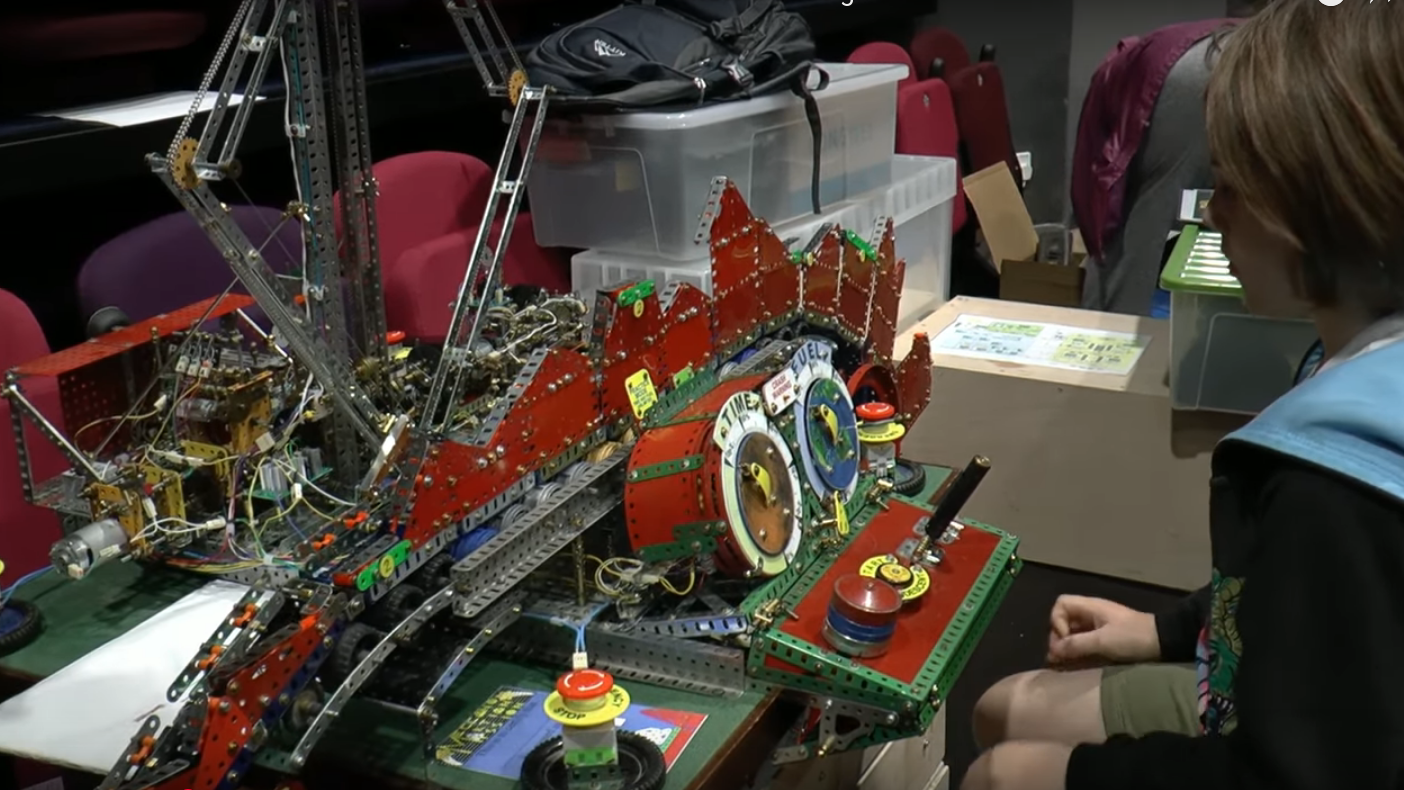
Some retro gaming projects are cool because they preserve the past. Others are cool because they look like they were assembled by a Victorian engineer who accidentally discovered arcade culture, drank three cups of tea, and said, “Yes, but what if the computer were made of gears?” Pete Wood’s Meccano Martian Mission belongs firmly in the second category.
This electromechanical Atari-inspired build recreates the spirit of Lunar Lander, the 1979 Atari arcade classic, using Meccano parts, cams, gears, dials, microswitches, potentiometers, and enough mechanical cleverness to make a modern microcontroller blush. No touchscreen. No GPU. No software patch notes. Just metal strips, rotating parts, careful calibration, and a landing craft trying very hard not to embarrass itself on Martian terrain.
The result is part arcade game, part kinetic sculpture, part STEM lesson, and part love letter to old-school engineering. It looks like steampunk because it behaves like steampunk at its best: not fake brass glued onto plastic, but visible machinery doing real work. Every lever has a job. Every gauge earns its keep. Every little motion says, “I was designed by someone who respects both play and precision.”
What Is Meccano Martian Mission?
Meccano Martian Mission is a playable, electromechanical recreation inspired by Atari’s Lunar Lander. Instead of piloting a digital lunar module on a vector monitor, the player controls a physical craft descending across a rugged scrolling Martian landscape. The challenge is familiar: manage thrust, angle, fuel, speed, and timing to land safely on marked pads. The difference is that nearly everything is achieved through mechanical and electrical hardware rather than code.
Builder Pete Wood reportedly began the project in 2015, and after years of trial, public testing, adjustment, and redesign, the machine began performing more reliably in 2024 and 2025. That timeline matters. This is not a weekend novelty build. It is a decade-long conversation between ambition and friction, with friction frequently winning by a small but annoying margin.
Like the original arcade game, the Meccano version includes a descending craft, landing zones, score multipliers, difficulty levels, a fuel gauge, a countdown timer, and a thrust flame. It even detects crashes and signals failure with theatrical flair. The original Atari game could zoom in as the lander approached the surface; the Meccano version wisely skips that feature, because sometimes genius must leave one mountain unclimbed.
Why Atari’s Lunar Lander Still Matters
Atari’s Lunar Lander was released in 1979, during a period when arcades were rapidly shifting from mechanical amusements to electronic and digital experiences. It was notable as Atari’s first vector graphics game, using sharp line-based visuals instead of blocky raster graphics. The game asked players to do something more subtle than shoot aliens or bounce a ball: it asked them to understand momentum.
The controls were wonderfully physical. A large throttle lever adjusted thrust, while buttons rotated the lander. Players had to fight gravity, conserve fuel, read altitude and velocity, and resist the urge to panic-thrust themselves into bankruptcy. In a nice little arcade-business twist, players could insert more coins to buy additional fuel. The machine was basically saying, “Congratulations, astronaut, capitalism is now part of your flight plan.”
Although Lunar Lander was not Atari’s biggest commercial hit, it helped pave the way for later vector games, especially Asteroids, which arrived the same year and became a phenomenon. In that sense, Lunar Lander was both a game and a technical bridge. It showed that a minimalist screen, elegant physics, and a tactile control scheme could create tension without visual clutter.
Meccano: The Perfect Material for Visible Engineering
Meccano has always been more than a toy. Developed from Frank Hornby’s early construction system in England and later connected historically with Erector sets in the United States, Meccano encouraged builders to think in beams, plates, axles, gears, pulleys, and fasteners. It was engineering in miniature, but not pretend engineering. A Meccano crane can lift. A Meccano gearbox can transmit torque. A Meccano clock can tick with the smug patience of a tiny mechanical professor.
That makes it an unusually good medium for a project like Meccano Martian Mission. A plastic model can show you what something looks like. Meccano can show you what something does. The holes, bolts, and exposed mechanisms invite inspection. You can trace the logic with your eyes. The machine is not hiding its thought process behind a black box; it is clanking, spinning, and switching in public.
In an era when much of our technology is sealed behind glass and adhesive, that visibility feels refreshing. A smartphone is powerful, but it does not want you to understand it. Meccano Martian Mission practically begs you to lean closer and whisper, “So that cam moves that linkage, which changes that signal, which affects the craft?” Exactly. Welcome to the club. Please bring a small wrench.
How the Electromechanical Magic Works
The beauty of this Atari-inspired Meccano masterpiece lies in its refusal to take the easy route. A modern maker could recreate Lunar Lander with a small computer, a screen, a few sensors, and a weekend of programming. That would be interesting. Pete Wood’s approach is delightfully unreasonable in the best possible way.
The project uses mechanical components such as cams and differentials alongside electrical components such as potentiometers and microswitches. These parts translate player input into motion and game-state changes. The ship rotates. The terrain moves. The thrust flame appears. The gauges respond. A crash is not merely calculated; it is detected and announced by a mechanism.
That is what makes the build feel alive. Digital games simulate systems invisibly. Electromechanical games externalize those systems. You can hear decision-making as a click. You can see stored motion in a wheel. You can sense the machine resisting sloppiness. It is not just a game about landing carefully; it is a machine that had to be built carefully in order to let you fail carefully.
Steampunk, But With Actual Function
The word “steampunk” gets thrown around a lot. Sometimes it means imaginative retrofuturism. Sometimes it means someone glued a brass gear to a hat and called it Tuesday. Meccano Martian Mission earns the label because its retro style is inseparable from its function. The project looks old-fashioned because its working principles are old-fashioned: mechanical logic, exposed structure, physical controls, visible feedback.
There is a direct line from Victorian mechanical imagination to Meccano building culture to arcade engineering. Steampunk often imagines a world where computers developed through gears and brass instead of silicon. This machine asks a wonderfully practical question: what would an Atari arcade game feel like if it had been built by a model engineer with a bench full of Meccano parts?
The answer is charming, educational, and slightly ridiculous. But ridiculous is not an insult here. Many important inventions look ridiculous before they look inevitable. A playable mechanical lander may not replace digital games, but it reminds us that interaction does not have to be invisible. Sometimes the best interface is a lever, a gauge, and a tiny flame that pops out when your imaginary spacecraft is trying not to become expensive confetti.
The Design Challenge: Translating Pixels Into Parts
Recreating a video game mechanically is harder than it sounds because video games cheat beautifully. A program can redraw terrain instantly, calculate velocity thousands of times per second, reset states, detect collisions, and adjust difficulty without breaking a sweat. A mechanical system must create equivalent behavior through physical relationships.
Consider the original Lunar Lander. The player reads altitude, horizontal speed, vertical speed, and fuel while steering over uneven ground. The game world is mathematical. In Meccano Martian Mission, those ideas must become shafts, gears, switches, rotating terrain, control linkages, and indicators. The builder has to decide which features are essential, which can be simplified, and which would cause the machine to explode emotionally if not physically.
That is why the project is so impressive. It does not merely imitate the look of a game. It captures the decision-making loop. The player still has to judge descent, conserve fuel, and choose a landing pad. The machine still rewards skill and punishes overconfidence. It preserves the drama of Lunar Lander while translating the language from vector graphics into mechanical choreography.
Why This Build Appeals to Makers and Retro Gamers
For retro gamers, the appeal is obvious. Lunar Lander is one of those classic arcade ideas that remains understandable within seconds. You do not need a tutorial, a login, or a battle pass. You see a craft, you see terrain, and you know gravity is about to become personally rude. The Meccano version keeps that simplicity while adding a new layer of fascination: the game itself becomes an object worth studying.
For makers, the build is a masterclass in problem-solving. It demonstrates that creativity is not limited to new parts or new technology. Sometimes innovation means taking old techniques seriously enough to apply them in a fresh context. Cams, switches, gears, and dials may seem outdated, but in the right hands they become a playable simulator.
For educators, the project is a gift. It can introduce physics, systems thinking, mechanical design, feedback loops, user interface design, and game history in one gloriously clattery package. Students can see that “input” does not have to mean typing, “output” does not have to mean a screen, and “programming” can exist as an arrangement of parts.
Electromechanical Games: The Missing Link in Arcade History
Before video games dominated arcades, mechanical and electromechanical amusements were everywhere. Pinball machines, shooting galleries, strength testers, helicopter games, driving games, and coin-operated novelty machines built the vocabulary of public play. Lights flashed. bells rang. relays clicked. motors spun. The arcade was already interactive before the microprocessor moved in.
That history matters because Meccano Martian Mission feels like a bridge traveling in the opposite direction. Atari’s Lunar Lander helped represent the digital future of arcade play. Pete Wood’s version pulls that future back through the electromechanical past. It is not nostalgia for nostalgia’s sake. It is a reminder that game design is older than the screen and broader than software.
The machine also highlights something modern devices often forget: physicality is fun. A real lever has drama. A moving gauge has suspense. A mechanical flame has personality. When a player fails, the failure has weight because the machine visibly responds. It is like being judged by a polite robot made of workshop leftovers.
The Humor and Humanity of a Decade-Long Build
One of the most endearing parts of this project is its stubbornness. Ten years is a long time to spend convincing metal strips to behave like a 1979 arcade cabinet. Most people abandon a hobby project the first time a screw rolls under the workbench and enters another dimension. Pete Wood kept refining, testing, showing, adjusting, and improving.
That persistence gives the build character. A finished commercial product tries to hide its history. A handmade machine carries its history in every adjustment. You can imagine the sticking switch, the unexpected rotation, the public demonstration where the machine decided to practice humility, and the later version that performed better after careful tuning.
This is why maker culture remains compelling. The final object is impressive, but the process is the real story. Every reliable motion represents earlier unreliable motions. Every successful landing is built on a small mountain of crashes, tweaks, and probably a few sentences not suitable for a family engineering magazine.
What Modern Designers Can Learn From It
Modern product designers can learn a lot from Meccano Martian Mission. First, tactile controls matter. Atari understood this with the original Lunar Lander throttle, and Wood’s machine reinforces the lesson. When the control matches the action, the player feels more connected to the system.
Second, visible feedback builds trust. A fuel gauge, timer, flame, rotating craft, and moving terrain all communicate state clearly. Good interfaces do not simply display information; they make consequences understandable.
Third, constraints can create charm. The Meccano version cannot do everything the arcade game did, but the limitations give it identity. The absence of a screen is not a weakness. It is the point. The machine becomes memorable because it solves problems in a way that feels specific, handmade, and honest.
Experience Notes: Living With a Mechanical Atari Dream
Spending time with a project like Meccano Martian Mission, even as an observer, changes how you think about games. A digital game often disappears into the moment of play. You press a button, something happens, and your brain accepts the magic. With an electromechanical machine, the magic remains visible. You play and analyze at the same time. Half of your mind wants a perfect landing; the other half is trying to reverse-engineer the mechanism before gravity wins.
The first experience is likely wonder. The machine looks familiar and unfamiliar at once. The idea of landing a spacecraft is instantly recognizable, but the physical execution feels like discovering an arcade cabinet from an alternate timeline. Instead of glowing pixels, there are moving assemblies. Instead of hidden calculations, there are mechanical relationships. It is like watching a video game take off its digital costume and reveal that underneath, it was a clockwork acrobat all along.
The second experience is respect. Anyone who has built even a simple model knows that alignment matters. A hole slightly off, a shaft under too much load, a gear meshing poorly, or a switch placed a fraction too far away can turn elegance into chaos. Now imagine coordinating a whole playable landing simulator. Suddenly, the decade-long development period does not sound excessive. It sounds realistic.
The third experience is humor. Mechanical systems have personality because their failures are dramatic. A software bug may freeze a screen. A mechanical quirk may make a spacecraft rotate without permission, wave a tiny flame at the wrong time, or announce a crash with the confidence of a town crier. That comedy does not weaken the machine. It makes it lovable.
The fourth experience is inspiration. This project encourages builders to stop asking, “What is the newest tool I can use?” and start asking, “What is the most interesting way to solve this?” Sometimes that answer will be a microcontroller. Sometimes it will be a cam. Sometimes it will be a lever attached to a linkage attached to a switch attached to a tiny moment of joy.
Finally, Meccano Martian Mission reminds us that play and engineering are not separate worlds. Play gives engineering a reason to be expressive. Engineering gives play a body. When the two meet, you get machines that teach, amuse, frustrate, reward, and endure. You also get grown adults cheering for a tiny lander as if Mars itself were waiting to issue a certificate.
Conclusion: A Masterpiece of Metal, Motion, and Imagination
Electromechanical Atari Is A Steampunk Meccano Masterpiece is more than a catchy title. It is an accurate description of a rare kind of project: one that respects arcade history, celebrates hands-on engineering, and proves that old mechanisms can still surprise modern eyes.
Pete Wood’s Meccano Martian Mission succeeds because it is not merely decorative. It works. It plays. It challenges. It translates Atari’s late-1970s spaceflight tension into a physical machine with levers, gauges, gears, and a sense of humor. In doing so, it reminds us that technology does not become obsolete simply because it gets older. Sometimes it waits patiently in a parts box until someone imaginative enough gives it a new mission.
And what a mission it is: land safely, conserve fuel, respect gravity, and never underestimate the emotional range of Meccano.