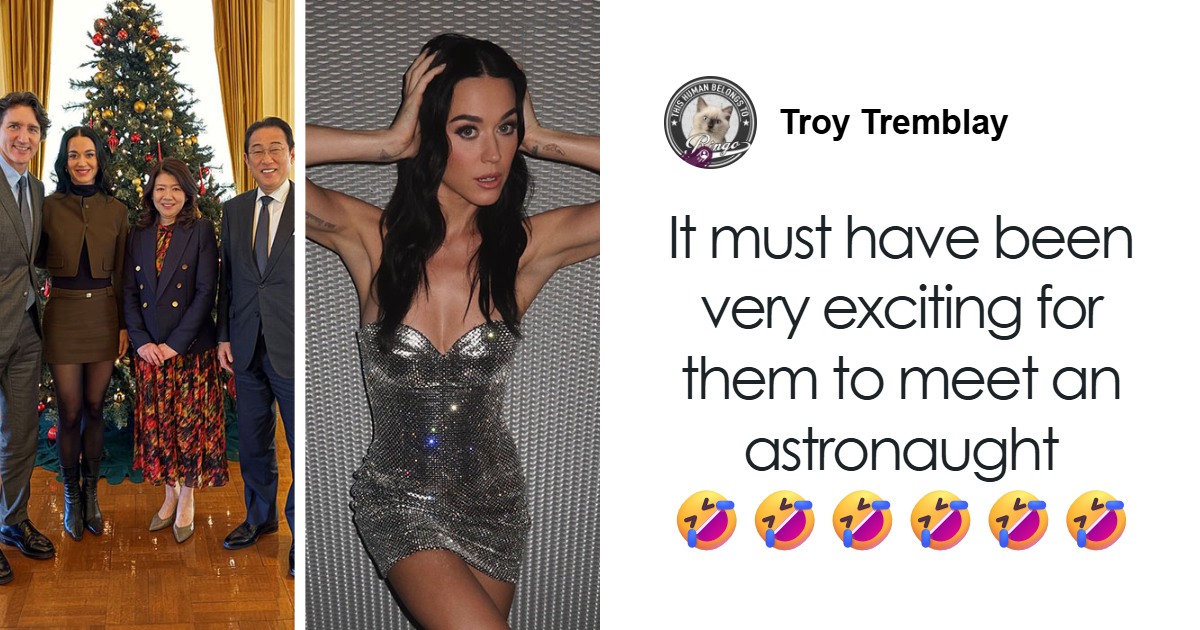
There are celebrity sightings, there are political photo ops, and then there are moments so oddly specific that the internet collectively drops its coffee and says, “Wait… what?” That is exactly what happened when Justin Trudeau and Katy Perry appeared together in Japan for a meeting with former Japanese Prime Minister Fumio Kishida and his wife, Yuko. The photo itself was polished, diplomatic, and perfectly pleasant. The reaction online? About as calm as a blender full of fireworks.
The image instantly sparked a frenzy because it looked like a mash-up no one had placed on their 2025 bingo card: a former Canadian prime minister, a global pop star, a former Japanese leader, a Christmas tree backdrop, and the kind of caption language that sent social media sleuths sprinting. For many readers, this was not just another celebrity relationship update. It was a symbol of how fame, politics, optics, and online culture now collide at full speed and with zero indoor voice.
What made the moment especially combustible was not merely the meeting itself. It was the setting, the timing, the phrasing, and the sheer unexpectedness of seeing Katy Perry step into a scene that looked less like a backstage VIP visit and more like a soft-focus diplomatic cameo. Suddenly, fans, critics, gossip watchers, and pop-culture commentators were all debating the same question: Was this just a polite lunch among prominent people, or had the Trudeau-Perry relationship entered a whole new level of public visibility?
Why This Photo Lit Up the Internet So Fast
Online frenzies usually need three ingredients: surprise, symbolism, and screenshot-worthy visuals. This story had all three. First, the surprise factor was enormous. Justin Trudeau is no stranger to public attention, and Katy Perry has spent years living under the celebrity microscope. Still, seeing them together in a quasi-diplomatic setting felt wildly different from a concert date, a dinner outing, or a paparazzi snap. The image told a bigger story without saying much at all.
Second, symbolism did the heavy lifting. A celebrity romance becomes much more headline-friendly when it drifts into the language of statesmanship, international friendship, and official-looking encounters. That is why the public reaction was so immediate. It was not simply “Katy Perry is dating someone famous.” It was “Katy Perry has now appeared in a setting that looks adjacent to global politics.” That distinction matters because optics matter more than ever.
Third, the visual itself was incredibly meme-ready. Social media thrives on contrast, and few contrasts work better than pop glamour meeting political protocol. To some users, the image looked classy and modern. To others, it seemed almost too surreal to process without jokes. That split reaction is exactly what fuels viral momentum. The internet loves a moment that can be admired, mocked, analyzed, and captioned in a dozen different tones before lunch.
The Real Story Behind the Meeting
Strip away the online chaos, and the underlying event is actually fairly straightforward. Trudeau and Perry were in Japan during a period when their relationship was already drawing public attention. During that trip, they met with Kishida and his wife. On its face, that sounds like a polished but ordinary interaction between public figures. Yet ordinary does not stay ordinary once the internet starts seasoning it with speculation.
Part of the reason the meeting mattered is that it looked like a relationship milestone. When two high-profile people appear together at a dinner, fans assume dating. When they appear together in a setting connected to a former world leader, fans assume seriousness. It may not be a legal standard, but it is certainly an online one.
That is what made the reaction so explosive. Many observers read the moment not as a random stop on a travel itinerary, but as an unofficial debut of Katy Perry in Trudeau’s public-political orbit. No one needed a formal announcement to sense that the photo was saying, “Yes, this is a real thing, and yes, we are comfortable being seen like this.” In the age of hyper-visual storytelling, that is often more powerful than a press release.
The Caption That Poured Jet Fuel on the Buzz
If the photo was the spark, the wording around it was the gasoline. Much of the online frenzy centered on the reference to Perry as Trudeau’s “partner.” That one word changed the conversation from speculative gossip to near-confirmation in the eyes of many readers. It also added a certain ceremonial polish to the relationship, as if the romance had just passed through customs and received an official stamp.
Language matters online because people do not simply read words anymore; they zoom in on them, repost them, translate them, joke about them, and build entire narratives around them. “Partner” sounded warm, serious, and publicly validating. It suggested a level of acknowledgment that fans had been waiting for, even if the delivery came through a former Japanese prime minister rather than a glossy couple’s magazine.
Trudeau’s own public response kept the story moving. By replying warmly and mentioning “Katy and I,” he helped shift the moment from rumor fog to something much clearer. He did not need to write a love poem or launch a relationship FAQ. The phrasing was enough. Once the public saw the pairing presented in that tone, the internet did what it does best: overanalyze every pixel and congratulate itself for being “there from the beginning.”
Why the Public Could Not Look Away
There is something irresistible about a story that crosses cultural lanes. A pop star and a politician already make for a compelling pairing. Add international travel, a formal lunch, and a public figure from another major country, and suddenly the story grows legs, roller skates, and its own comment section ecosystem.
People were fascinated for a few obvious reasons. One, the pairing felt unlikely. Two, both figures come with enormous name recognition but belong to totally different kinds of fame. Three, the meeting created a visual story that seemed to say more than anyone had said explicitly before. In internet terms, that is premium fuel.
There was also a larger fascination with what Katy Perry’s presence represented. Was she simply joining someone she was dating on part of a travel day? Of course. But to the public, she also became a symbol of celebrity crossing into soft diplomacy. That idea generated jokes, admiration, and some eye-rolling, all at once. The internet rarely picks one emotion and sticks to it. It prefers a buffet.
Celebrity Romance Meets Diplomatic Optics
This is where the story becomes more interesting than a standard celebrity update. Public figures do not just appear; they signify. Trudeau, even as a former prime minister, still carries the visual grammar of politics. Perry, even outside a concert venue, carries the visual grammar of global celebrity. When those grammars overlap, the public reads the overlap as meaningful, whether or not the people involved intended it to be historic.
That is why the internet response was not merely about romance. It was also about optics. Some viewers loved the elegance of it all. Others thought the moment felt overly curated. A few critics treated it like a branding exercise, while fans saw it as charming and refreshingly grown-up. That split says a lot about modern audiences: we are no longer just watching celebrity relationships unfold; we are evaluating the staging, the symbolism, and the implied message behind every appearance.
In older eras, a relationship reveal might come through a TV interview or a posed magazine cover. Today, it can arrive through a leader’s social post, a reposted thank-you message, and a cascade of reactions from people who believe they are basically unpaid publicists, crisis consultants, and body-language experts all at once.
The Timing Made the Story Even Bigger
Timing is everything in media, and this story landed at exactly the kind of moment that encourages amplification. By the time the Japan meeting circulated widely, public curiosity about Trudeau and Perry was already simmering. The audience did not need a full introduction. It needed only one strong image to move from “maybe” to “okay, this is happening.”
The timing also worked because both figures had already been navigating post-relationship public narratives of their own. That meant the audience was primed to view the photo as a major development rather than a random coincidence. Once a story fits into an existing emotional and cultural framework, it spreads faster. People understand the stakes, or at least the soap-opera version of the stakes, immediately.
Then there was the holiday-season backdrop, which somehow made the entire thing feel even more cinematic. A Christmas tree in the group photo did not just decorate the scene; it made the whole moment look like a surprise chapter from a prestige rom-com called Love, Actually, But Make It Geopolitical.
How Fans and Critics Split Into Camps
As usual, the online crowd divided into recognizable tribes. Team A found the whole thing adorable. For them, the image suggested maturity, ease, and a relationship comfortable enough to exist in public without screaming for attention. They saw two famous adults doing something sophisticated and low-key. Their response was basically: good for them, now pass the Tokyo travel itinerary.
Team B reacted with disbelief and comedy. To them, the image was less “sweet milestone” and more “how did we get here?” These were the posters making jokes about unexpected power couples, first-lady aesthetics, and alternate-universe headlines. Their tone was not always hostile; often it was the playful kind of amazement reserved for stories that seem AI-generated but somehow are not.
Team C focused on appearance, protocol, and presentation. That is always the messier corner of the internet, where style criticism, tone policing, and amateur diplomacy critiques tend to multiply. Some commenters debated whether Perry’s look matched the formality of the setting. Others thought that discussion was silly and outdated. Either way, it kept the conversation hot, because once the internet starts arguing about clothing and context, the discourse practically writes itself.
What the Meeting Says About Modern Fame
This moment reveals something bigger than one relationship headline. It shows how modern fame is no longer neatly separated into categories. Politics, entertainment, image management, international visibility, and social media now exist in one giant blender. A former head of government can post a friendly lunch photo, and within hours that image becomes celebrity news, relationship confirmation, diplomatic chatter, and meme material all at the same time.
That kind of collapse between categories is now normal. Celebrities are expected to be culturally fluent. Politicians are judged visually as much as verbally. And audiences do not passively consume these moments; they actively remix them. They turn public appearances into narratives with heroes, side characters, costume notes, and imagined subplots.
In that environment, even a modest gathering can become a global conversation. The Justin Trudeau-Katy Perry-Kishida photo was never going to remain a simple luncheon snapshot. It was too loaded with symbolism, timing, and personality. It was practically engineered for the internet, even if no one set out to engineer it.
So, Was This a Hard Launch?
Call it a soft-hard launch. Not quite a fireworks-filled relationship manifesto, but definitely more than a casual shrug. The meeting with Kishida gave the public a frame through which to view Trudeau and Perry as an established pair rather than a rumor in expensive shoes. The wording around the image made that frame even sharper. And the social response proved that audiences instantly recognized the shift.
In celebrity culture, milestones are rarely announced with legal precision. They emerge through signs: a trip, a photo, a caption, a reply, a public appearance that feels too pointed to dismiss. This Japan meeting checked nearly every box. It gave fans confirmation, gave critics material, and gave the internet one more unusual romance storyline to chew on with great enthusiasm and very little chill.
So yes, the frenzy made sense. This was not just a couple being seen together. It was a vivid little moment where pop culture, politics, and public fascination collided in a way that felt both elegant and deeply meme-able. That combination is internet gold. And once the world saw Katy Perry standing beside Justin Trudeau at a meeting with Japan’s former prime minister, there was simply no chance anyone was going to scroll past quietly.
Extra Perspective: What Moments Like This Feel Like in Real Life
There is a reason stories like this travel so quickly, and it has less to do with raw gossip than people sometimes admit. When an unexpected celebrity-political crossover happens, it creates a strange little jolt of recognition. You look at the image and think, “I know all these faces, but I never expected them in the same frame.” That surprise is fun because it briefly makes the world feel both smaller and weirder.
Think about the average scrolling experience. One minute, someone is checking sports scores or vacation reels. The next, they are staring at a polished photo of a former Canadian prime minister, a pop superstar, and Japan’s former leader. It feels like opening your fridge for a soda and finding a string quartet in there. Not dangerous, not unpleasant, just incredibly hard to ignore.
That is why public reaction often swings between fascination and comedy. People are trying to process a moment that seems meaningful but also slightly surreal. It is the same emotional rhythm that powers the biggest modern internet stories: first confusion, then jokes, then armchair analysis, then a flood of hot takes from people who suddenly speak fluent body language and diplomatic etiquette.
There is also something inherently theatrical about seeing a celebrity in a setting that looks more formal than usual. Fans project all kinds of ideas onto it. Some see growth. Some see strategy. Some see romance getting serious. Others see image management with better lighting. The truth may be simpler, but simplicity has never been social media’s favorite flavor.
For many readers, the appeal of this story is not whether they are deeply invested in Trudeau or Perry individually. It is that the pairing tells a bigger story about status, visibility, and the weird new rules of public life. Today, relationships do not merely happen; they unfold across timelines, captions, reposts, and public appearances that invite instant decoding. The audience is not sitting in the back row anymore. It is live-commenting from the stage.
There is an emotional familiarity to that, too. Most people know what it feels like when a relationship suddenly becomes more public than expected. The scale is obviously different when celebrities are involved, but the emotional shape is recognizable. There is that moment when something private starts looking official, and everyone around it reads the change before anyone spells it out. That is part of why these stories resonate. They are glamorous, yes, but they are also oddly human.
Another layer is aspirational curiosity. A Tokyo trip, a high-profile lunch, a beautifully composed group photo, and a backdrop of international familiarity all create a kind of modern fairy-tale sheen. People enjoy imagining what conversations sounded like, what the room felt like, and whether everyone was totally relaxed or hyper-aware that the internet would soon dissect every detail. The mystery fuels the fascination.
And then, of course, there is the delightfully ridiculous side of it all. A world-famous singer and a former head of government turning a lunch meeting into a viral culture event is exactly the kind of storyline that reminds us the internet still loves absurd elegance. It wants romance, but with geopolitical garnish. It wants sincerity, but also jokes. It wants a polished image and a chaotic comment section. This story delivered every one of those things.
In the end, the experience of following a moment like this is not just about celebrity news. It is about watching how quickly modern culture builds meaning from a single photo. One image becomes a relationship milestone, a style debate, a diplomacy-adjacent curiosity, and a meme in waiting. That transformation happens fast because audiences are now conditioned to search for the meta-story inside every public appearance.
So when people say the internet went into a frenzy, they are not exaggerating. A frenzy is what happens when a moment feels glamorous, symbolic, slightly bizarre, and instantly discussable. This one checked every box. And that is why the meeting did not just make headlines. It became an experience: part romance reveal, part cultural Rorschach test, and part reminder that in the digital age, even lunch can become lore.
Conclusion
The online reaction to Justin Trudeau bringing Katy Perry to meet Japan’s former prime minister was never going to be subtle. The image was too unusual, the symbolism too rich, and the public curiosity too well-fed. What could have been a simple, polite international visit instead became one of those rare internet moments that feels equal parts headline, meme, and social decoding exercise.
At its core, the frenzy came from contrast: politics and pop stardom, seriousness and spectacle, diplomacy and relationship confirmation. Whether viewers found the moment classy, surreal, funny, or all three at once, they could not ignore it. And in today’s media world, that is the real currency. A single well-timed image can say more than a dozen official statements ever could.