Before Joe Rogan became the man whose podcast could make headlines, move markets, annoy musicians, boost comedians, frustrate journalists, and swallow three hours of your day before you realized you forgot to eat lunch, he was simply a working comic trying to get stage time. That is the funny part of the Joe Rogan story: the “podcasting demi-god” did not arrive from a corporate media lab, a polished broadcasting school, or a carefully branded influencer boot camp. He came from comedy clubs, martial arts gyms, television odd jobs, cage-fighting commentary, and a stubborn belief that long conversations were more interesting than tidy interviews.
Today, The Joe Rogan Experience is one of the most recognizable podcasts in the world. Rogan has interviewed comedians, scientists, athletes, politicians, actors, entrepreneurs, fighters, authors, musicians, and people whose job titles sound like they were invented during a late-night debate about aliens. His show helped turn podcasting from a niche hobby into a cultural arena where politics, comedy, sports, health, conspiracy theories, pop culture, and business all bump elbows at the same table.
But Rogan’s rise was not a clean elevator ride. It was more like climbing a weird obstacle course built out of stand-up comedy, sitcom fame, reality TV, mixed martial arts, YouTube clips, Spotify checks, controversy, and a whole lot of “let’s just talk for three hours and see what happens.” To understand how Joe Rogan went from fairly unknown comic to podcasting’s demi-god, you have to understand the unusual combination that made him different: relentless curiosity, comic timing, niche credibility, media independence, and an audience that felt like it had discovered him before the establishment knew what to do with him.
From Boston Comedy Clubs to a Bigger Stage
Joe Rogan began his career in stand-up comedy in the late 1980s in the Boston area, a scene known for sharpening comics the old-fashioned way: in front of real crowds that did not care about your feelings, your “brand,” or your future podcast empire. Comedy was Rogan’s first identity, and it stayed central even after television, UFC commentary, and podcast fame turned him into a multi-platform figure.
That matters because Rogan’s podcasting style has always been shaped by stand-up. Comics are trained to observe, interrupt, poke, confess, exaggerate, challenge, and listen for what feels alive. A traditional journalist may enter an interview with a strict question list. A comic enters with a radar for oddness. Rogan’s best conversations often work because he sounds less like a host conducting a segment and more like the guy at the back of the comedy club who cannot let a strange idea pass without grabbing it by the collar.
The “Fairly Unknown” Years Were Actually Training
Calling young Rogan “unknown” is fair only if you are measuring him against the mega-famous podcaster he became. In comedy circles, he was building a name. On television, he was gradually getting noticed. But before the podcast era, Rogan was not yet the cultural force who could sit across from a presidential candidate, a tech billionaire, or a UFC champion and make the conversation feel like a digital campfire watched by millions.
Those early years gave him something more useful than instant fame: range. He learned how to perform, how to riff, how to bomb, how to recover, and how to keep talking when the room got weird. For a future podcaster, that is basically superhero training, except the cape is a black T-shirt and the origin story includes hecklers.
Television Made Him Familiar, But Not Yet Powerful
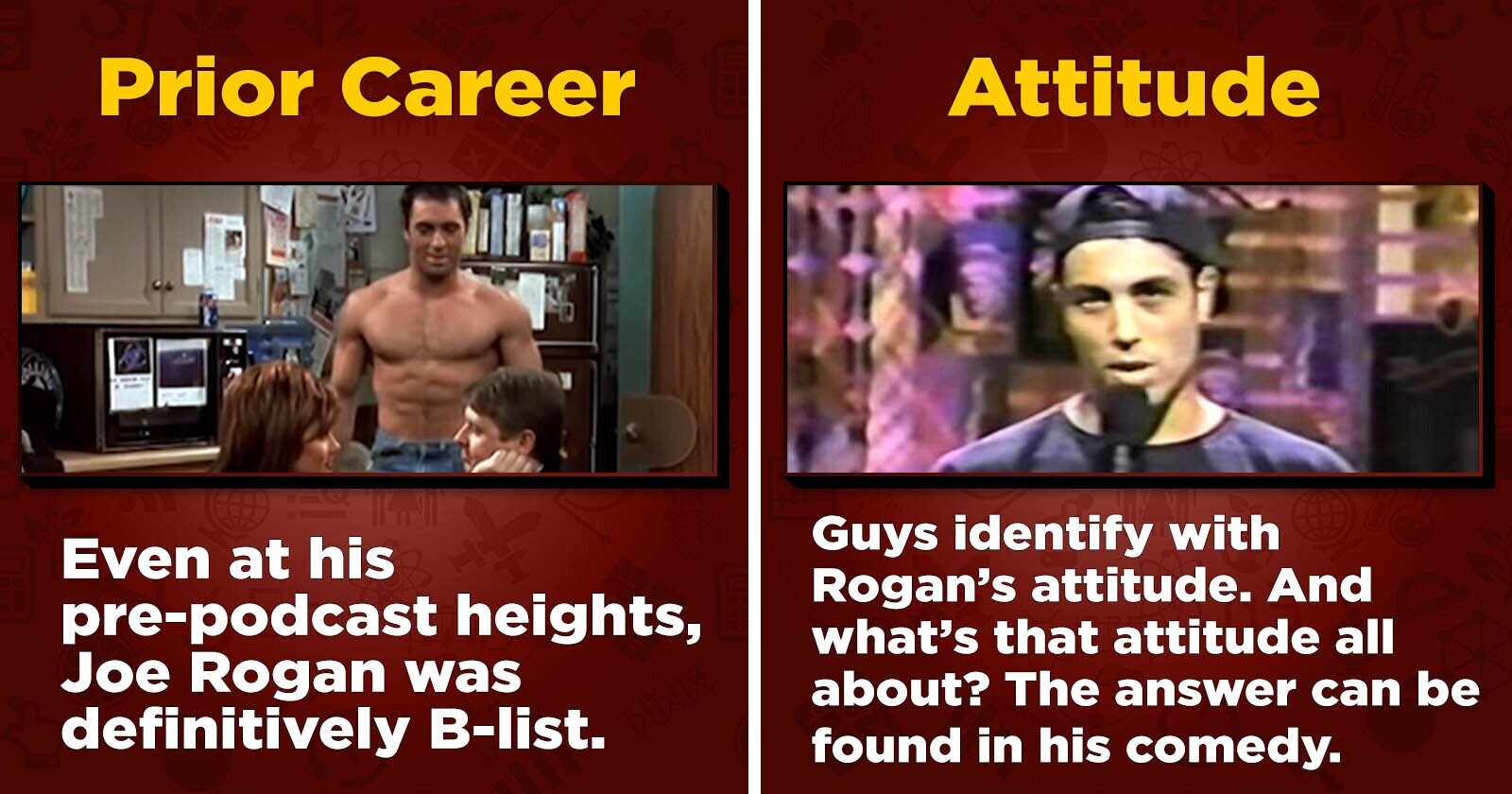
Rogan’s move to Los Angeles opened the door to television. He appeared on shows including Hardball and became widely known for playing Joe Garrelli, the electrician on NBC’s sitcom NewsRadio. That role put him in front of mainstream audiences during the 1990s, but it did not make him a household media authority. It made him recognizable in a “Hey, isn’t that the guy from that show?” way.
Then came Fear Factor, the NBC reality competition that ran during the early 2000s and asked contestants to do things that made viewers shout at the television while secretly wondering how much money it would take for them to do the same. Rogan hosted the show from 2001 to 2006, and later returned for the revival. It gave him national exposure, but it also created a strange public image. To many casual viewers, he was not yet a serious interviewer or a cultural commentator. He was the guy calmly explaining terrifying stunts while America watched people test their gag reflexes for prize money.
That could have trapped him. Many TV hosts become forever attached to one format. Rogan did the opposite. He used television fame as fuel, not as a cage. It expanded his audience, sold more stand-up tickets, and gave him a public profile. But it did not define the final version of his career.
UFC Commentary Gave Rogan Something TV Could Not: Credibility
If Fear Factor made Rogan recognizable, the UFC made him credible to a passionate, fast-growing subculture. Rogan had a serious martial arts background and a genuine fascination with fighting. He was not a celebrity parachuting into mixed martial arts for a paycheck. He understood techniques, respected fighters, and could explain the action in a way that made casual viewers smarter without making hardcore fans roll their eyes.
This became one of Rogan’s secret weapons. The UFC audience valued authenticity. They could smell fake enthusiasm the way a dog smells a sandwich through a backpack. Rogan’s excitement sounded real because it was real. When a fighter locked in a submission or changed the rhythm of a bout, Rogan could translate the moment in plain language. He brought the energy of a fan, the vocabulary of a practitioner, and the timing of a comic.
That mix later became central to Joe Rogan podcast success. His audience trusted that he did not need to pretend interest in a subject. If he cared, you could hear it. If he was confused, he admitted it. If something amazed him, he reacted like a person, not like a polished host trapped inside a media training manual.
The Joe Rogan Experience Began Like an Experiment, Not an Empire
The Joe Rogan Experience launched in 2009, when podcasting was still far from the mainstream machine it is today. Back then, many podcasts felt like internet side quests. They were looser, rougher, and less respected than radio or television. That looseness was exactly what made the format powerful.
Rogan did not need to squeeze guests into eight-minute blocks between commercials. He did not need to chase a network-approved tone. He could talk to a comedian for three hours, drift into martial arts, detour into science, argue about diet, laugh about absurd personal stories, and somehow land on the meaning of civilization before anyone remembered what the original topic was.
That format was a rebellion against traditional media pacing. In a world of quick clips, Rogan offered long-form conversation. In a world of polished interviews, he offered casual unpredictability. In a world where many hosts seemed desperate to sound correct, he sounded curious, skeptical, excited, occasionally wrong, and extremely human.
Why the Long-Form Format Worked
The magic of The Joe Rogan Experience was not simply length. Plenty of long conversations are boring enough to make wallpaper seem charismatic. Rogan’s advantage was that he made long episodes feel informal and alive. Guests were not just promoting a movie, book, fight, or campaign. They were entering a room where the conversation could wander.
This made the show feel more intimate than traditional celebrity interviews. Listeners were not just hearing answers; they were hearing people think. That is a very different experience. Sometimes it produced brilliant moments. Sometimes it produced messy ones. Either way, the audience felt present. Rogan built loyalty by making listeners feel like they were sitting at the table, not standing outside the studio window.
YouTube Turned Rogan Into a Clip Machine
Before the Spotify era, YouTube played a huge role in spreading Rogan’s influence. Clips from the podcast traveled easily. A three-hour conversation could become a ten-minute segment about artificial intelligence, comedy, fighting, history, nutrition, space, politics, or some bizarre animal fact that ruined your productivity for the afternoon.
This clip-friendly structure helped Rogan reach people who did not think of themselves as podcast listeners. Someone might discover one conversation with Elon Musk, another with a comedian, another with a scientist, and another with a UFC fighter. The show was not one lane. It was an entire highway system with occasional traffic jams caused by controversy.
That variety helped make the Joe Rogan Experience podcast unusually durable. If a listener did not care about one guest, another episode might feel made for them. Comedy fans, fight fans, politics junkies, wellness obsessives, tech bros, skeptics, libertarians, gym rats, and curious weirdos could all find an entry point. Rogan’s audience was not one tribe. It was many tribes sharing the same audio campfire.
The Spotify Deal Made Podcasting Feel Like Big Business
In 2020, Spotify announced an exclusive partnership with The Joe Rogan Experience. The move was a thunderclap for the podcast industry. Rogan had already been huge, but the deal signaled that podcasting was no longer just “radio’s scrappy internet cousin.” It was premium media real estate.
The reported size of Rogan’s Spotify deals became part of the mythology. The first arrangement was widely discussed as one of the biggest podcast deals ever. In 2024, Spotify renewed its partnership with Rogan under a new multiyear agreement, with reports placing the potential value as high as $250 million. Even more importantly, the new deal made the show available beyond Spotify again, including platforms such as YouTube and Apple Podcasts.
That shift was revealing. Spotify had once bet on exclusivity. Rogan’s renewed arrangement suggested that the future was not just about locking content inside one app, but about combining massive distribution with advertising power. Rogan had become too big to be treated like ordinary inventory. He was not just a podcast host. He was a platform inside the platform.
Controversy Became Part of the Rogan Machine
No honest article about Joe Rogan’s rise can pretend the story is all microphones, jokes, and victory laps. Rogan’s influence has repeatedly brought controversy, especially around COVID-19 discussions, disputed claims, polarizing guests, and offensive past language. The backlash reached a major point in 2022 when musicians including Neil Young objected to Spotify’s relationship with Rogan over concerns about misinformation. Spotify added content advisories for COVID-related discussions and faced intense debate over moderation, censorship, and responsibility.
For critics, Rogan’s show became an example of what happens when massive reach meets loose standards. For fans, he remained a curious entertainer willing to host conversations that mainstream outlets avoided. That tension is central to his power. Rogan is not influential because everyone agrees with him. He is influential because enough people trust the format, the vibe, or the independence to keep listening even when the show becomes the news.
In a strange way, controversy strengthened his brand among many listeners. Traditional media criticism often made his audience more protective. Each public fight reinforced the idea that Rogan existed outside the old gatekeeping system. Whether that is healthy for public discourse is a separate debate. As a media strategy, intentional or not, it made him harder to ignore.
Why Rogan Became Podcasting’s Demi-God
Rogan did not become podcasting’s demi-god because he was the smoothest interviewer. He is not. He did not become the biggest because every episode is perfect. They are not. He became dominant because he combined several rare advantages at once.
First, he had credibility in multiple worlds: comedy, UFC, television, fitness culture, and alternative media. Second, he was early to long-form podcasting and stayed consistent long enough for the culture to catch up. Third, he understood that audiences were tired of overproduced conversations. Fourth, he turned curiosity into a brand. Fifth, he built a guest ecosystem where comedians, fighters, scientists, politicians, and celebrities all had reasons to appear.
Most importantly, Rogan created a feeling. Listeners often describe the show as casual, open, and unfiltered. That feeling is difficult to manufacture. Many companies have tried to copy it with expensive studios and celebrity hosts, only to discover that buying microphones is easy and building trust is not.
The Audience Did the Marketing
One of the biggest lessons from Rogan’s rise is that his audience became his distribution engine. Fans shared clips, argued about episodes, recommended interviews, defended him online, criticized him loudly, and turned the show into a constant topic of conversation. In modern media, attention is not just gained through promotion. It is gained when audiences feel like participation gives them status.
Listening to Rogan often became part of a person’s identity. Some fans heard him as a voice of curiosity and independence. Some critics heard him as a symbol of platform irresponsibility. Both reactions kept him relevant. In the attention economy, love and outrage are different fuels, but both burn hot.
This is why Rogan’s career is so difficult to compare with older media personalities. He is not simply a radio host, comic, commentator, interviewer, or influencer. He is a hybrid figure built for the internet age, where authority comes less from institutional approval and more from repeated presence in people’s ears, feeds, conversations, and group chats.
The Austin Chapter and the Comedy Ecosystem
Rogan’s move to Austin, Texas, became another chapter in his evolution. It was not just a relocation. It symbolized a shift away from Los Angeles entertainment culture and toward a self-built media-and-comedy universe. His club, his podcast studio, his comedian network, and his UFC connections all reinforced one another.
This ecosystem matters because Rogan is not only a podcaster with guests. He is a node in a larger cultural network. Comedians appear on his show and reach huge audiences. Fighters become more familiar to casual fans. Authors sell books. Political figures reach voters who may not watch cable news. Scientists and entrepreneurs introduce ideas to people who might never read a journal article or business magazine.
That is the real power of the Rogan machine: it turns attention into opportunity. A strong Rogan appearance can become a career accelerant. In the old media world, you wanted a late-night couch. In the podcast era, for certain audiences, Rogan’s studio became the couch that mattered most.
Experience-Based Lessons From Rogan’s Rise
For creators, marketers, journalists, and anyone trying to build an audience, the Joe Rogan story offers several practical lessons. The first is that expertise is useful, but authentic obsession is magnetic. Rogan did not win because he knew everything. He won because he seemed genuinely interested in learning, arguing, laughing, and exploring. Audiences can forgive imperfect knowledge more easily than fake curiosity.
The second lesson is that format can be a competitive advantage. Rogan’s long episodes looked inefficient by old media standards. Why would anyone listen to three hours when television had trained people to expect tight segments? The answer is that long-form content creates depth, habit, and intimacy. A five-minute interview informs. A three-hour conversation can create a relationship. When listeners spend that much time with a host, the host becomes part of their routine.
The third lesson is consistency. Rogan did not publish one viral episode and vanish into the motivational-speaker fog. He kept showing up. Episode after episode, year after year, the archive became a moat. New listeners could discover old interviews. Fans could binge by topic. Guests could point to previous appearances. Consistency turned the podcast from a show into a library.
The fourth lesson is that niche credibility can become mainstream power. Rogan’s UFC work may have seemed separate from podcasting at first, but it gave him a loyal base and a language of authenticity. He knew a world deeply, and that depth made him more believable when he explored other worlds. Creators often try to start broad. Rogan’s path suggests the opposite: go deep somewhere first, then expand.
The fifth lesson is more complicated: freedom creates both opportunity and risk. Rogan’s loose format allowed unforgettable conversations, but it also created room for disputed claims, weak pushback, and reputational storms. Anyone copying his model should understand that “unfiltered” is not automatically a virtue. The larger the audience, the greater the responsibility. A small podcast can be messy and charming. A massive podcast can be messy and consequential.
From a publishing perspective, Rogan’s rise also shows why personality-driven media keeps beating faceless content. People do not return only for topics. They return for a host’s reactions, habits, worldview, humor, and flaws. That is uncomfortable for brands that want safe, interchangeable content. But audiences are human. They bond with humans, not committees.
Finally, Rogan’s story proves that modern influence is built across platforms. Stand-up gave him voice. Television gave him recognition. UFC gave him credibility. YouTube gave him discovery. Spotify gave him industry validation and enormous money. Apple Podcasts and other platforms restored wider reach. No single channel explains the whole rise. The empire worked because each stage stacked on the last.
Conclusion: Joe Rogan Did Not Break Media; He Exposed Where It Was Going
Joe Rogan’s climb from working comic to podcasting’s demi-god is not a simple rags-to-riches tale. It is a story about timing, talent, stubborn independence, audience trust, platform shifts, and the public’s hunger for conversations that feel less packaged than traditional media. Rogan did not invent podcasting, but he became its most visible proof of concept: one host, one room, one long conversation, and an audience large enough to make the media industry rethink its rules.
His career also raises hard questions. What does responsibility look like when an entertainer has the reach of a major news outlet? How should platforms handle controversial speech from their biggest stars? Why do so many people trust informal conversations more than professional interviews? Those questions are not going away, because the Rogan model is no longer an oddity. It is part of the new media landscape.
The most remarkable thing about Rogan’s rise is that it still feels unlikely. A stand-up comic, sitcom actor, reality TV host, and UFC commentator somehow became one of the most powerful voices in global audio. That sounds absurd until you remember that the internet loves hybrids. Rogan is exactly that: part comic, part fight nerd, part curious everyman, part media mogul, part controversy magnet, and part human algorithm for long conversations.
Note: This article was written from synthesized public reporting, official platform materials, and reputable media coverage. No source links are embedded in the article body so the HTML remains clean and publication-ready.