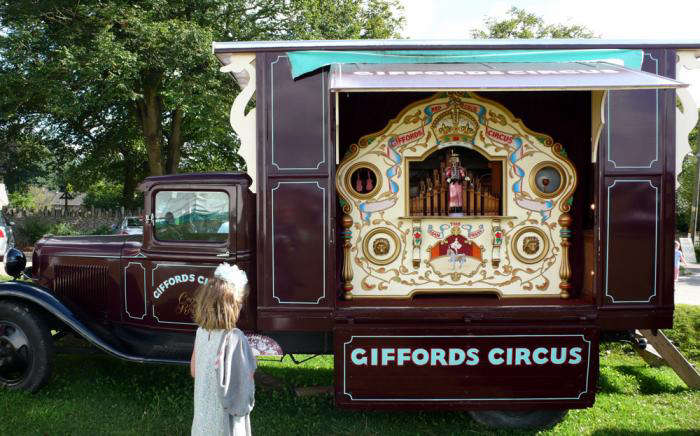
If I ran the circus, I would not begin with a boardroom, a focus group, or a spreadsheet named “Audience Delight Q3.” I would begin with a field. Preferably a slightly muddy one. I would add a painted wagon, a striped tent, a few musicians tuning up like cheerful chaos in human form, a clown who looks as though he has misplaced both his hat and his sense of caution, and the sort of suspense that makes children sit perfectly still for the first time since breakfast.
In other words, if I ran the circus, it would be Giffords.
Giffords Circus is not the biggest circus in the world, and that is exactly its superpower. It does not need stadium-sized spectacle to make people gasp. Its magic is smaller, stranger, warmer, and more handmade. It feels less like entertainment manufactured under fluorescent lights and more like a dream that learned how to pitch a tent. Founded by Nell and Toti Gifford in 2000, Giffords Circus has become one of the most beloved touring circuses in England, famous for its village-green charm, theatrical storytelling, live music, comedy, acrobatics, horses, vintage wagons, and a strong sense that something wonderful might happen before anyone has fully finished their ice cream.
This is a circus for people who still believe in wonder but prefer it with wit, skill, and good costumes. It is old-fashioned without being dusty, artistic without being snooty, and family-friendly without treating grown-ups as decorative luggage. Giffords proves that the circus does not have to be louder to be better. Sometimes it simply has to be closer to the heart.
What Makes Giffords Circus So Special?
The secret of Giffords Circus is that it understands atmosphere. Plenty of shows can produce applause. Giffords produces a feeling. From the moment visitors approach the tent, the experience begins. The wagons, the music, the performers, the rural setting, the smell of grass, the bustle of families, and the promise of a story all work together before the first act even appears.
That matters because circus has always been more than tricks. The modern circus, shaped in the 18th century by equestrian performance, acrobatics, clowning, and ring-based spectacle, has survived because it creates a temporary world. For a couple of hours, normal rules are politely shown the exit. People fly. Horses dance. Clowns fail upward. Musicians make mischief. A child discovers that gravity is not as strict as advertised.
Giffords Circus leans beautifully into this tradition while giving it a theatrical, storybook personality. It is not just “act follows act.” Each season has its own theme, mood, visual language, and emotional rhythm. The result feels closer to a traveling folk opera with tumbling than a standard variety show. That is not a complaint. Frankly, more folk operas should include tumbling.
The Nell Gifford Vision: A Circus Built from a Childhood Dream
To understand Giffords, you have to understand Nell Gifford. She grew up with ponies, imagination, and a deep love of performance. After studying at Oxford, she pursued circus life with a seriousness that only dreamers possess. Nell and Toti Gifford founded the circus in 2000, building it from modest beginnings into a celebrated touring company rooted in the Cotswolds and the English countryside.
Nell’s idea was not to create a glossy mega-circus. She wanted a village green circus: intimate, beautiful, mischievous, and full of soul. That phrase matters. A village green circus belongs to a place, even when it moves. It feels communal. It invites grandparents, toddlers, teenagers, theater lovers, horse lovers, food lovers, and anyone who secretly wants to wear a velvet jacket and call it “practical outerwear.”
Although Nell Gifford died in 2019, her creative spirit remains central to the company. Giffords continues to honor her belief that circus is not merely entertainment but an act of love. The shows carry her fingerprints: the horses, the romance, the careful visual design, the literary sparkle, the family feeling, and the stubborn refusal to become ordinary.
A Circus That Knows the Power of Place
One of the joys of Giffords Circus is where it appears. The company tours through picturesque locations, often in the Cotswolds and southern England, setting up its big top at estates, commons, gardens, and countryside venues. The locations are not just backdrops. They are part of the spell.
A Giffords performance at a country house garden does not feel the same as a show dropped into a concrete arena. The tent seems to grow out of the landscape. The wagons look as if they have rolled in from another century and parked just long enough to cause delightful trouble. The audience arrives not simply to watch a show but to enter a seasonal ritual: spring grass, summer evenings, autumn light, muddy shoes, excited children, and adults pretending they came “for the kids.”
That connection to place is a major reason Giffords has earned such loyalty. People return year after year because the circus becomes attached to memory. It is the birthday outing, the annual family trip, the date night with better snacks, the summer treat, the tradition nobody wants to skip. In a world where entertainment often arrives through a screen while you are eating toast over the sink, Giffords insists on presence. You have to be there. You have to look up.
The Giffords Style: Handmade, High-Skill, and Slightly Bonkers
Giffords Circus has a distinctive style: elegant but playful, nostalgic but alive, polished but never sterile. Its shows often blend acrobatics, clowning, aerial work, juggling, equestrian performance, live music, and theatrical design. The costumes matter. The props matter. The transitions matter. Even the awkward pauses seem to have been trained.
Comedy is one of the company’s great strengths. The best circus clowning is not just “funny man falls down.” It is timing, trust, vulnerability, rhythm, and the noble art of appearing completely doomed while being very much in control. Giffords has long understood this. Its comic tradition gives the shows human warmth. Spectacle may make an audience gasp, but comedy makes it breathe together.
Then come the physical acts: performers balancing, flipping, swinging, climbing, riding, and risking just enough to make the audience reconsider its own relationship with stairs. These acts remind us that circus is one of the few art forms where effort is visible. You see the muscle, the breath, the concentration, the split-second trust between performers. In a digital age full of edits and filters, that live risk feels refreshing. Nobody can pause the trapeze and say, “Let’s fix that in post.”
Why Giffords Feels Modern Without Losing Tradition
Modern circus has changed dramatically. Around the world, many companies have shifted away from the giant animal-heavy model that dominated popular imagination for generations. Contemporary circus often emphasizes human skill, theatrical narrative, music, design, comedy, and emotional storytelling. In the United States, even iconic brands have reimagined circus for new audiences, focusing on acrobatics, dance, BMX-style movement, highwire feats, and live spectacle without the old formula.
Giffords is different from those large-scale productions, but it belongs to the same broader conversation: What should circus be now? Its answer is wonderfully clear. Circus should be intimate. It should be artful. It should be funny. It should feel handmade. It should respect the audience’s intelligence while still giving them the pleasure of a good pratfall. It should have beauty, danger, charm, food, music, and at least one moment when everyone forgets to blink.
Rather than chasing modernity by becoming sleek and anonymous, Giffords becomes modern by being deeply specific. It knows what it is. That confidence is rare. Many brands spend fortunes trying to discover an identity. Giffords seems to have found one in a field, brushed straw off its jacket, and invited everyone in.
From “Laguna Bay” to “Waterfield”: A Circus That Reinvents Itself
Another reason Giffords Circus remains exciting is that it changes every season. A returning audience does not simply get last year’s show with a new ribbon. Each production brings a fresh theme, new acts, fresh music, and a different emotional flavor.
The 2025 show, “Laguna Bay,” celebrated the company’s 25th anniversary with a bright, stylish, theatrical energy. It drew attention for its warmth, humor, and sense of family, reminding audiences that Giffords is not just a performance company but a living creative community.
In 2026, Giffords returned with “Waterfield,” a countryside-inspired production filled with animals of the imagination, rural poetry, daring acts, and a wilder sense of adventure. The show reflects what Giffords does best: turning a simple idea into a complete world. It is not enough to say, “Here are some performers.” Giffords asks, “What if the tent became a valley, the audience became villagers, and the acts became part of a story?”
That approach makes each season feel collectible. People do not just remember that they “saw Giffords.” They remember which Giffords they saw: the colors, the music, the joke that nearly made Uncle Brian lose his lemonade, the aerial act that made everyone whisper, the horse that seemed to understand show business better than most executives.
Circus Sauce: Because Wonder Works Up an Appetite
No discussion of Giffords Circus is complete without mentioning Circus Sauce, the company’s traveling restaurant. This is the kind of detail that transforms a show into an occasion. Instead of hurrying home after the curtain call, visitors can extend the evening with a meal that feels connected to the world of the circus.
It is a smart idea because Giffords understands that memory is built around more than a ticket. People remember the whole outing: arriving early, wandering near the wagons, finding their seats, laughing together, eating together, talking about favorite acts afterward. A restaurant turns the circus from “something we watched” into “somewhere we went.” That difference is enormous.
Also, let’s be honest: acrobatics are more impressive when you are comfortably fed. Admiring a trapeze artist on an empty stomach can lead to unhealthy thoughts like, “Could I do that for a sandwich?” No, friend. No, you could not.
Why Families Love Giffords Circus
Giffords Circus is often described as family-friendly, but that phrase can be dangerously bland. It sometimes means “bright colors and mild exhaustion.” Giffords offers something better. It creates entertainment that children and adults can enjoy at the same time, for different reasons.
Children respond to the immediacy: the clown, the music, the movement, the animals, the tent, the gasp-worthy stunts. Adults notice the craft: the direction, the design, the references, the pacing, the musicianship, the emotional intelligence. Nobody has to endure the show for someone else. Everyone gets a doorway in.
That is rare. The best family entertainment never talks down to children and never forgets adults are present. Giffords succeeds because it treats wonder as a shared language. You do not need to be five years old to be delighted by a performer flying through the air. You simply need to have a pulse and a working appreciation for not falling.
What Businesses and Creators Can Learn from Giffords
Giffords Circus is not just a lovely show. It is also a masterclass in branding, audience loyalty, and experience design. Any business, creator, or event organizer can learn from it.
1. Be specific enough to be unforgettable
Giffords does not try to be every circus. It is a village green circus with a romantic, handmade, countryside soul. That specificity makes it memorable. Bland brands aim for everyone and land nowhere. Giffords aims for enchantment and hits the bullseye.
2. Make the entrance part of the experience
The show begins before the show begins. The setting, wagons, food, staff, and atmosphere all prepare the audience emotionally. Online businesses can learn from this too. Your homepage, packaging, welcome email, or waiting area is your tent entrance. Make it count.
3. Balance tradition with reinvention
Giffords honors circus history while creating new seasonal productions. That balance keeps loyal fans comfortable and curious. The lesson is simple: keep your soul, change your outfit.
4. Let humor do serious work
Comedy relaxes the audience. It makes danger more thrilling, beauty less precious, and artistry more human. Brands often underestimate humor because they confuse professionalism with emotional beige. Giffords knows better.
5. Build community, not just attendance
People do not merely buy tickets to Giffords; they return to a tradition. That is the difference between a customer and a fan. A customer pays once. A fan brings cousins.
If I Ran the Circus, Here Is What I Would Steal from Giffords
First, I would steal the intimacy. Not the wagons, obviously, because that is frowned upon and difficult to explain in court. I mean the idea that smaller can be stronger. When the audience is close enough to see a performer’s expression, every trick becomes more personal. The danger feels real. The comedy lands harder. The applause becomes a conversation.
Second, I would steal the seasonal imagination. Every year would have a world of its own: maybe a moonlit garden show, a storm-at-sea show, a picnic-gone-wrong show, or a circus set inside the dreams of a sleepy dog. The point is not novelty for novelty’s sake. The point is to give people a reason to return and a story to remember.
Third, I would steal the respect for atmosphere. I would make sure every touchpoint felt intentional, from the ticket confirmation to the signage to the music playing before the performance. Details are not decoration. Details are proof that somebody cared.
Fourth, I would steal the courage to be sincere. Giffords can be funny, cheeky, and eccentric, but it is never cynical. It believes in beauty. It believes in skill. It believes audiences still want to be moved. That sincerity is its bravest trick.
Experience Notes: If I Ran the Circus… It Would Be Giffords
If I imagine running a circus inspired by Giffords, I do not picture myself barking orders through a megaphone while wearing a suspiciously shiny jacket. I picture myself standing at the edge of a field at 7 a.m., holding coffee, wondering why a tent pole looks emotionally complicated. The glamour of circus, I suspect, is built on a heroic amount of practical labor: hauling, sweeping, repairing, rehearsing, feeding, warming up, calming nerves, and locating whatever essential object has vanished five minutes before showtime.
The experience would begin long before the audience arrived. I would want the performers to feel like artists, not props. I would want the musicians to be part of the heartbeat of the show. I would want the clown to have space to fail brilliantly. I would want the horses, handlers, technicians, cooks, ticket sellers, drivers, and costume makers to feel like members of the same strange traveling family. A great circus is not created by one star. It is created by many people making one temporary world sturdy enough for wonder to stand inside.
Then the audience would arrive, and the entire field would change temperature. Children would tug sleeves. Parents would negotiate snacks like diplomats at a sugar summit. Someone would be late. Someone would ask whether there are bathrooms. Someone would take a photo of a wagon and say, “This is so cute,” which is adult language for “I am already enchanted.”
Inside the tent, I would want the first moment to feel like a door opening. Not a loud announcement, not a desperate grab for attention, but a shift. The music begins. A performer steps into the ring. The audience leans forward. The everyday world loosens its belt and takes a break.
My Giffords-style circus would have danger, but not cruelty. It would have beauty, but not stiffness. It would have jokes that make children squeal and adults snort in a way they later deny. It would have acts that celebrate practice: the juggler who drops nothing because he has dropped everything thousands of times in rehearsal; the aerialist who looks weightless because she is unbelievably strong; the clown who turns embarrassment into architecture.
At the end, I would not want people to rush away as if leaving a parking garage. I would want them to linger. I would want them to talk about the act that scared them, the costume they loved, the song stuck in their head, the joke they will badly retell at breakfast. I would want the circus to follow them home like glitter on a coat: mildly inconvenient, impossible to ignore, and proof that something festive happened.
That, to me, is the Giffords lesson. A circus is not merely a performance. It is a memory factory with better lighting. It reminds us that skill can be joyful, tradition can be fresh, and a field can become a kingdom if the right people arrive with ropes, canvas, courage, and imagination.
Conclusion: The Circus I Would Run
If I ran the circus, I would run it like Giffords: intimate, artful, funny, generous, and a little wild around the edges. I would not chase the biggest possible spectacle. I would chase the rarest kind of entertainment: the kind that makes people feel younger without making them feel childish.
Giffords Circus endures because it understands that wonder is not outdated. It simply needs care. It needs a tent, a story, a skilled company, a few good jokes, and the nerve to believe that live performance still matters. In a distracted world, that belief feels almost radical.
So yes, if I ran the circus, it would be Giffords. There would be music in the air, mud on the shoes, laughter in the ring, and at least one moment when everyone looked up together. That is the real trick. Not flying. Not juggling. Not balancing on something no sensible person would climb. The real trick is gathering people under canvas and making them believe, for a little while, that life is stranger, funnier, braver, and more beautiful than they remembered.