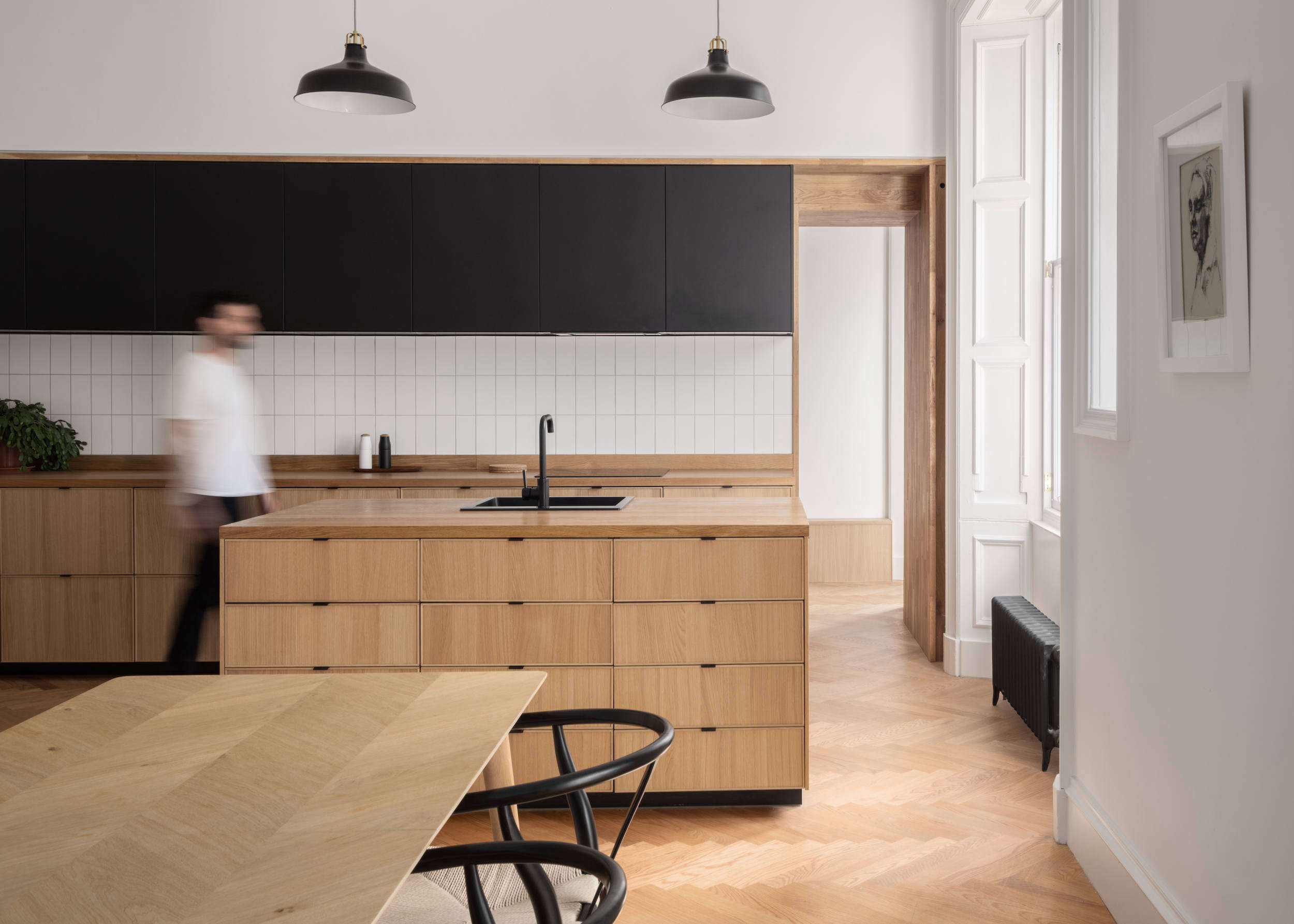
There are kitchen remodels that strut around like they own the block, dripping in marble and custom millwork, and then there are kitchen remodels that quietly whisper, “Guess how much I cost,” before leaving everyone stunned. This one belongs firmly in the second category. At first glance, the space reads like a high-design, architect-led renovation with the kind of budget that requires a deep breath and maybe a second mortgage. In reality, the kitchen came together for just $13,000, including appliances, though not labor. That number is especially wild when you consider the broader U.S. market, where even a minor kitchen remodel often lands in the five-figure range and the national average commonly floats around the mid-$20,000s and up.
So what gives? How does a kitchen end up looking tailored, calm, expensive, and thoroughly grown-up without devouring a family’s savings account? The answer is not magic. It is discipline. It is restraint. It is a refusal to blow money on the wrong things. And yes, it is a reminder that the most luxurious-looking kitchens are often less about flash and more about smart composition: strong lines, integrated storage, cohesive finishes, thoughtful lighting, and a layout that does not fight the room.
The remodel behind this story, designed by architects Luke and Joanne McClelland for their own home, has become a perfect case study in the art of the affordable kitchen remodel. Their goal was not to create a cheap kitchen. It was to recreate the qualities people associate with luxury: simplicity, symmetry, integration, and material warmth. That is a much smarter target. Cheap is a price. Luxury is a feeling. The good news for budget-conscious homeowners is that feelings are often less expensive than they look.
Why This $13,000 Kitchen Looks So Much More Expensive
1. It treats simplicity like a design feature, not a compromise
The fastest way to make a kitchen look expensive is to stop asking it to perform circus tricks. This remodel works because the composition is clean and deliberate. There is visual order. Cabinet lines are uninterrupted. Appliances are concealed. The palette is restrained. Nothing seems to be yelling for attention, which is exactly why the whole room feels polished.
That approach lines up beautifully with what U.S. designers and kitchen-industry pros keep emphasizing: homeowners increasingly want kitchens that feel calm, organic, uncluttered, and easy to maintain. In other words, the luxury look of the moment is not “more stuff.” It is “better edited stuff.” If your budget is tight, this is terrific news. Editing is much cheaper than overbuilding.
2. It uses stock cabinetry in a way that avoids looking stock
Here is the real budget hero: IKEA. In this kitchen, the cabinetry is built from IKEA components, including matte black KUNGSBACKA fronts and oak elements. That matters because stock cabinet systems can slash costs compared with custom joinery, especially in the United States, where cabinets tend to devour the biggest chunk of a remodel budget. Many U.S. estimates place cabinets, countertops, and flooring at roughly three-quarters of total spending, and cabinetry alone is often the heavyweight champion of financial regret.
But the McClellands did not just install budget cabinets and hope nobody noticed. They framed the cabinetry with oak surrounds and a stud bulkhead so the units appear recessed and custom-fitted. That single move changes the whole read of the room. Instead of “flat-pack convenience,” the eye sees architecture. It is a brilliant lesson for anyone planning a kitchen remodel on a budget: the cabinet box can be economical, but the finishing moves should be intentional.
3. It hides the practical parts
Luxury kitchens are masters of looking serene while secretly storing life’s chaos. This remodel pulls off that trick by concealing appliances within the lower cabinetry and using fronts that read as unified drawer banks even when some sections are actually hinged cupboards. The effect is subtle but powerful. A kitchen starts to feel expensive when it looks less like a workshop and more like integrated furniture.
That idea has broad relevance in the U.S. market too. Current kitchen trends continue to favor clutter reduction, integrated storage, multifunctional design, and a cleaner visual field. The less countertop chaos you see, the more refined the room feels. Translation: if you cannot afford a full custom kitchen, at least aim for custom behavior.
4. It balances dark drama with natural warmth
Matte black cabinetry can go one of two ways. It can look tailored and moody, or it can look like your kitchen is in a prolonged sulk. This space avoids the second outcome by pairing dark fronts with warm oak worktops, pale walls, and classic tile. The contrast gives the room character without making it feel heavy. It is a reminder that a budget kitchen remodel gets more mileage from contrast than from complexity.
That material mix also fits neatly with what American designers are leaning toward: wood tones, light neutrals, soft minimalism, and layered textures. The high-end look today is rarely built from one superstar material. More often, it comes from mixing affordable surfaces with one or two tactile, grounding elements that create depth.
The Smart Budget Moves That Actually Changed the Outcome
Keep the fancy feelings, not the fancy invoice
One of the most useful lessons from this remodel is that expensive-looking design is often the result of where you do not spend. In the United States, pros regularly advise homeowners to protect the budget by keeping the existing layout whenever possible. Moving plumbing, electrical lines, walls, and venting can turn a manageable remodel into a wallet-flattening event. The McClellands did open the room by knocking down a wall, but the kitchen itself still relies on efficient planning and disciplined detailing rather than a hundred high-ticket changes.
For American homeowners, that may be the biggest takeaway of all. A kitchen can feel transformed without relocating every major function. If the sink, range, and fridge are already working reasonably well, spending the money on visual refinement instead of full-scale rearrangement often produces a better beauty-to-budget ratio.
Use affordable materials where people touch them every day
The oak worktops do a lot of heavy lifting here. Wood counters bring instant warmth, tactile appeal, and a soft, custom feel that many people associate with more expensive European kitchens. They do require maintenance, but in the right kitchen they can look wonderfully rich without entering natural-stone price territory. American design sites continue to show butcher block and wood slab surfaces as reliable budget-friendly options, particularly when used strategically.
The same logic applies to hardware. Slim matte-black pulls help reinforce the kitchen’s tailored look without demanding luxury-brand pricing. Hardware is jewelry for cabinetry, and a modest hardware upgrade can rescue a very ordinary cabinet setup from looking builder-grade. It is one of the most repeated tips across U.S. shelter magazines for a reason: it works.
Spend small, look big
Another thing this remodel nails is selective emphasis. Vertical subway tile gives the backsplash a fresh, contemporary edge even though the material itself is classic and broadly affordable. In American kitchens, rectangular tile remains one of the most common backsplash choices because it is accessible, versatile, and easy to style. What changes the vibe is not necessarily the tile price. It is the installation pattern, scale, grout choice, and how far the tile extends.
This is where budget remodeling gets fun. You do not need an entire wall of imported stone to create a luxe impression. Sometimes you need ordinary tile used with uncommon confidence. That is cheaper and, frankly, more charming.
How This Remodel Compares With U.S. Kitchen Costs
Now for the part that makes American readers clutch their measuring tapes. In the U.S., average kitchen remodel costs are frequently cited around $27,000, with many homeowners spending somewhere between roughly $14,500 and $41,500 depending on scope, region, labor, and finishes. Minor remodels can still start around $10,000 to $20,000, while upscale projects can soar into six-figure territory. That makes this $13,000 kitchen, even with labor excluded, a useful benchmark in one sense and a cautionary one in another.
The benchmark is this: a genuinely elevated look is possible below the national average when the design is disciplined, the materials are chosen carefully, and stock systems are elevated through thoughtful detailing. The caution is this: American homeowners should not assume they can replicate the exact number line for line. Labor costs, permitting, demolition needs, local trade rates, and layout changes can push a similar project much higher stateside.
Still, the spirit of the remodel translates beautifully. In an American context, the same approach might mean using a stock cabinet line, investing in better door fronts or trim details, staying with the existing footprint, choosing durable but affordable countertops, upgrading lighting, and creating a tight, coherent palette. That strategy can absolutely produce an affordable kitchen remodel that feels custom, even if the final number lands north of $13,000.
The Design Lessons Worth Stealing
Symmetry makes people think “custom”
Humans love order. When cabinet widths align, handles are consistent, and the room has a clear rhythm, the brain reads quality. Custom kitchens often look expensive because they feel composed. You can borrow that effect without borrowing the custom invoice.
Concealed storage beats decorative clutter
If you want a kitchen to look high-end, let the counters breathe. Hide the microwave, stash the blender, and keep everyday gear behind doors whenever possible. A clean counter is like good posture for a room. It makes everything else look better.
Natural materials create emotional richness
Oak, wood grain, matte finishes, and tactile surfaces add visual depth. Even one natural element can stop an affordable kitchen from looking flat. In this remodel, the oak details do exactly that. They soften the black cabinetry and make the room feel lived-in rather than staged.
Lighting matters more than people think
Pendants, task lighting, and a thoughtful balance of ambient and functional illumination can make budget materials look significantly more sophisticated. Across U.S. design guidance, lighting keeps showing up as one of the best returns on a relatively modest spend. A kitchen under bad lighting is like a movie with the wrong soundtrack. Everything feels off, and nobody can quite explain why.
What Homeowners Can Learn Before Starting Their Own Budget Kitchen Remodel
If you are planning your own kitchen renovation cost strategy, the smartest first question is not, “What style do I want?” It is, “What needs to stay put?” The more you can preserve the layout, the more freedom you gain elsewhere. After that, think in layers. Cabinet system. Countertop. Backsplash. Hardware. Lighting. Paint. Storage discipline. Those are the pieces that build the expensive-looking effect.
Then decide where the room truly needs its moment. Maybe it is a warm wood island top. Maybe it is a statement light fixture. Maybe it is beautifully proportioned pulls or a full-height backsplash. Budget kitchens get into trouble when they try to make every element special. Pick two stars. Let the rest be the supporting cast. Every great kitchen needs a lead actor, but nobody needs a cast of 47 divas.
Most importantly, remember that “budget” and “beautiful” are not opposites. They are often just waiting for a grown-up design plan. This kitchen proves the point with refreshing clarity. It does not look expensive because money was thrown at it. It looks expensive because someone knew exactly what luxury was supposed to feel like and then reverse-engineered that feeling using affordable tools.
Extended Experience: What Living Through a Budget Kitchen Remodel Actually Teaches You
Anyone who has lived through a budget kitchen remodel knows the process is part strategy, part patience, and part staring at hardware samples like they hold the secrets of the universe. Projects like this $13,000 kitchen look calm in the finished photos, but the real-world lesson is messier and much more useful. A lower-cost remodel teaches you very quickly that money is not the only finite resource. Attention is finite. Energy is finite. Decision-making stamina is very, very finite.
The first emotional hurdle is usually expectation management. Once homeowners begin scrolling through dream kitchens online, budgets start developing delusions of grandeur. Suddenly everybody wants paneled appliances, handcrafted zellige, white oak cabinetry, a sculptural faucet, and a pantry worthy of a food stylist. Then the estimates arrive, and reality kicks open the door wearing work boots. That moment is not failure. It is actually the beginning of better design. The most successful affordable kitchen remodels happen when people stop asking, “How do I copy that exact luxury kitchen?” and start asking, “Which parts of that feeling matter most to me?”
The second lesson is that good planning feels almost boring, and that is a compliment. Keeping the layout mostly intact is not glamorous. Reusing appliance locations is not glamorous. Measuring twice to avoid filler-strip weirdness is not glamorous. But glamour, funny enough, often shows up at the end because of those supposedly dull decisions. Homeowners who spend carefully tend to become ruthless editors. They learn to separate “pretty” from “necessary,” and that skill usually leads to cleaner rooms.
There is also the strange psychological power of one well-chosen upgrade. In many budget remodels, the whole room turns not on a giant splurge but on a single move that sets the tone. Maybe it is painting the cabinets a velvety dark color. Maybe it is adding warm wood counters. Maybe it is swapping in a beautiful pendant that makes the room feel intentional after 6 p.m. when every countertop is covered in homework, grocery bags, and life. One upgrade with strong visual authority can convince the eye that the entire kitchen has been elevated.
Then there is the lived experience after the dust settles. That is where the hidden value of an expensive-looking, budget-conscious kitchen really shows up. People cook more when the layout works. They clean up faster when storage makes sense. They enjoy the room more when it does not feel visually chaotic. A kitchen that looks polished often behaves better too, because the design encourages order. That may be the least flashy truth in remodeling, but it might be the most important one.
And finally, budget remodels tend to make homeowners sharper for future projects. After you have debated drawer fronts, backsplash height, oiling wood counters, and whether matte black hardware is timeless or just currently photogenic, you become harder to impress and easier to please. You start noticing proportion, rhythm, and function instead of just price tags. That is a useful education. A room does not have to be expensive to feel valuable. Sometimes the best remodel outcome is not that the kitchen looks like it cost a fortune. It is that the homeowner no longer believes a fortune is the only path to a kitchen worth loving.
Conclusion
Kitchen of the Week: An Expensive-Looking Remodel for Just $13,000 is more than an eye-catching title. It is a practical blueprint for anyone chasing a luxury look on a real-world budget. The remodel succeeds because it focuses on proportion, restraint, integrated storage, warm materials, and smart cost control instead of flashy overspending. For American homeowners, the exact number may vary once labor and regional pricing enter the picture, but the principles are universal. Keep the layout as stable as possible. Use affordable cabinetry intelligently. Choose one or two materials that add warmth and texture. Upgrade hardware and lighting. Let simplicity do the heavy lifting. That is how a budget kitchen remodel stops looking cheap and starts looking confident.