Let’s get the obvious joke out of the way: necroprinting sounds like a hobby for a haunted 3D printer that only works during thunderstorms. The name is delightfully dramatic, a little gross, and practically begging for a low-budget sci-fi movie poster. But the actual science is much less “mad scientist in a castle” and much more “engineers noticed nature already built an incredible micro-nozzle.”
In simple terms, 3D necroprinting is a biohybrid manufacturing technique that uses a nonliving biological structure as part of a 3D printer. The most attention-grabbing example so far uses the proboscis of a dead female mosquito as an ultra-fine printing nozzle. Yes, the same mosquito mouthpart that ruins summer evenings can apparently help print tiny structures with impressive precision. Annoying in life, useful in death: character development at its finest.
The big idea is not to turn insects into ink, grind up bugs, or make creepy souvenirs. Necroprinting is about using biological architecture that evolution has already optimized. A mosquito proboscis is narrow, straight, strong for its size, biodegradable, and capable of handling fluid flow at microscopic scales. That makes it a surprisingly practical substitute for expensive engineered micro-nozzles used in high-resolution 3D printing and bioprinting.
What Is Necroprinting?
Necroprinting belongs to the wider world of biohybrid manufacturing, where researchers combine biological materials with engineered systems. Instead of merely copying nature’s design, necroprinting directly reuses a biological part after the organism is no longer alive. In this case, researchers harvest and prepare a mosquito’s proboscis, attach it to a printer system, and use it as the final channel through which bioink is extruded.
The term comes from the same naming neighborhood as necrobotics, a field that repurposes nonliving animal structures for robotic functions. One famous example involved dead spiders turned into pneumatic grippers. Spiders naturally move their legs using hydraulic pressure, so researchers found that applying pressure to a deceased spider’s body could open and close the legs like a tiny claw. It sounded spooky, but the engineering logic was straightforward: nature had already built a small, flexible, lightweight gripping mechanism.
Necroprinting applies that same philosophy to 3D printing. Rather than spending huge amounts of time and money fabricating a nozzle at the micrometer scale, researchers ask a practical question: has nature already made something better?
Why a Mosquito Proboscis Makes Sense
The female Aedes aegypti mosquito has a proboscis built for one very specific and irritating job: piercing skin and moving fluid through a tiny channel. For humans, that means itchy bumps and dramatic arm-slapping choreography. For engineers, it means a ready-made microfluidic structure.
A Tiny Natural Nozzle
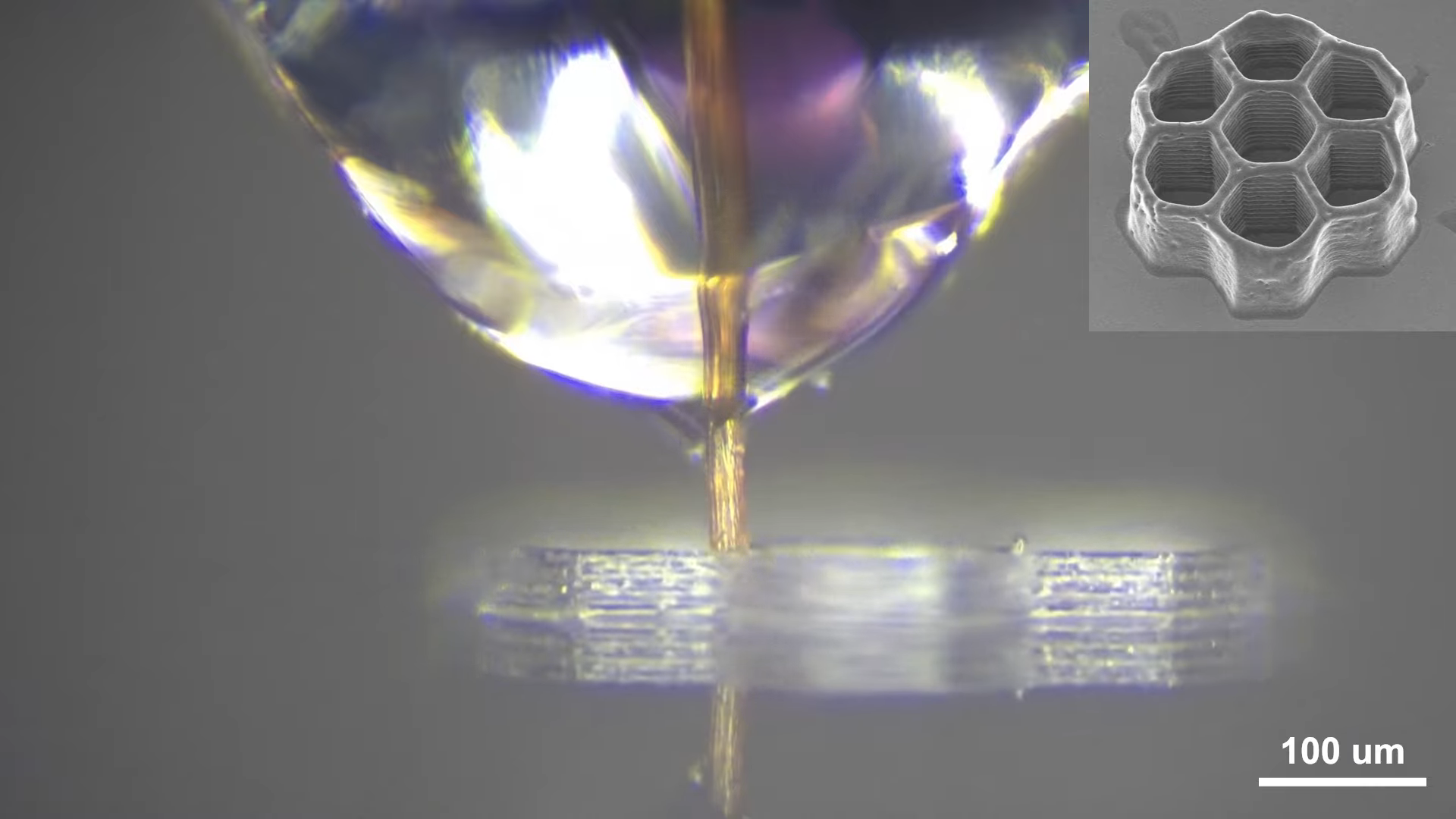
The mosquito proboscis has an inner diameter around the 20-micrometer range, roughly half the width of a very fine human hair. That is much finer than many commercial metal or plastic dispense tips used for micro-scale printing. In experiments, the mosquito-based nozzle produced lines as fine as about 20 micrometers, allowing researchers to print delicate shapes such as honeycomb patterns, maple leaf outlines, and biological scaffolds.
This matters because nozzle size directly affects printing resolution. A smaller nozzle can deposit thinner lines, which is essential for microfabrication, biomedical research, lab-on-a-chip devices, and tissue-like structures. In other words, a mosquito’s least popular feature may be useful for making things too small to appreciate without a microscope.
Strong Enough for Bioinks
Micro-nozzles need to do more than be tiny. They must also survive pressure. The mosquito proboscis can withstand internal pressure high enough for controlled extrusion of certain thick bioinks used in direct ink writing. Researchers measured rupture limits and built safe operating guidelines so the nozzle would not fail mid-print. Nobody wants a microscopic printer sneeze.
To make the proboscis usable, the team did not simply tape a mosquito to a printer and call it innovation. The process involved careful microscopic dissection, cleaning, resin reinforcement, and attachment to a custom adapter. The proboscis becomes the final precision outlet, while the surrounding engineered system provides alignment, support, and pressure control.
What Can Necroprinting Actually Print?
Necroprinting is not designed for your average desktop FDM printer. It will not replace the brass nozzle on a hobby printer that melts PLA in your garage. A mosquito proboscis would not enjoy molten plastic, and frankly, who would?
Instead, this technique is aimed at direct ink writing and bioprinting, where materials are often soft, gel-like, or cell-friendly. Researchers demonstrated the nozzle with commercially available bioinks and printed small complex structures. One important test involved bioscaffolds containing living cells, including cancer cells and red blood cells. The high cell viability reported in testing suggests that the natural nozzle can move sensitive biological materials without creating destructive shear stress.
That is a big deal. In bioprinting, the goal is often to place cells in precise patterns without damaging them. If the nozzle is too rough on the material, the final printed structure may look good but perform poorly. Necroprinting offers a possible path toward gentler, finer deposition.
Why Not Just Use Metal, Glass, or Plastic?
Commercial micro-nozzles already exist, but they come with trade-offs. Metal and plastic tips can be expensive, difficult to manufacture at very small diameters, and not biodegradable. Glass nozzles can achieve extremely fine openings, but they are fragile and can be costly or inconsistent depending on the process used to make them.
The mosquito proboscis sits in an interesting middle ground. It is not stronger than glass, and it cannot handle every material or pressure range. But it offers an unusual combination of fine diameter, flexibility, natural geometry, low cost, and biodegradability. It is the engineering equivalent of finding out the weird old tool in the junk drawer does exactly the job your expensive kit cannot.
Cost and Sustainability
One of the most compelling parts of necroprinting is the potential cost difference. High-end micro-dispense tips can be expensive, especially in research settings where nozzles may need frequent replacement. A mosquito-derived nozzle can be prepared at a far lower estimated cost when sourced from controlled laboratory colonies.
There is also a sustainability argument. Traditional nozzles are often made from metals, plastics, or specialty glass. A biological nozzle is biodegradable and derived from a natural structure. That does not mean mosquito farms are about to become the next Silicon Valley gold rush, but it does make the technique interesting for researchers trying to reduce waste in advanced manufacturing.
The “Necro” Part Sounds Worse Than It Is
The name “necroprinting” does a lot of emotional heavy lifting. It makes the technique sound darker than the actual lab work. In reality, the mosquitoes used in this research are not random backyard pests scooped from a porch light. They come from controlled laboratory sources, and the process is closer to biological materials engineering than horror-movie prop design.
There are still ethical questions worth taking seriously. Any research involving animal-derived materials should consider sourcing, humane handling, biosafety, and necessity. Even with insects, researchers should avoid the lazy assumption that small organisms require no ethical framework. That said, necroprinting is not about cruelty for novelty. It is about whether nonliving biological structures can replace harder-to-make synthetic parts in useful, responsible ways.
Where Necroprinting Could Be Useful
Necroprinting is still early-stage research, so it is not ready to transform manufacturing overnight. But it hints at several exciting directions.
Bioprinting and Tissue Research
Because the mosquito proboscis can print fine lines using bioinks, it could help researchers build more detailed cell scaffolds. These scaffolds are not replacement organs yet, but they can support studies in cancer biology, drug testing, tissue engineering, and cell behavior. The more precisely researchers can place cells and materials, the better they can mimic real biological environments.
Microfluidics
Microfluidic systems move tiny amounts of liquid through small channels. They are important in diagnostics, lab-on-a-chip devices, chemical testing, and biomedical analysis. A cheap, fine, biodegradable nozzle could make certain kinds of micro-scale fabrication more accessible.
Education and Low-Cost Research Tools
Not every lab has the budget for expensive precision tools. If biological nozzles can be standardized, sterilized, stored, and used reliably, they may help lower barriers for research groups working on micro-scale printing. That accessibility angle is one of the reasons scientists are paying attention. A mosquito nozzle will not solve every problem, but it might help more people enter the room where tiny things happen.
The Limitations Are Real
Before anyone declares mosquitoes the new kings of manufacturing, it is important to understand the limits. Biological structures vary. One proboscis may not be identical to another. Handling them requires skill, microscopes, sterilization procedures, and careful mounting. The nozzle can rupture if pressure gets too high. It is also suited to specific inks, not every printable material.
Scale is another challenge. Preparing one biological nozzle in a lab is one thing. Producing thousands with consistent geometry, strength, cleanliness, and traceability is another. Industry loves repeatability. Nature, charming as it is, enjoys variety. That means future necroprinting work will need better preparation workflows, quality control, and perhaps automated harvesting or inspection systems.
There is also the branding problem. “Necroprinting” is memorable, but it may not be the easiest term to put in a hospital procurement proposal. “Bio-derived micro-nozzle printing” sounds less like a metal band and more like something a grant committee can sip coffee over.
Necroprinting vs. Bioinspiration
Engineers have copied nature for centuries. Velcro was inspired by burrs. Airplane wings borrow lessons from birds. Sharkskin-like surfaces have influenced drag-reducing materials. Usually, this process is called biomimicry: observe nature, understand the design, then build an artificial version.
Necroprinting takes a different route. It does not imitate the mosquito proboscis; it uses the proboscis itself. That distinction is important. At microscopic scales, nature can manufacture shapes that are difficult, expensive, or fragile when humans try to recreate them. Evolution has had millions of years to refine insect anatomy. Researchers are essentially saying, “Why rebuild the tiny tube when the tiny tube is right there?”
Why This Research Is More Than a Gimmick
It is easy to laugh at necroprinting, and honestly, we should laugh a little. Science is allowed to have a sense of humor. But underneath the spooky name is a serious engineering lesson: materials do not have to come only from factories. Sometimes the best component is a natural structure that already has the required geometry, stiffness, flow properties, and environmental profile.
That does not mean every biological part should be repurposed. The value of necroprinting depends on whether it solves a real problem better than existing options. In this case, the problem is high-resolution, low-cost, potentially sustainable micro-scale printing. The mosquito proboscis offers a clever answer, even if it arrives wearing the least marketable name tag at the conference.
Experience Notes: What Necroprinting Teaches Anyone Who Has Fought a 3D Printer
Anyone who has spent time around 3D printers knows that nozzles are tiny tyrants. A regular desktop printer can behave beautifully for hours, then suddenly produce a spaghetti sculpture that looks like it escaped from a cafeteria accident. Often, the culprit is not the big machine, the software, or the grand philosophical meaning of additive manufacturing. It is the nozzle. It clogs. It oozes. It drags through the print like a stubborn shopping cart wheel. It reminds you that engineering often fails at the smallest point of contact.
That everyday experience makes necroprinting oddly relatable. The entire idea revolves around a familiar maker problem: how do you get material out of a very small opening in a controlled, repeatable way? Hobbyists deal with this at the scale of fractions of a millimeter. Researchers working with cells and bioinks deal with it at the scale of micrometers. The frustration is the same; only the microscope budget changes.
The lesson from necroprinting is that better tools do not always look more futuristic. A high-end engineered nozzle sounds impressive, but it may be expensive, wasteful, or hard to fabricate at the desired scale. Meanwhile, a mosquito proboscis looks absurd on paper and elegant under a microscope. The experience many makers learn the hard way is that usefulness beats appearance. The ugliest jig in the shop may be the one that saves the project. The weirdest adapter may be the one that finally stops the leak. In necroprinting, the weird adapter just happens to come from the world’s most disliked picnic guest.
There is also a practical mindset here: do not overbuild what nature has already solved. A maker might use a binder clip as a cable guide, a toothbrush as a cleaning tool, or a scrap of cardboard as a temporary shim. Necroprinting is that same spirit elevated into advanced microfabrication. It asks researchers to look around, question assumptions, and treat biology as a library of parts rather than merely a source of inspiration.
Of course, experience also teaches caution. A clever hack is not automatically a reliable product. Anyone who has “temporarily” fixed a machine with tape and then forgotten about it for six months knows the difference between a prototype and a system. Necroprinting still needs standardization, safe sourcing, reproducibility, and quality control. The first successful print is exciting; the hundredth identical print is engineering.
That is why necroprinting is best understood as a promising research direction, not a magic replacement for every micro-nozzle. Its value is in the question it raises: what if the next generation of manufacturing tools is not only smaller and cheaper, but also borrowed from biological structures we used to overlook? If that question leads to better bioprinting, less waste, and more accessible research equipment, then the spooky name is a small price to pay. Besides, in the long history of technology, “dead mosquito becomes precision tool” is far from the strangest chapter. It may just be one of the most useful.
Conclusion
Necroprinting is not as bad as it sounds. It is not a zombie printer, not insect ink, and not a Halloween prank from a materials science department. It is a clever form of biohybrid manufacturing that uses a dead mosquito’s proboscis as an ultra-fine 3D printing nozzle. The concept is strange, but the logic is solid: nature has already built microscopic structures that are difficult and costly for humans to manufacture.
The technique is still young, and it comes with real limitations in strength, handling, repeatability, and ethical sourcing. But it also offers a fascinating path toward cheaper, finer, more sustainable micro-scale printing. For bioprinting, microfluidics, biomedical research, and advanced manufacturing, necroprinting may become less of a creepy curiosity and more of a useful tool.
In the end, the mosquito may finally be giving something back. After centuries of buzzing in ears and crashing barbecues, it has contributed a tiny nozzle to science. That does not make mosquitoes lovable, but it does make them harder to dismiss. Sometimes innovation does not arrive with lasers and chrome. Sometimes it arrives with wings, a proboscis, and a name that sounds like it should come with a fog machine.
Note: This article is original, publication-ready content based on real scientific research and reputable technology reporting. Source links and citation artifacts have intentionally been omitted from the HTML for clean web publishing.