If you have ever dipped sushi into a bright green blob, felt your nose briefly leave your body, and thought, “Wow, wasabi is intense,” here is the spicy little plot twist: you probably were not eating real wasabi. Most of the wasabi served in American restaurants and sold in supermarket tubes is imitation wasabi, usually made from horseradish, mustard, starch, and green coloring. It delivers the familiar sinus fireworks, but it is not the same ingredient as freshly grated real wasabi.
Real wasabi comes from the rhizome of Eutrema japonicum, also known as Wasabia japonica. It is a delicate, difficult-to-grow plant from the mustard family, traditionally associated with Japanese cuisine. Fake wasabi, on the other hand, is the stunt double: cheaper, louder, greener, and much easier to mass-produce. It is not automatically “bad,” but it is different. Very different.
This guide explains real wasabi vs fake wasabi in plain English: what they are, why the imitation is so common, how to spot the difference by color, texture, flavor, price, label, and serving style, and when it is worth paying extra for the real thing.
What Is Real Wasabi?
Real wasabi is made by grating the fresh rhizome of the wasabi plant. A rhizome is an underground stem, not exactly a root, even though many people casually call it “wasabi root.” When freshly grated, it forms a pale green paste with a clean aroma, gentle heat, subtle sweetness, and a fresh, almost grassy flavor.
The heat from real wasabi is not like chili pepper heat. Chili burn comes from capsaicin and tends to sit on the tongue. Wasabi’s heat comes from volatile compounds that rush upward into the nose. That is why a strong bite feels like someone opened a tiny spicy window inside your sinuses. The sensation is sharp, but it fades quickly.
Authentic wasabi is prized because it is fragile in several ways. The plant prefers cool, shaded, humid conditions and clean water. It grows slowly, can be vulnerable to disease, and does not enjoy the kind of easy mass farming that makes grocery-store condiments cheap. Once grated, its best flavor fades fast, often within minutes. That is why high-end sushi chefs usually grate it shortly before serving.
What Is Fake Wasabi?
Fake wasabi, better described as imitation wasabi, is usually a blend of horseradish, mustard powder, starch or other stabilizers, and green coloring. Some products include a tiny amount of real wasabi powder, but many contain none at all. If the label lists horseradish first, you are dealing with the common sushi-bar version.
Horseradish and wasabi are relatives in the mustard family, so the substitution is not completely random. Horseradish can create a similar nasal burn, especially when combined with mustard. But the flavor is simpler, harsher, and more persistent. Real wasabi is more like a polite but fascinating dinner guest; fake wasabi is the friend who kicks the door open and shouts, “I brought heat!”
Imitation wasabi became common for practical reasons. It is cheaper, more stable, easier to ship, easier to store, and more predictable for restaurants. For many casual sushi meals, it does the job. The problem is that diners often believe they are eating authentic wasabi when they are actually eating dyed horseradish paste.
Real Wasabi vs Fake Wasabi: The Main Differences
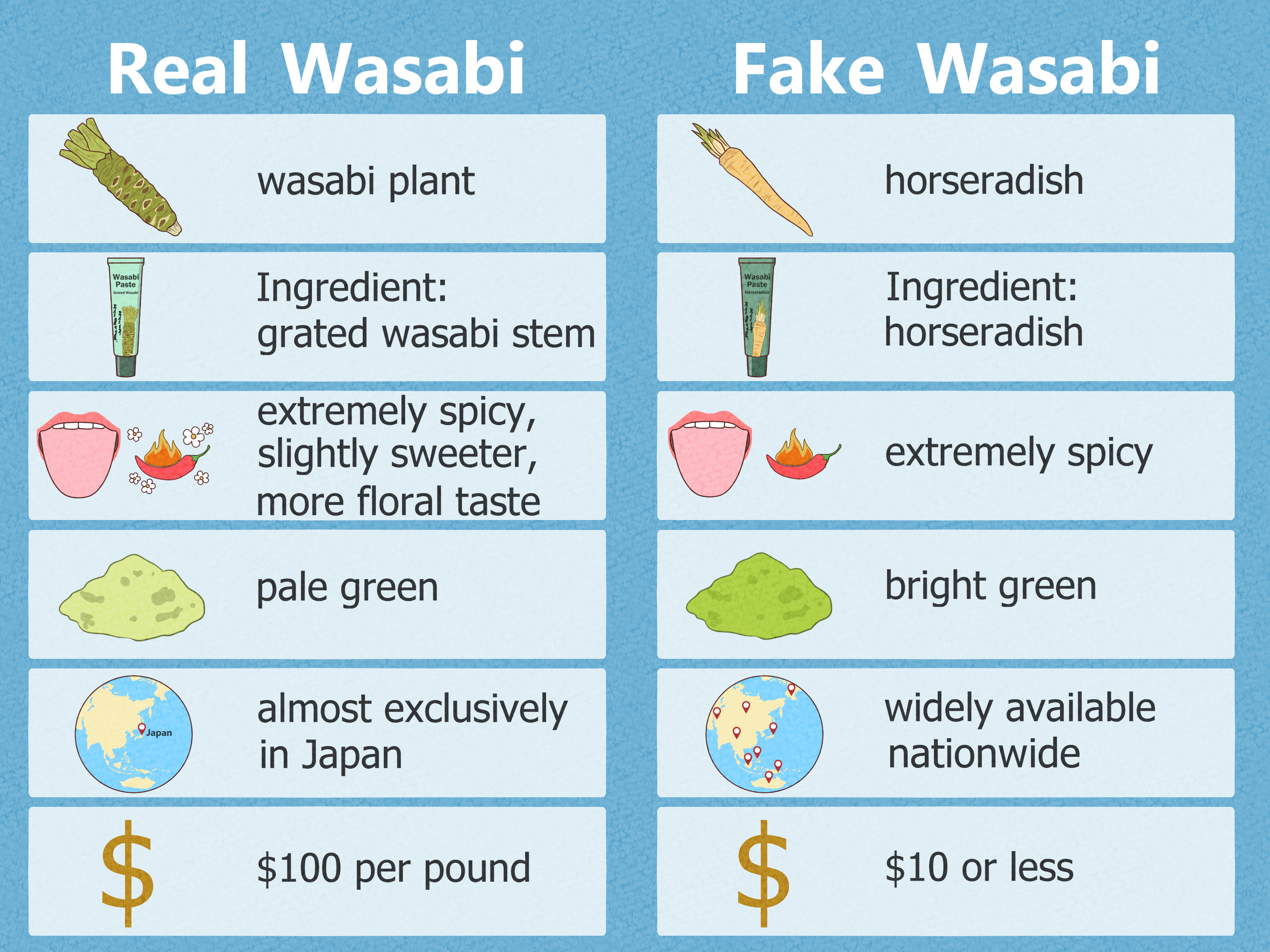
1. Color: Pale Green vs Neon Green
Real wasabi usually has a soft, natural green color. It may look pale, muted, or slightly uneven because it comes from a freshly grated plant. It should not look like it escaped from a glow-stick factory.
Fake wasabi is often brighter, smoother, and more uniform. Many supermarket tubes and restaurant portions have a bold artificial green shade because coloring is added to help the paste look like what customers expect. If the color is aggressively electric, it is probably not freshly grated real wasabi.
2. Texture: Freshly Grated vs Smooth Paste
Fresh wasabi has a lightly grated texture. It can be creamy, but it often has a delicate, fibrous feel because it is made from the rhizome itself. The texture is part of the experience. It feels alive, fresh, and slightly rustic.
Fake wasabi is usually smoother, thicker, and sometimes a little pasty or gummy. Powdered versions mixed with water may feel grainy in a different way, while tube versions can feel like spicy toothpaste. If it squeezes out perfectly from a tube and keeps its shape for a long time, it is probably imitation or a blended product.
3. Flavor: Complex and Brief vs Harsh and Lingering
This is the most important difference. Real wasabi has a layered flavor: fresh, herbal, lightly sweet, and aromatic. The heat rises quickly and fades quickly. It should enhance sushi, sashimi, soba, grilled meats, vegetables, and sauces without bulldozing everything on the plate.
Fake wasabi hits harder and often lasts longer. It can taste sharper, more bitter, and more mustard-forward. The heat may feel exciting, but it is usually less refined. If the paste dominates your bite so completely that the fish might as well be wearing a witness protection disguise, you are probably eating imitation wasabi.
4. Ingredients: One Plant vs A Small Green Committee
The easiest way to tell the difference is to read the ingredient list. Real freshly grated wasabi should be just wasabi. Packaged authentic products may contain wasabi plus small amounts of stabilizers, but the label should clearly mention real wasabi, wasabi rhizome, Eutrema japonicum, or Wasabia japonica.
Imitation wasabi often lists ingredients such as horseradish, mustard, cornstarch, tapioca starch, soybean oil, sorbitol, turmeric, spirulina, artificial colors, or blue and yellow dyes. If horseradish is the first ingredient, the product is horseradish-based. That does not mean it is unusable; it simply means it is not the real thing.
5. Price: Special Occasion vs Everyday Condiment
Real wasabi is expensive because the plant is slow and picky. It needs very specific growing conditions, careful handling, and a patient grower. Fresh rhizomes can cost dramatically more than prepared tubes or powdered imitation wasabi.
So if a sushi restaurant gives you a large mound of “wasabi” for free with a lunch special, that is a clue. Real wasabi is typically served in smaller portions, often grated to order, and sometimes listed as an upgrade. When real wasabi appears on a menu, the restaurant usually wants you to know, because it is a selling point.
6. Serving Style: Grated Fresh vs Scooped From the Back
At restaurants serving authentic wasabi, you may see the rhizome grated on a fine grater before service. The chef may place a small amount directly between fish and rice or serve it beside sashimi. Because fresh wasabi loses its punch quickly, it is treated with care.
Fake wasabi is often pre-mixed, scooped, piped, or placed in packets. It is convenient and consistent, which is exactly why restaurants use it. If your wasabi arrives in a plastic packet next to soy sauce, no detective hat is required. It is imitation.
Why Is Real Wasabi So Rare?
Real wasabi has a reputation for being one of the fussiest crops in the culinary world. It prefers shade, cool temperatures, moisture, and excellent drainage. It does not like too much heat, too much sun, or careless farming. In traditional growing systems, wasabi is often associated with clean, flowing mountain water.
That pickiness limits supply. Even growers outside Japan who successfully cultivate real wasabi must manage temperature, humidity, water quality, pests, and disease. The crop can take roughly two years or more to develop a desirable rhizome. Compare that with horseradish, which is much easier to grow and process, and the economics become obvious.
Restaurants also care about consistency. A tube of imitation wasabi stays stable, costs less, and can be portioned quickly. Fresh wasabi needs special storage, quick use after grating, and customers willing to pay for the difference. That is why imitation became the default in many American sushi restaurants.
How to Read a Wasabi Label Like a Pro
Shopping for wasabi can feel like reading a tiny green mystery novel. The front of the package may say “wasabi,” but the ingredient list tells the truth.
Look for terms such as “real wasabi,” “hon wasabi,” “wasabi rhizome,” Eutrema japonicum, or Wasabia japonica. If those appear near the beginning of the ingredient list, the product may contain a meaningful amount of real wasabi. If they appear near the end, the amount may be small.
Now look for horseradish. If horseradish is the first ingredient, the product is mostly horseradish. Mustard powder and starches are also common in imitation wasabi. Green coloring may appear as artificial color, spirulina, turmeric, or other color sources. Again, imitation wasabi is not automatically terrible. It can be delicious in its own bold way. Just do not buy a kazoo and expect a violin concerto.
Does Real Wasabi Taste Better?
For most people, yes, real wasabi tastes better when it is fresh and used properly. It is less aggressive and more elegant. It adds fragrance and lift rather than just heat. With fatty fish such as tuna or salmon, real wasabi cuts richness without smothering the flavor. With white fish, scallops, or soba noodles, it adds brightness without turning the dish into a dare.
However, fake wasabi has its place. Many people grew up with that sharp horseradish-style burn and genuinely enjoy it. It is also affordable, easy to find, and useful in sauces, marinades, dressings, deviled eggs, mashed potatoes, burgers, and snack dips. The goal is not to shame fake wasabi. The goal is to know what you are eating and choose intentionally.
Best Uses for Real Wasabi
Fresh real wasabi shines when the food is simple. Try it with sashimi, nigiri, cold soba, grilled steak, seared tuna, roast beef, oysters, or lightly cooked vegetables. It also works beautifully in small amounts stirred into butter, mayonnaise, vinaigrette, or crème fraîche.
The key is restraint. Real wasabi is not meant to be shoveled onto food like green mashed potatoes. Use a small amount and let it support the dish. Think of it as a flavor spotlight, not a leaf blower.
Best Uses for Fake Wasabi
Imitation wasabi is better when you want punch, convenience, and affordability. Mix it into mayo for sandwiches, add it to salad dressing, blend it into mashed avocado, stir it into cocktail sauce, or use it in a marinade for grilled chicken or tofu. It can also wake up noodles, rice bowls, roasted vegetables, and snack mixes.
Because imitation wasabi is usually stronger and saltier, start small. You can always add more. You cannot easily remove it once your sauce tastes like a dragon sneezed into it.
Quick Checklist: How to Tell Real Wasabi From Fake Wasabi
- Check the color: Real wasabi is usually pale or muted green; fake wasabi is often bright green.
- Feel the texture: Real wasabi is freshly grated and slightly fibrous; fake wasabi is often smooth, thick, or pasty.
- Taste the heat: Real wasabi is aromatic and short-lived; fake wasabi is sharper and lingers longer.
- Read the label: Real wasabi should list wasabi rhizome or the scientific name; fake wasabi often starts with horseradish.
- Notice the price: Real wasabi costs much more and is rarely served in large free portions.
- Watch the service: Fresh grating is a strong sign of authenticity; packets and tubes usually mean imitation.
Common Myths About Wasabi
Myth 1: All Green Wasabi Paste Is Real Wasabi
Nope. Color alone means very little. Many imitation products are colored green to look like wasabi. Always check flavor, texture, price, and ingredients.
Myth 2: Fake Wasabi Is Dangerous
For most people, imitation wasabi is simply a horseradish-based condiment. It is not dangerous when eaten normally, though people with allergies or sensitivities should always read labels. The bigger issue is transparency, not panic.
Myth 3: Real Wasabi Should Burn Like Crazy
Actually, real wasabi is usually more delicate than fake wasabi. It has heat, but it should not feel like culinary punishment. If the burn is harsh, bitter, and long-lasting, horseradish and mustard are probably doing most of the work.
Personal Experiences: What Real Wasabi Teaches You Once You Finally Try It
The first time someone tries real wasabi after years of eating the imitation version, the reaction is often confusion. Not disappointment, exactlymore like the brain is trying to update old software. You expect a blast of green thunder. Instead, you get something quieter: fresh, fragrant, slightly sweet, and sharp for only a moment. It does not attack the sushi. It shakes its hand.
One of the easiest ways to understand the difference is to taste both side by side. Put a tiny amount of common tube wasabi on one spoon and freshly grated real wasabi on another. Smell them first. The imitation usually smells stronger in a blunt, horseradish-like way. The real wasabi smells greener and more botanical. It may remind you of cut stems, herbs, mustard greens, or even a clean garden after rain. That sounds dramatic, but food people are allowed to be a little dramatic. It is in the contract.
Then taste a small amount. The fake wasabi usually jumps out fast. It gives you the familiar nose rush and may leave a mustardy aftertaste. The real wasabi rises quickly, then steps back. The flavor does not hang around trying to win an argument. This is why real wasabi pairs so well with high-quality fish. It lets the fish remain the main character.
At a sushi counter, real wasabi also changes how you eat. Instead of mixing a green lump into soy sauce until it becomes a swampy potion, you start using smaller amounts. A good chef may place wasabi between the fish and rice, balancing it with the fish’s fat, temperature, and texture. With real wasabi, less is often more. With fake wasabi, more is often just more.
Buying real wasabi for home use can be fun, but it requires realistic expectations. A fresh rhizome is expensive and perishable. You need to store it carefully in the refrigerator, grate only what you need, and use it quickly. The experience feels special, almost ceremonial. It is not the condiment you absentmindedly squeeze onto leftovers while standing in front of the fridge at midnight. That job still belongs to the tube.
Still, even one taste of the real thing can make you a smarter shopper. You begin to notice labels. You notice when “wasabi” actually means “horseradish with ambition.” You notice that some restaurants proudly mention real wasabi, while others quietly serve the standard paste because that is what most customers expect. And honestly, both can be enjoyable. The win is knowing the difference.
Conclusion: Real Wasabi Is Subtle, Fake Wasabi Is Loud
The difference between real wasabi and fake wasabi comes down to plant, price, flavor, texture, and honesty. Real wasabi is freshly grated from the rhizome of Eutrema japonicum. It is pale green, aromatic, lightly sweet, and short-lived in heat. Fake wasabi is usually made from horseradish, mustard, starch, and coloring. It is brighter, cheaper, stronger, and more common.
If you love the classic sushi-bar burn, there is nothing wrong with enjoying imitation wasabi. But if you want to experience the elegant side of Japanese wasabi, look for fresh grating, muted color, a short clean heat, and a label that clearly identifies real wasabi. Once you know the clues, the green paste on your plate becomes less mysteriousand your sushi nights get a lot more interesting.