Note: This article is a rewritten, source-informed synthesis based on a publicly shared viral family story and broader holiday etiquette, gift-giving, and family-stress research.
Every family has at least one Christmas story that gets replayed like a holiday classic. Some families have the “burned turkey” story. Others have the “uncle fell asleep in the mashed potatoes” story. And then there are the elite few blessed with a tale so petty, so ridiculous, and so perfectly wrapped in seasonal chaos that it deserves its own ornament.
This is one of those stories.
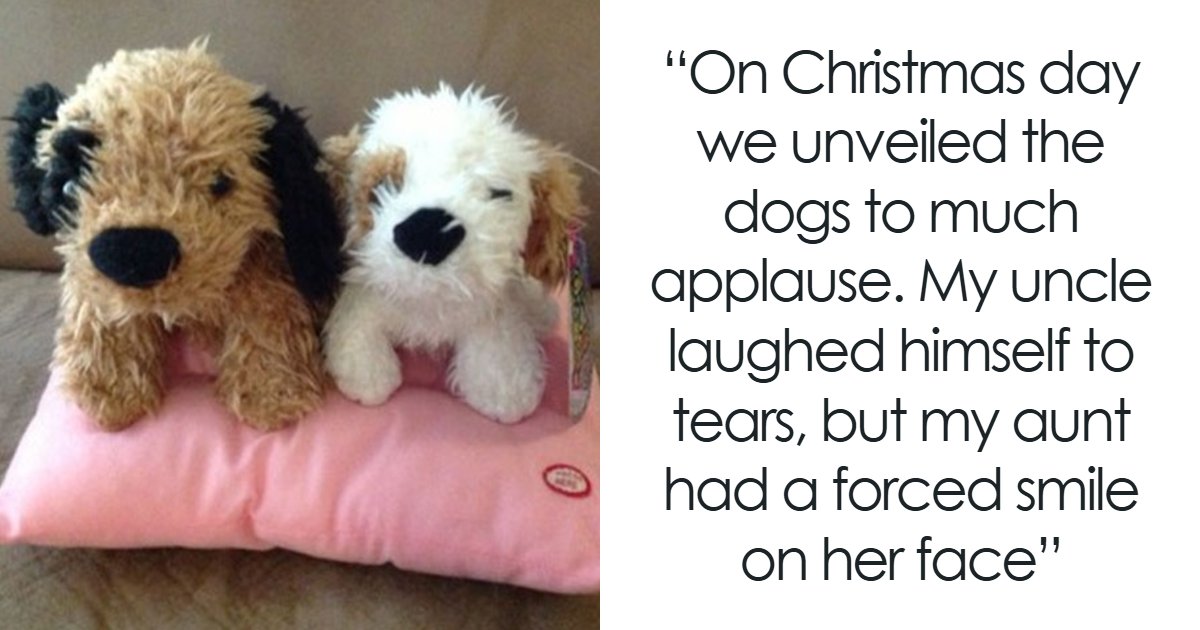
In a viral online account, a dad with a sharp sense of humor bought his wealthy sister and brother-in-law a pair of vintage animatronic singing dogs from a charity shop. The gift was silly, affordable, and clearly chosen with laughter in mind. The uncle reportedly loved it. The family laughed. Even the cat got involved by trying to attack the musical dogs mid-performance, which, frankly, sounds like the most authentic Christmas entertainment money can’t buy.
The aunt, however, was not amused. According to the story, she was wealthy, serious, and not exactly known for appreciating her brother’s lower-budget gifts. Instead of politely accepting the present, she allegedly snuck the dogs back into the family’s car before they left. The dad discovered them only after arriving home. Many people would have been hurt, angry, or tempted to send a ten-paragraph family group chat essay. This dad chose art.
He packed the singing dogs into an empty luxury beauty-product box, mailed them back to his sister, and included a handwritten note: “A dog is for life, not just for Christmas.” Somewhere, Santa’s sleigh made room for one more petty legend.
Why This Petty Christmas Revenge Story Went Viral
The reason this rich aunt and cheap gift story caught so much attention is simple: it combines three things the internet loves deeplyfamily drama, poetic justice, and a punchline that arrives wearing a festive bow.
At its core, the story is not really about singing dogs. The dogs are hilarious, yes. They are the fuzzy, battery-powered stars of the show. But the emotional engine is the contrast between two siblings with very different lives. The dad, as described by the storyteller, had financial struggles and physical disability, yet remained optimistic and playful. The aunt, by contrast, was said to be wealthy and dismissive, especially around Christmas when gifts became an uncomfortable reminder of class differences.
That tension is what makes the dad’s response feel satisfying. He did not yell. He did not demand an apology. He did not buy something expensive to prove himself. Instead, he used the exact same gift to expose the absurdity of the situation. The aunt tried to quietly erase the present. The dad turned it into a delivery with dramatic presentation. If petty revenge were an Olympic sport, this would at least earn a bronze medal and a seasonal cookie.
The Real Lesson: A Cheap Gift Is Not Always a Thoughtless Gift
One of the biggest mistakes people make during the holidays is assuming that price equals thoughtfulness. It does not. A gift can be expensive and lazy. A gift can be cheap and deeply personal. A gift can also be two singing dogs from a charity shop that make everyone laugh until the cat questions its life choices.
In this case, the dad reportedly chose the animatronic dogs because he knew the uncle would find them funny. That matters. The present had a target audience. It had personality. It had a built-in performance. It was not glamorous, but it was memorable. Years later, the family was still laughing about it, which is more than most luxury candles can claim.
The problem came from the aunt treating the gift as an insult rather than a gesture. Holiday etiquette experts often emphasize that the spirit of gift-giving is generosity, gratitude, and connectionnot proving your income bracket through wrapping paper. When someone gives a present with good intentions, the gracious response is usually to thank them, even if the item is not exactly your dream possession.
That does not mean everyone must keep every unwanted gift forever. Nobody needs to build a shrine to a sweater that itches like a cactus. But sneaking a gift back into someone’s car crosses from “I don’t have space for this” into “I reject your thoughtfulness with stealth technology.” That is where the dad’s revenge becomes funny instead of mean.
Gift-Giving, Money, and the Holiday Pressure Cooker
Christmas has a magical way of making ordinary family tension wear a glitter hat. Money, expectations, old sibling rivalries, and social comparison all show up at the table next to the cranberry sauce. That is why gift exchanges can feel emotionally loaded, especially when relatives have very different financial situations.
Many Americans still see gifts and family gatherings as major parts of Christmas tradition. At the same time, holiday spending can create real pressure. Food, decorations, travel, cards, tips, and presents all add up quickly. When one family member can afford lavish gifts and another cannot, the exchange can stop feeling festive and start feeling like a public performance review.
That appears to be the emotional background in this story. The dad could not compete with expensive gifts, so he leaned into humor. The aunt seemed to expect something more polished. The result was a holiday clash between two definitions of value: one based on price and presentation, the other based on personality and shared laughter.
Why the Luxury Box Was the Perfect Move
The dad’s revenge worked because it used expectation against itself. A luxury beauty box suggests elegance, expense, and maybe a cream with a name so fancy it sounds like a French moon colony. The aunt opened it expecting something upscale. Instead, she got the exact same singing dogs she had tried to return.
That packaging choice made the prank sharper without making it cruel. The dad did not damage her property. He did not embarrass her in front of a crowd. He simply sent the gift back in a way that forced her to experience the same moment twiceonce as rejection, once as comedy.
The handwritten note sealed the deal. “A dog is for life, not just for Christmas” is a classic animal-welfare phrase, but in this context it became a perfect joke. The dogs were not alive, of course. They were animatronic. But the message was clear: you cannot just abandon these festive little weirdos in someone else’s car and expect no consequences.
Was the Dad Right, or Was Everyone Being Petty?
The best viral family stories work because they invite debate. Was the aunt rude? Absolutely, as presented in the story. Was the dad petty? Also yes. Was his pettiness proportionate, funny, and oddly elegant? Very much yes.
The dad’s response lands well because it matches the scale of the offense. He did not escalate into cruelty. He simply returned the return. That is why readers loved it. It was not revenge designed to destroy a relationship; it was revenge designed to make a point with a wink.
Still, there is a practical lesson here for real families. If you receive a gift you dislike, do not sneak it back into the giver’s belongings like a raccoon with social anxiety. Say thank you. Keep it for a while. Donate it later if appropriate. If the gift is large, expensive, or impossible to use, have a private conversation that focuses on appreciation first. The goal is to protect the relationship, not win a hidden-object game called “Where Did Aunt Carol Put the Singing Dogs?”
How To Handle a Gift You Secretly Hate
Most people have received at least one gift that required emergency acting skills. Maybe it was a shirt in a color not found in nature. Maybe it was a decorative object shaped like an anxious frog. Maybe it was a kitchen gadget that assumes you have both counter space and ambition. The key is to respond with kindness.
First, thank the person for thinking of you
You do not have to lie and say, “This is exactly what I wanted since childhood.” A simple, warm thank-you is enough. Focus on the gesture: “That was thoughtful of you,” or “I appreciate you thinking of me.”
Second, avoid public rejection
Even if the gift is not your style, rejecting it in front of others can embarrass the giver. The rich aunt’s mistake, according to the viral account, was not just disliking the dogs. It was trying to secretly dump them back onto the giver’s family, which turned a private preference into a public character flaw.
Third, be honest only when honesty helps
If a gift is expensive, duplicate, unsafe, or impossible to use, a gentle conversation may be appropriate. But for smaller gifts, discretion is usually kinder. Not every unwanted item needs a courtroom hearing.
Fourth, remember that regifting has rules
Regifting can be acceptable when the item is unused, appropriate for the new recipient, and not personal or sentimental. But passing along a gift just to get rid of it usually shows. People can smell low-effort gifting through three layers of tissue paper.
Why Funny Gifts Often Become Family Legends
The irony of this story is that the aunt may have rejected the cheapest gift, but it became the most valuable one in memory. Expensive gifts often disappear into closets, drawers, and credit-card statements. Funny gifts become folklore.
A novelty present works when it is chosen with the recipient’s humor in mind. In this case, the uncle reportedly laughed until he cried. That means the dad succeeded with at least half the couple. The singing dogs created a shared moment. The cat attack added bonus choreography. The aunt’s refusal accidentally upgraded the whole thing from “funny Christmas gift” to “family legend.”
This is why families should make room for playful gifts. Not every present has to be practical. Sometimes the best gift is not the one that improves your life, but the one that gives everyone a story to retell. A pair of singing dogs may not match the curtains, but they can outlive a luxury soap set in family memory.
Experience Section: What This Story Teaches About Real Holiday Gatherings
Anyone who has survived a big family Christmas knows that gifts are rarely just gifts. They carry expectations, history, pride, insecurity, and occasionally batteries that should have been removed before dinner. The rich aunt and petty dad story feels exaggerated because it is funny, but the emotions behind it are very familiar.
In many families, there is one person who gives expensive presents and expects everyone to react like a game-show contestant. There is another person who gives smaller, quirkier gifts and hopes the thought will count. Trouble starts when those two people measure love using different rulers. One sees generosity as money spent. The other sees generosity as time, humor, or personal meaning.
The best holiday experiences happen when families talk about expectations before the wrapping paper comes out. A simple spending limit can prevent awkward comparisons. A Secret Santa exchange can help large families avoid gift overload. Wish lists can reduce guessing. Handmade or thrifted gifts can be wonderful when everyone agrees that creativity counts. The goal is not to remove joy from gift-giving; it is to remove the silent competition that makes people feel judged.
This story also shows the power of responding with humor instead of resentment. The dad could have let the insult ruin Christmas. Instead, he turned it into a joke his family still enjoys. That does not mean every rude moment deserves a prank. Some situations need a direct conversation. But when the offense is small, absurd, and safely reversible, humor can keep bitterness from taking over.
There is also a useful boundary lesson here. Accepting a gift graciously does not mean surrendering your home to every object ever handed to you. People are allowed to donate, store, exchange, or quietly rehome things they cannot use. But kindness matters. If someone gives you a goofy gift with love, do not make them feel small for not spending more. And definitely do not sneak the item into their car unless you are emotionally prepared to receive it again in a box that looks more expensive than your entire skincare routine.
For gift-givers, the lesson is just as important. Know your audience. A joke gift is best when the recipient enjoys that kind of humor. If someone is extremely serious, a singing dog duo may not land. But in this story, the dad knew the uncle would love it, and the family did. That makes the aunt’s rejection feel more like snobbery than simple mismatch.
For receivers, the lesson is timeless: gratitude is free, portable, and always in season. You do not need to adore every present. You do not need to display it on your mantle until the end of civilization. But a little grace can save everyone from unnecessary drama.
Ultimately, this petty Christmas revenge story is funny because it is small enough to laugh at and sharp enough to remember. It reminds us that family holidays are not perfect magazine spreads. They are messy, loud, emotional, and occasionally scored by animatronic dogs. The best people at the table are not always the richest or the most polished. Sometimes they are the ones who can take an insult, wrap it in a luxury box, add a note, and deliver the final punchline with style.
Conclusion: The Gift That Came Back With a Bark
The tale of the rich aunt, the cheap gift, and the dad’s petty Christmas revenge works because it flips the usual holiday script. The expensive-looking box was empty of luxury but full of meaning. The “cheap” gift became priceless comedy. The aunt tried to quietly reject the present, but the dad turned the rejection into a joke that traveled farther than the gift itself.
At its heart, the story is a reminder that Christmas should not be a financial contest. A thoughtful gift does not need a luxury label. A family gathering does not need perfection. And if someone gives you singing dogs from a charity shop, maybe let them sing. You might not want them forever, but you should at least respect the effortand check your car before assuming the matter is over.