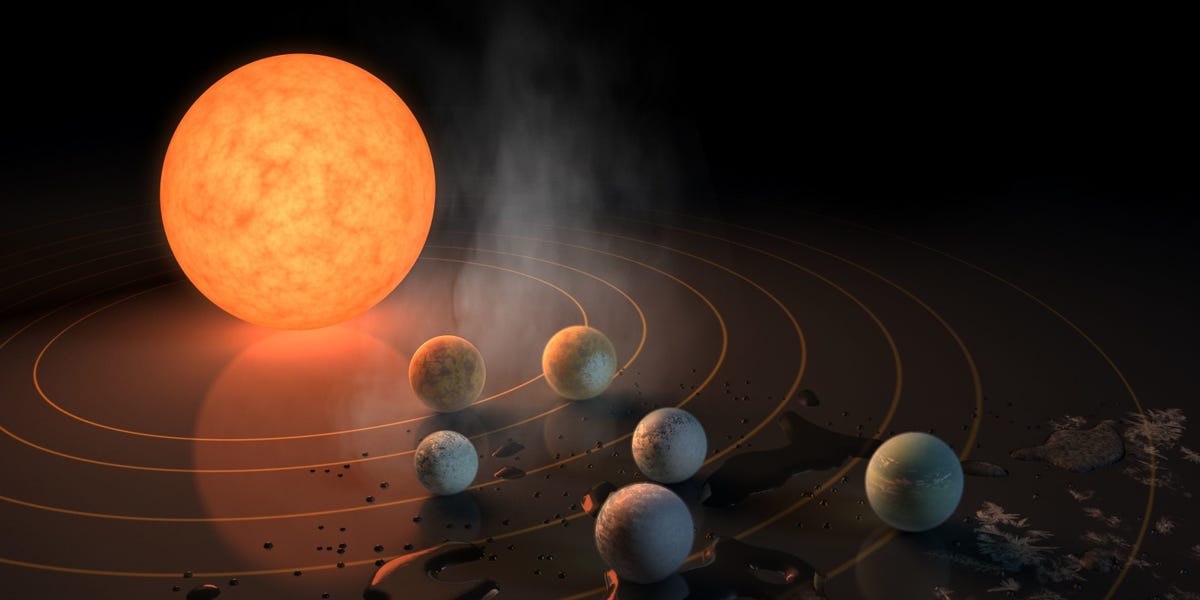
Every so often, space news arrives with the subtlety of a marching band in your living room. That is exactly what happened when astronomers revealed that one nearby star hosts not one, not two, but seven roughly Earth-sized planets. The star is called TRAPPIST-1, and ever since it entered the public imagination, it has been the overachiever of exoplanet systems: compact, mysterious, and just close enough to make scientists lean forward in their chairs.
The headline sounds like science fiction with better branding. Seven Earth-like planets? Around one nearby star? It practically begs for dramatic music and a slow pan across the cosmos. But the real story is even better than the headline. These worlds are not “Earth 2.0” clones with guaranteed blue skies and sensible weather. They are rocky planets orbiting a small, cool red dwarf about 40 light-years away, and together they form one of the most important natural laboratories in the search for life beyond our solar system.
TRAPPIST-1 matters because it gives astronomers a rare jackpot: a whole family of small, rocky planets in one place. Instead of studying one lonely exoplanet and shrugging at the lack of context, researchers can compare seven worlds that formed around the same star but ended up in different conditions. That is cosmic gold. It lets scientists ask better questions about atmospheres, water, climate, and habitability without constantly changing the entire setup.
What Was Actually Discovered?
TRAPPIST-1 is an ultra-cool red dwarf star in the constellation Aquarius. It is much smaller and dimmer than our Sun, which helps explain why its planets can orbit so close in without instantly turning into molten disasters. In 2016, astronomers first identified planets around the star using the transit method, which watches for tiny dips in starlight when a planet passes in front of its host star. Follow-up observations, especially from NASA’s Spitzer Space Telescope, revealed the full seven-planet lineup.
That alone was headline-worthy. Seven planets orbiting one star is fun. Seven rocky, Earth-sized planets orbiting one nearby star is the kind of discovery that makes scientists, journalists, and every amateur space nerd within Wi-Fi range stop what they are doing. Even better, the system is remarkably compact. All seven planets orbit closer to TRAPPIST-1 than Mercury orbits the Sun. If our solar system were a sprawling suburb, TRAPPIST-1 would be a downtown apartment building where everybody shares walls and probably overhears each other’s gravity.
The planets are labeled TRAPPIST-1b through TRAPPIST-1h, in order of discovery and orbital period. Their years are astonishingly short. The innermost world loops around its star in about a day and a half, while the outermost takes less than three weeks. These are not leisurely Earth-style laps. These are planets speed-running their calendars.
Why the Discovery Made Such a Big Splash
Exoplanet discoveries are no longer rare, but the TRAPPIST-1 system still stands out. Before this, astronomers had found plenty of giant planets, plenty of hot worlds, and plenty of “interesting if terrifying” environments. What made TRAPPIST-1 different was the combination: small, rocky planets, all in one system, all around a nearby star that is relatively favorable for observation.
Because the host star is small, each transiting planet blocks a larger fraction of its light than a similar planet would block from a Sun-sized star. That makes the planets easier to study. It is a bit like trying to spot a moth crossing a porch light versus a moth crossing a stadium floodlight. One is manageable. The other is an argument for stronger coffee.
Another reason the system drew so much attention is that several of the planets fall within or near the star’s habitable zone. That does not mean “inhabited,” “lush,” or “waiting patiently for visitors.” It means the temperatures could, under the right atmospheric conditions, allow liquid water to exist on the surface. In the original excitement around the system, planets e, f, and g were highlighted as especially promising, with other habitability estimates sometimes stretching the possibilities depending on cloud cover, atmospheric chemistry, and greenhouse effects.
Are These Planets Really Earth-Like?
This is where science has to gently take the microphone away from the hype machine. “Earth-like” is useful in headlines, but it can be misleading in practice. In the case of TRAPPIST-1, Earth-like mostly means Earth-sized and rocky, not Earth-resembling in the everyday sense. These planets are not confirmed to have oceans, breathable air, weather patterns, or a friendly neighborhood hardware store.
Still, size matters. Small rocky planets are exactly the kind of worlds scientists most want to study when asking whether life could exist elsewhere. Gas giants are fascinating, but if you are looking for solid ground and chemistry that might support biology, rocky planets are where the action is. TRAPPIST-1 delivered seven of them in one shot.
Researchers have also learned that the seven planets have surprisingly similar densities. That suggests they may share broadly similar building materials, though not identical internal structures. Some appear slightly less dense than Earth, which could mean less iron, more oxidized material, or a higher fraction of water or other lighter compounds. In other words, they are siblings, not photocopies.
The system is also likely tidally locked, or close to it, for at least many of the planets. One side may face the star most of the time while the other stays in long-term darkness. That sounds dramatic, and it is, but tidal locking does not automatically kill habitability. With the right atmosphere, heat could circulate around the planet. A world with permanent day and permanent night might still have a “just right” twilight belt around its terminator. Nature, as usual, refuses to be simple.
Could Any of the TRAPPIST-1 Planets Support Life?
This is the billion-dollar question, minus the ease of a billion-dollar answer. The most honest reply is: maybe, but we are still sorting out the details. Habitability depends on far more than size and location. A planet also needs the right atmosphere, enough long-term stability, and ideally a way to hang onto water without having it blasted away by stellar radiation.
That last point is especially important because red dwarf stars can be energetic and unruly, particularly in their youth. TRAPPIST-1 is small and cool, but stars of this type can produce flares and high-energy radiation capable of stripping atmospheres from nearby planets over time. So even though some TRAPPIST-1 worlds sit in the habitable zone, their star may have made life difficult, especially for the inner planets.
Among the seven, TRAPPIST-1e often gets the most scientific side-eye in the best possible way. It sits in the habitable zone, has a density close to Earth’s, and is frequently described as one of the system’s most compelling candidates for temperate conditions. TRAPPIST-1f and g remain important as well, especially in climate modeling studies that explore how water, ice, greenhouse gases, and cloud cover might behave on worlds around red dwarfs.
As for the outermost planet, TRAPPIST-1h, it appears too cold for surface liquid water under ordinary assumptions. That does not make it boring. It just means it is probably not hosting beach weather. Scientists still care about worlds like h because planetary systems tell a richer story when you study the whole cast, not just the likely stars.
What the James Webb Space Telescope Is Telling Us
If the 2017 discovery was the thrilling first act, the James Webb Space Telescope is the painstaking detective work that followed. Webb has begun probing the atmospheres, or possible lack of atmospheres, on several TRAPPIST-1 planets. The results so far have been exciting in a very scientist way: less “aliens confirmed” and more “we can rule out several important possibilities.”
For TRAPPIST-1b, the innermost planet, early Webb data strongly suggested a hot, airless or nearly airless world rather than a planet wrapped in a thick atmosphere. That was not shocking, given how much radiation the planet receives, but it was still a crucial result. Science advances just as much by eliminating bad ideas as by celebrating good ones.
Webb also helped rule out a thick carbon dioxide atmosphere for TRAPPIST-1c, a planet sometimes compared to Venus because of its size and stellar heating. That matters because it narrows the menu of plausible climates. TRAPPIST-1d has proven similarly tricky: recent studies have found no strong evidence for an Earth-like atmosphere there either, though some thinner or harder-to-detect atmospheric scenarios remain on the table.
The biggest long-term intrigue may center on TRAPPIST-1e. Recent Webb-era analysis has chipped away at some atmosphere models without delivering a final verdict. That may sound underwhelming, but it is actually the exciting part. A planet does not become less interesting because the easy answers disappear. It becomes more scientifically valuable. The system is teaching astronomers how rocky planets evolve around red dwarf stars, and that lesson extends far beyond TRAPPIST-1 itself.
Why This System Still Matters So Much
TRAPPIST-1 is not just famous because it has seven rocky planets. It matters because it gives planetary science a controlled comparison set. Same star. Same broad origin story. Seven different planetary outcomes. That setup lets researchers test models of climate, composition, orbital dynamics, atmospheric escape, and water retention with far more nuance than a one-planet case study ever could.
It also reshaped public understanding of what planetary systems can look like. Our solar system is not the universal template we once assumed. Nature is more inventive than that. TRAPPIST-1 looks less like a duplicate of our neighborhood and more like a reminder that the universe enjoys variety. Sometimes it builds giant worlds skimming close to their stars. Sometimes it builds chains of compact rocky planets around a red dwarf. Apparently, the cosmos does not believe in boring floor plans.
And perhaps most importantly, this system turned the search for life from an abstract dream into a more targeted scientific project. We still do not know whether any of these worlds are habitable. We definitely do not know whether any are inhabited. But for the first time, researchers have a nearby set of Earth-sized planets they can test, compare, and revisit again and again with increasingly powerful tools.
A Longer Reflection: What This Discovery Feels Like From the Human Side
There is the science of TRAPPIST-1, and then there is the feeling of TRAPPIST-1. Those are not the same thing, but both matter. The science gives us numbers, models, orbital periods, density estimates, and atmospheric constraints. The feeling gives us perspective. It reminds us that human beings are strange, ambitious creatures who looked into a patch of sky and somehow figured out that seven small worlds were circling a star too faint to see with the naked eye.
Think about that for a second. Most of human history happened without anyone knowing that planets existed beyond our solar system at all. Then, in a blink of cosmic time, we went from guessing to cataloging. We now discuss whether a rocky world 40 light-years away might have clouds, ice, or a stripped atmosphere as casually as people once argued about the weather next Tuesday. That shift is astonishing. It is also weirdly moving.
The TRAPPIST-1 story lands with people because it sits at the crossroads of hard data and imagination. On one hand, it is all precision: tiny changes in starlight, careful measurements, telescope time, and years of analysis. On the other hand, it invites the oldest human instinct we have, which is to wonder what it would be like to be there. What would the sky look like? How bright would the star feel? Could neighboring planets hang in the sky larger than our moon appears from Earth? What would it mean to stand on one rocky world and know that several others are close by, each with its own climate, chemistry, and possibilities?
That is part of why this discovery has stayed in the conversation. It gives people a cosmic scene they can almost picture. Our own solar system is spread out. TRAPPIST-1 is compact and dramatic. It feels intimate. It feels architectural. It feels like a place where worlds live shoulder to shoulder, where gravity writes tight choreography and every orbit matters.
There is also something humbling about the phrase “Earth-like.” We use it because Earth is our benchmark, our one known success story. But TRAPPIST-1 keeps reminding us that Earth-like is not a finish line. It is an opening question. Similar size does not guarantee similar fate. A rocky surface does not promise an ocean. A habitable zone does not hand over life in a gift bag. These planets invite us to respect complexity, which is one of science’s healthiest habits.
At the same time, the system offers hope without fantasy. It tells us that small rocky planets are not rare oddities. Nature can make them in bunches. It can place them in interesting zones around stars. It can build systems that are testable, not just poetic. That matters because the search for life works best when hope is paired with evidence. TRAPPIST-1 gives us both: enough promise to keep looking, and enough uncertainty to keep us honest.
For many readers, the experience of learning about TRAPPIST-1 is less about astronomy trivia and more about emotional scale. Suddenly, home feels both precious and less lonely. Earth remains the only world we know that definitely hosts life, which makes it more valuable, not less. But the existence of seven nearby rocky worlds around one small star suggests that the universe may not be stingy with opportunities. It may be overflowing with them.
That is why the TRAPPIST-1 discovery still resonates. It does not just tell us something about planets. It tells us something about ourselves. We are the kind of species that can look at dim starlight, decode hidden worlds, and then turn that knowledge into wonder. We ask whether life could survive there, but the discovery also reflects back on life here: curious, fragile, stubborn, and determined to know what is beyond the next horizon. In that sense, TRAPPIST-1 is not only a nearby star system. It is a mirror held up to human curiosity, and honestly, it is a pretty flattering angle.
Conclusion
The phrase “seven Earth-like planets orbit one nearby star” sounds like a flashy headline, but it describes a genuinely extraordinary scientific milestone. The TRAPPIST-1 system gave astronomers seven rocky worlds to compare, challenge, and test. It also gave the public a rare gift: a discovery that feels big because it is big.
We still do not know whether any TRAPPIST-1 planet hosts life. We do not even know whether the most promising candidates hold onto the kinds of atmospheres life might need. But that uncertainty is not a weakness in the story. It is the story. TRAPPIST-1 is important precisely because it keeps the biggest questions open while giving science a realistic way to answer them.
And that may be the most exciting part of all. The system is close enough, compact enough, and scientifically rich enough that it will stay under investigation for years. In astronomy, that is how a discovery graduates from headline to legacy.