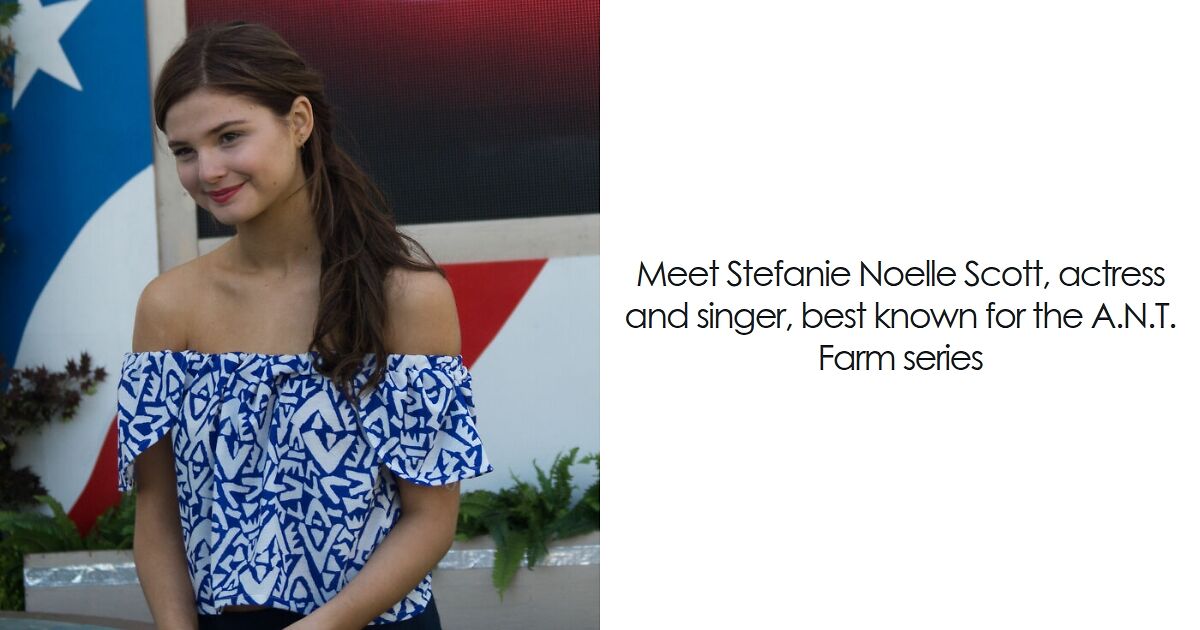
Stefanie Scott is one of those performers whose career makes you say, “Wait, she was in that too?” From Disney Channel comedy to supernatural horror, indie drama, music videos, streaming thrillers, and screenwriting, Scott has built a résumé that is surprisingly versatile for someone who first became familiar to many viewers as a polished teen queen on A.N.T. Farm. She did not simply graduate from child actor to adult actor; she swerved, experimented, and chose projects that let her test new emotional territory.
Born Stefanie Noelle Scott on December 6, 1996, in Chicago, Illinois, and raised partly in Florida, Scott began working professionally at a young age. Her early career included family-friendly projects, guest appearances, voice work, and music. But the bigger story is how she moved beyond the safe glow of Disney stardom into darker, more demanding roles. In Hollywood terms, that is a bit like leaving a cupcake shop and voluntarily walking into a haunted basement. Bold? Yes. Memorable? Also yes.
Early Life: From Florida Talent to Hollywood Opportunity
Stefanie Scott’s early years gave her the mix of discipline and curiosity that often shapes young entertainers. Before becoming a recognizable face on television, she was a young performer learning auditions, sets, scripts, and the weird rhythm of an industry where “hurry up and wait” is practically a national anthem. She attended Holy Trinity Episcopal Academy in Florida before eventually being homeschooled as her acting schedule became more demanding.
Her early training and auditions led to screen opportunities while she was still very young. Unlike some performers who seem to appear overnight, Scott’s rise was gradual. She built experience through smaller roles, learned camera technique, and developed the on-set confidence needed to move between comedy, drama, and genre storytelling.
First Screen Roles and Early Recognition
Beethoven’s Big Break and Early Guest Spots
Scott’s film career began with Beethoven’s Big Break in 2008, a family comedy connected to the long-running Beethoven franchise. It was not exactly Shakespeare with slobber, but it gave her valuable early screen exposure. Around the same period, she also appeared in television guest roles, including a young version of Sarah Walker in Chuck and roles in shows such as The New Adventures of Old Christine and Sons of Tucson.
These early credits mattered because they showed Scott could handle different formats. Sitcom timing, family-film warmth, and guest-star drama each require a slightly different acting muscle. For a young performer, that variety is like a starter pack for surviving Hollywood.
Flipped and a Young Artist Award Win
One of Scott’s first major career boosts came with Rob Reiner’s 2010 coming-of-age film Flipped. She played Dana Tressler in a movie remembered for its nostalgic tone, emotional sincerity, and old-fashioned storytelling. Her work in the film helped earn her a Young Artist Award for Best Performance in a Feature Film by a Supporting Young Actress.
That win was an early sign that Scott was more than a young face on screen. Awards for young performers can be tricky to interpret, but in her case, the recognition reflected a growing ability to stand out in ensemble settings. Flipped also connected her to a respected director and a film that continues to attract viewers years later.
The Disney Channel Breakthrough: A.N.T. Farm
Playing Lexi Reed
For many fans, Stefanie Scott became a household name through Disney Channel’s A.N.T. Farm, which aired from 2011 to 2014. She played Lexi Reed, the stylish, popular, sometimes hilariously self-absorbed rival to the younger prodigies at Webster High School. Lexi could have been a one-note “mean girl,” but Scott gave the character energy, confidence, and enough comic flair to keep her watchable even when Lexi was being gloriously dramatic.
The role worked because Scott understood the rhythm of Disney comedy. Lexi needed big reactions, sharp delivery, and a touch of theatrical vanity. In the wrong hands, the character might have felt cartoonish. In Scott’s hands, she became a memorable part of the show’s personality.
Why A.N.T. Farm Was a Career Turning Point
A.N.T. Farm did what Disney Channel often does best: it introduced young performers to a wide audience. Scott’s role gave her visibility, fan recognition, and regular experience on a multi-camera-style youth sitcom. She also won another Young Artist Award for her work on the series, strengthening her reputation as one of Disney’s notable young talents of that era.
Just as important, the show positioned her for a more complicated transition. Many actors who begin on children’s television face the same challenge: how do you move from bright sets and punchlines into mature film and television roles without looking like you are wearing someone else’s career? Scott’s answer was simple: choose boldly.
Music, Voice Work, and Expanding Her Creative Range
Scott has also explored music throughout her career. She released songs and promotional singles, and she contributed to projects connected to her Disney era. Her musical background added another layer to her public image, especially during the years when Disney stars were often expected to sing, act, smile, tour, and possibly solve a Rubik’s Cube before breakfast.
In 2012, Scott also lent her voice to Disney’s animated hit Wreck-It Ralph. While her voice role as Moppet Girl was not the largest part of the film, it placed her inside one of Disney Animation’s major modern successes. Voice work is a different skill from live-action acting; it forces performers to communicate personality through sound alone. For Scott, it was another useful credit in a career already spreading across multiple entertainment lanes.
Insidious: Chapter 3 and the Move Into Horror
Quinn Brenner: A Defining Film Role
Scott’s biggest post-Disney pivot came with Insidious: Chapter 3 in 2015. She starred as Quinn Brenner, a teenager who becomes the focus of a terrifying supernatural haunting. This was a major shift from the glossy world of A.N.T. Farm. Instead of delivering punchlines, Scott had to carry fear, grief, vulnerability, and physical distress through much of the film.
The role was a smart choice. Horror can be a powerful proving ground for young actors because it demands emotional intensity. A performer has to make the audience believe in terror that may not even be present on set. One day you are screaming at a demon; in reality, you may be screaming at a tennis ball on a stick. Glamour!
Scott’s performance helped establish her as a capable genre actress. Insidious: Chapter 3 also became one of her most widely recognized film credits, introducing her to horror fans who may never have watched her Disney work.
Why Horror Fit Her Career Evolution
Horror gave Scott a chance to show emotional range. Quinn Brenner is not just a victim; she is a grieving daughter, an aspiring actress, and a teenager trying to move forward while trapped by forces she cannot understand. That emotional foundation gave Scott room to create a performance that was scared, human, and sympathetic.
The move also suggested something important about her instincts. Rather than chase only safe mainstream roles, Scott leaned into darker stories. That choice would continue to shape her later work in thrillers, supernatural dramas, and independent films.
Jem and the Holograms: Pop Energy and Cult Curiosity
Also in 2015, Scott played Kimber Benton in Jem and the Holograms, a live-action adaptation inspired by the animated series. The movie received mixed-to-negative critical reactions, but it remains an interesting part of Scott’s filmography because it connected her acting and musical presence. She joined a young cast in a project built around fame, friendship, performance, and pop spectacle.
Not every career highlight has to be a critical smash. Sometimes a project matters because it shows an actor trying a new tone or stepping into a recognizable property. Jem and the Holograms gave Scott a colorful, music-driven credit that contrasted sharply with the shadowy terror of Insidious: Chapter 3. Few performers can say they faced supernatural evil and pop-band drama in the same year. That is range, and also probably a scheduling headache.
Independent Films and Dramatic Growth
Small Town Crime, 1 Mile to You, and At First Light
After her Disney and horror breakout years, Scott continued working in independent films. She appeared in 1 Mile to You, Small Town Crime, and At First Light, projects that allowed her to operate outside the machinery of major teen franchises. These films gave her opportunities to explore quieter performances, genre blending, and character-driven storytelling.
At First Light, in particular, placed her in a science-fiction drama opposite Théodore Pellerin. The film combined mystery, emotional tension, and supernatural elements, which suited Scott’s growing interest in atmospheric stories. Rather than relying on spectacle alone, the movie asked its lead performers to ground strange events in believable human reactions.
Beautiful Boy and Prestige Drama
Scott also appeared in Beautiful Boy, the 2018 drama starring Steve Carell and Timothée Chalamet. Her role as Julia was part of a larger, emotionally heavy story about addiction, family, relapse, and recovery. Even in a supporting role, being part of a film with that level of acting talent and awards-season attention added prestige to her résumé.
For Scott, Beautiful Boy reinforced her ability to move within serious dramatic material. It also placed her alongside performers known for subtle, emotionally detailed work. That kind of environment can sharpen an actor’s instincts, and Scott’s continued move toward mature roles showed she was not interested in being boxed into one image.
Television Thrillers: Girl in the Basement and The Girl in the Woods
Girl in the Basement
In 2021, Scott starred as Sara Cody in Lifetime’s Girl in the Basement, a disturbing drama inspired by real events. The film required a performance built around trauma, fear, endurance, and survival. It was far removed from the bright comedy of her Disney years and proved again that Scott was willing to take on emotionally demanding subject matter.
The role became one of her most discussed television performances because of the intensity of the story. Playing a character trapped in such terrifying circumstances requires care. Scott had to communicate vulnerability without flattening the character into helplessness, and that balance helped the film reach audiences who respond to true-crime-inspired drama.
The Girl in the Woods
That same year, Scott led Peacock’s supernatural series The Girl in the Woods as Carrie. The show, from Crypt TV, blended monster mythology, mystery, and coming-of-age tension. Scott’s role again placed her in a dark genre world, but this time with a streaming-series format that allowed for more character development across episodes.
By this point, a pattern was clear: Scott had become particularly effective in roles where innocence, danger, and resilience collide. Whether facing ghosts, family horror, or monsters in the woods, she brings an emotional directness that helps genre stories feel human.
The Last Thing Mary Saw and the Appeal of Dark Stories
Scott starred alongside Isabelle Fuhrman, Rory Culkin, and Judith Roberts in The Last Thing Mary Saw, a folk-horror film set in the 19th century. The movie leaned into atmosphere, repression, secrecy, and dread. For Scott, it was another strong example of her interest in unconventional horror and psychologically tense material.
Her role as Mary continued her evolution from mainstream teen star to actress drawn toward layered, unsettling stories. Folk horror depends heavily on mood, silence, and implication. It is not just about jump scares; it is about the slow feeling that something is deeply wrong and everyone in the room knows it except maybe the person holding the candle. Scott’s screen presence fits that kind of tension well.
Screenwriting and the Next Chapter: Girls Like Girls
One of the most interesting recent developments in Stefanie Scott’s career is her move into screenwriting. Focus Features lists Girls Like Girls, based on Hayley Kiyoko’s hit single and bestselling novel, with a screenplay by Hayley Kiyoko and Stefanie Scott. The film is scheduled for theatrical release on June 19, 2026.
This credit matters because it shows Scott expanding beyond acting into authorship. She appeared in Kiyoko’s original “Girls Like Girls” music video in 2015, a video that became culturally meaningful for many fans because of its queer coming-of-age story. Years later, helping adapt that concept into a feature film gives Scott a creative link between past performance and future storytelling.
For an actor, moving into writing can be a major career step. It suggests a desire not only to perform characters but also to shape narrative structure, tone, and emotional perspective. If Scott continues down this path, she may become known not just as a performer who chooses interesting roles, but as a creator helping build them from the page up.
Career Highlights at a Glance
- 2008: Made an early film appearance in Beethoven’s Big Break.
- 2010: Appeared in Rob Reiner’s Flipped, later earning Young Artist Award recognition.
- 2011–2014: Played Lexi Reed on Disney Channel’s A.N.T. Farm.
- 2012: Contributed voice work to Disney’s Wreck-It Ralph.
- 2015: Starred as Quinn Brenner in Insidious: Chapter 3.
- 2015: Played Kimber Benton in Jem and the Holograms.
- 2018: Appeared in At First Light and Beautiful Boy.
- 2021: Led Lifetime’s Girl in the Basement and Peacock’s The Girl in the Woods.
- 2021–2022: Starred in the folk-horror film The Last Thing Mary Saw.
- 2026: Credited as co-screenwriter of Focus Features’ Girls Like Girls.
Why Stefanie Scott’s Career Stands Out
Stefanie Scott’s career stands out because it refuses to stay in one lane. She could have remained primarily associated with Disney nostalgia, but instead she pursued horror, indie drama, streaming genre television, music-connected roles, and writing. That kind of path is not always the loudest, but it can be the most durable.
Her choices suggest a performer interested in transformation. Lexi Reed was confident, funny, and polished. Quinn Brenner was vulnerable and terrified. Sara Cody was trapped and resilient. Mary was secretive and haunted by a repressive world. Those roles do not feel like variations of the same character. They show an actress testing different emotional keys.
In modern Hollywood, that flexibility is valuable. Audiences discover actors in many different ways now: a Disney Channel rerun, a horror franchise, a streaming thriller, a viral music video, or a filmography rabbit hole at 1 a.m. Scott has credits in all those zones, which gives her a broad and unusual cultural footprint.
Additional Experience-Based Insights: What Stefanie Scott’s Career Can Teach Young Performers
Looking at Stefanie Scott’s career is useful not only for fans but also for aspiring actors, writers, and entertainers. Her path shows that early success is helpful, but reinvention is what keeps a career alive. Many young performers become closely tied to one role, especially when that role comes from Disney Channel or another major youth platform. The challenge is not getting noticed; it is being seen differently after everyone thinks they already know who you are.
Scott’s transition offers a practical lesson: choose roles that stretch the public’s expectations. Moving from A.N.T. Farm to Insidious: Chapter 3 was not a tiny adjustment. It was a full genre leap. She went from playing a glamorous school rival to carrying a horror film built around grief, fear, and physical vulnerability. That kind of choice tells casting directors and audiences, “There is more here.” For young actors, that is an important strategy. Safe roles may maintain comfort, but challenging roles create new possibilities.
Another lesson is the value of working across formats. Scott has done television, feature films, independent cinema, voice acting, music videos, streaming series, and screenwriting. Each format teaches a different skill. Television builds speed and consistency. Film rewards subtlety and patience. Voice acting sharpens expression. Horror builds emotional stamina. Writing develops story awareness. Together, those experiences create a more complete creative toolkit.
Her career also shows that not every project needs to be a blockbuster to matter. Independent films such as At First Light and The Last Thing Mary Saw may not have the same mainstream visibility as Disney or Insidious, but they help define an actor’s artistic identity. These roles often allow performers to take risks that larger commercial projects might avoid. For Scott, darker and more atmospheric material became part of her signature.
There is also a branding lesson here, though not the boring corporate kind where everyone says “authenticity” until the word begs for a vacation. Scott’s brand is not built on one character type. It is built on range: Disney comedy, horror, emotional drama, supernatural mystery, and now creative writing. That makes her career more interesting to follow because each new project can reveal a different side of her work.
Finally, Scott’s screenwriting credit on Girls Like Girls points to a larger truth about longevity in entertainment: creative control matters. Actors who learn to write, produce, direct, or develop material often gain more power over the stories they tell. By helping adapt a meaningful music-video concept into a feature film, Scott steps into a role that is not limited to being cast by someone else. She becomes part of the storytelling engine.
For fans, the takeaway is simple: Stefanie Scott’s career is still evolving. For aspiring performers, the takeaway is even better: do the work, take the weird role, learn the extra skill, and do not let one successful chapter become the whole book. Scott’s journey proves that a career can begin with teen comedy and still grow into horror, drama, streaming, and screenwriting. Not bad for someone many viewers first met as Lexi Reed with a perfectly timed eye roll.
Conclusion
Stefanie Scott has built a career defined by movement. She started young, gained major visibility through Disney Channel, earned early awards recognition, and then made smart, sometimes surprising choices in horror, drama, and independent film. Her best-known roles in A.N.T. Farm, Insidious: Chapter 3, Girl in the Basement, The Girl in the Woods, and The Last Thing Mary Saw show a performer comfortable with both charm and darkness.
Now, with a screenwriting credit on Girls Like Girls, Scott’s career appears to be entering another creative phase. She is not just revisiting past success; she is expanding what her name can mean in entertainment. That is the real highlight of Stefanie Scott’s bio: she keeps choosing growth over comfort, and that makes her next chapter worth watching.