On Earth, clouds are familiar enough to be background decoration. They drift over commutes, photobomb vacations, and occasionally ruin a perfectly good picnic with the confidence of a tiny weather dictator. But on Titan, Saturn’s largest moon, one cloud has managed to do something far more impressive: it broke the rulebook.
Scientists studying Titan found a high-altitude ice cloud made of dicyanoacetylene, a carbon-and-nitrogen compound also written as C4N2. That alone sounds wonderfully alien, like something a sci-fi villain would keep in a locked cabinet. The real mystery, however, is not what the cloud was made of. It is that the cloud appeared where there did not seem to be enough vapor to make it. In ordinary cloud physics, that is a problem. Clouds need ingredients. Titan’s strange cloud looked like a cake baked in a kitchen with no flour.
This is why the discovery became known as the cloud on Titan that “shouldn’t exist.” It is not magic, of course. Science rarely lets us keep magic for long. But it is a beautiful example of how alien worlds can force researchers to rethink what “normal” means.
Why Titan Is Already One of the Strangest Worlds We Know
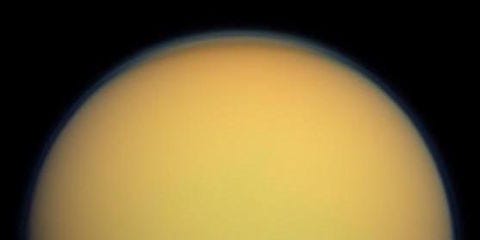
Titan is not just another gray rock orbiting a giant planet. It is Saturn’s largest moon, bigger than Mercury, wrapped in a thick golden-orange haze, and famous for being the only moon in the solar system with a dense atmosphere. Even better, Titan has weather. Real weather. It has clouds, rain, rivers, lakes, and seas.
The twist is that Titan’s rain is not water. It is mostly methane and ethane, hydrocarbons that behave on Titan much like water behaves on Earth. On our planet, water evaporates, forms clouds, falls as rain, and runs into rivers and oceans. On Titan, methane plays the starring role in a colder, stranger version of that cycle. Imagine Earth’s water cycle after someone replaced the ocean with lighter fluid and turned the thermostat down to around minus 290 degrees Fahrenheit. Cozy? Not exactly. Fascinating? Absolutely.
Titan’s atmosphere is mostly nitrogen, like Earth’s, but it also contains methane and a complex mix of organic chemicals created when sunlight and energetic particles interact with atmospheric gases. These reactions build haze, hydrocarbons, nitriles, and other compounds that slowly drift downward. Titan is, in a sense, a giant natural chemistry lab with a smog machine, freezer, and planetary-scale mixing spoon included.
What Was the “Impossible” Cloud?
The mystery cloud was located in Titan’s stratosphere, the atmospheric layer above the lower weather zone where methane rain clouds usually form. It was made of dicyanoacetylene ice, or C4N2 ice. This compound contains carbon and nitrogen, two elements that are central to Titan’s rich atmospheric chemistry.
NASA’s Voyager 1 spacecraft first found evidence for this kind of ice cloud decades ago. Later, Cassini, the spacecraft that studied Saturn and its moons in extraordinary detail, detected a similar cloud using its Composite Infrared Spectrometer, known as CIRS. That instrument could read the infrared “fingerprints” of chemicals in Titan’s atmosphere, a little like identifying guests at a party by their shoes under the door.
The problem was simple and stubborn: Cassini saw the ice cloud, but it did not detect enough dicyanoacetylene vapor nearby to explain how the cloud condensed. In fact, scientists estimated that Titan’s stratosphere would have needed at least 100 times more vapor than observed to make the cloud through ordinary condensation. That is not a small rounding error. That is the atmosphere equivalent of trying to fill a swimming pool with a teaspoon and confidently saying, “Close enough.”
How Clouds Usually Form
To understand why Titan’s cloud was so puzzling, it helps to revisit basic cloud formation. On Earth, water evaporates from oceans, lakes, rivers, soil, and plants. The vapor rises, cools, and eventually condenses into droplets or ice crystals when temperature and pressure conditions allow it. A cloud forms when there is enough vapor available and the air reaches the right balance point.
Titan follows similar principles, but with different ingredients. In the lower atmosphere, methane can evaporate from lakes and seas, rise, cool, condense, and fall as rain. This is why Titan is often described as one of the most Earthlike places in the solar system, even though no one would recommend packing sandals.
In Titan’s stratosphere, cloud formation is different. Seasonal circulation can move gases toward the winter pole, where they sink into colder layers and condense into ice clouds. This creates layered polar clouds made from various organic chemicals. In a normal case, researchers can calculate how much vapor should exist near a cloud. If the ice is there, enough vapor should be there too.
But with dicyanoacetylene, the numbers did not cooperate. The ice was present. The vapor was nearly missing. The cloud looked real, but the usual recipe failed.
The Solid-State Chemistry Solution
The leading explanation is that the cloud did not form by ordinary vapor condensation. Instead, scientists proposed that dicyanoacetylene ice may be produced directly inside other ice particles through solid-state chemistry.
Here is the simplified version. First, tiny ice particles made of cyanoacetylene, or HC3N, form in Titan’s stratosphere. As they drift downward, they become coated with hydrogen cyanide, or HCN. Now each particle has something like a frozen core and shell. Ultraviolet light can penetrate the outer layer and trigger chemical reactions inside the ice. Those reactions may transform the materials into dicyanoacetylene ice.
In other words, Titan may be making the cloud ingredient inside the cloud particles themselves. The vapor does not need to be abundant because the chemistry is happening in the frozen state. It is less like steam condensing into frost and more like a tiny chemical workshop operating inside an ice grain. Titan, apparently, has artisanal cloud manufacturing.
This matters because it expands how scientists think about atmospheric chemistry. Clouds are not merely passive collections of condensed vapor. On Titan, they may act as active chemical reactors, producing new materials as they move through the atmosphere.
Why Earth Helps Explain Titan
One reason the Titan discovery is so exciting is that the proposed process has a distant cousin on Earth. Our planet has polar stratospheric clouds, which form high above the poles under extremely cold conditions. These clouds can provide surfaces for chemical reactions that affect ozone. They are not identical to Titan’s dicyanoacetylene cloud, but they show that ice particles can be more than frozen dust. They can be reaction platforms.
That comparison helps scientists avoid treating Titan as completely unknowable. Titan is alien, but physics and chemistry still travel well. Temperature, pressure, radiation, circulation, and molecular reactions do not stop working just because they are happening nearly a billion miles from the Sun.
At the same time, Titan keeps reminding us that familiar rules can produce unfamiliar outcomes. Earth’s clouds are mostly part of a water cycle. Titan’s clouds belong to a hydrocarbon and organic chemistry cycle. The same basic logic is there, but the ingredients are wilder, colder, and more chemically adventurous.
Other Strange Clouds on Titan
The dicyanoacetylene cloud is not Titan’s only atmospheric oddball. Cassini also helped identify a high-altitude methane ice cloud in Titan’s stratosphere, which researchers had not expected to form so high above the surface. Methane clouds were already known in Titan’s lower atmosphere, but finding methane ice in the stratosphere required scientists to look more carefully at temperature differences near Titan’s poles.
Later, researchers found evidence for an exotic hybrid ice cloud high above Titan’s south pole. This cloud appeared to contain hydrogen cyanide and benzene condensed together, creating a chemical mixture that sounded less like weather and more like something from a laboratory safety poster. It was invisible to human eyes but detectable in infrared data.
These discoveries reveal Titan as a place where weather and chemistry are deeply connected. Clouds are not just clouds. They are moving laboratories, seasonal signposts, and delivery systems for organic materials that eventually settle onto the surface.
What Titan’s Clouds Tell Us About the Surface
Titan’s atmosphere does not keep its chemistry to itself. Over time, organic particles fall from the sky and accumulate on the surface. Methane rain can carve channels, fill lakes, and reshape landscapes. Hydrocarbon seas near Titan’s poles may contain complex mixtures of methane, ethane, and dissolved organic compounds.
This makes Titan a prime target for studying prebiotic chemistry, the kind of chemistry that may help scientists understand steps that occurred before life emerged on early Earth. Titan is not “Earth 2.0,” and there is no evidence of life there. But it does offer a rare chance to study organic chemistry on a planetary scale.
The impossible cloud fits into that larger story. If complex molecules can form in Titan’s atmosphere through unexpected pathways, then the moon’s chemical inventory may be richer than simple models predict. A cloud that should not exist becomes a clue that Titan’s atmosphere is still hiding processes we do not fully understand.
Why Cassini Was So Important
Cassini transformed Titan from a fuzzy orange ball into a detailed world with weather, lakes, dunes, mountains, and seasonal changes. The mission arrived at Saturn in 2004 and studied the system for 13 years. It carried instruments that could see through Titan’s haze, measure atmospheric composition, map surface features, and track seasonal patterns.
The Huygens probe, carried by Cassini and released by the European Space Agency, descended through Titan’s atmosphere in 2005 and landed on the surface. For a brief but historic moment, humanity had a probe sitting on a moon in the outer solar system, surrounded by icy pebbles under an orange sky. That is the sort of sentence that makes space exploration worth every headache.
Without Cassini’s long-term observations, the dicyanoacetylene cloud mystery would be much harder to investigate. Titan’s seasons last for years because Saturn takes nearly 30 Earth years to orbit the Sun. A quick flyby can offer a snapshot, but Cassini provided a moving picture.
What Dragonfly Could Add
NASA’s Dragonfly mission is designed to take the next major step. Planned as a rotorcraft lander, Dragonfly will fly from place to place on Titan, sampling surface materials and studying chemistry, geology, and habitability. Titan’s thick atmosphere and low gravity make flight easier than it would be on many other worlds, although the cold creates major engineering challenges.
Dragonfly will not fly into the dicyanoacetylene cloud itself, but its measurements may help connect atmospheric chemistry to surface materials. If Titan’s clouds manufacture or transport complex organic compounds, Dragonfly could study what happens after those materials land. That link between sky chemistry and ground chemistry is one of Titan’s biggest scientific attractions.
Think of Cassini as the detective who spotted the suspicious clue from orbit. Dragonfly will be the investigator walking around the scene with instruments, looking for fingerprints.
Why the Cloud Matters Beyond Titan
The cloud on Titan that should not exist matters because it shows how incomplete our assumptions can be. Scientists had a good model for cloud formation: vapor condenses when conditions are right. That model still works. But Titan added a footnote in bold: sometimes clouds may form through chemistry inside existing ice particles.
This lesson may apply to other worlds with thick atmospheres, complex chemistry, or extreme cold. It may also help researchers think about chemical reactions on icy grains in space, including in planetary atmospheres, comets, and interstellar environments. Tiny frozen particles can be surprisingly active places.
The discovery also carries a more human message. When nature refuses to match our expectations, it is not being rude. It is offering us a better question. Titan’s impossible cloud did not end the story of cloud physics. It made the story bigger.
Experiences and Reflections: Imagining the Cloud on Titan
Trying to imagine Titan’s impossible cloud is a strangely humbling experience. Picture standing under Titan’s orange haze, wearing a very serious spacesuit and trying not to think about the temperature. The Sun would be a dim glow, not the warm spotlight we know on Earth. The sky would not be blue. The air would be thick, cold, and rich with nitrogen and methane. Somewhere high above, hidden from ordinary sight, an ice cloud made of dicyanoacetylene might drift through the stratosphere like a secret written in infrared.
What makes this image powerful is not just the alien scenery. It is the idea that something so quiet can overturn expectations. A cloud is usually gentle in our imagination. It floats. It shades. It becomes a cartoon sheep if you stare too long. But Titan’s cloud is a scientific troublemaker. It asks how a substance can freeze into a cloud when the atmosphere seems to lack enough vapor. It forces researchers to look beyond the obvious and consider hidden chemistry inside ice grains.
There is a lesson here for anyone who loves science, writing, or simply being surprised. The most interesting discoveries often begin as contradictions. A reading does not match the model. A signal appears where it should not. A cloud shows up without enough vapor. At first, the mismatch feels like a problem. Later, it becomes the doorway.
For readers, Titan’s cloud is also a reminder that exploration is not only about dramatic images. Yes, Saturn’s rings are spectacular. Yes, Titan’s methane lakes sound like something painted on a heavy metal album cover. But some of the deepest discoveries come from spectra, temperature profiles, chemical fingerprints, and careful calculations. Space science is not always fireworks. Sometimes it is a spreadsheet whispering, “That cannot be right,” and a scientist wisely answering, “Let’s check again.”
Writing about this topic feels like walking a tightrope between wonder and precision. Too much wonder, and Titan becomes fantasy. Too much precision, and the story freezes harder than Titan’s water ice. The sweet spot is where the chemistry stays real and the imagination still has room to breathe. That is where Titan shines. It is scientifically rigorous and wildly poetic at the same time.
The cloud on Titan that should not exist is not proof that nature breaks its own rules. It is proof that our first version of the rules was too small. Somewhere above that distant moon, frozen particles may be carrying out chemistry in the dark cold, building molecules in ways researchers are still working to understand. That is not just a cloud. It is a reminder that the universe has excellent comedic timing: just when we think we have the recipe, it changes the kitchen.
Conclusion
The cloud on Titan that should not exist is one of the best examples of why planetary science is so exciting. Cassini detected a dicyanoacetylene ice cloud in Titan’s stratosphere, but the expected vapor was far too scarce for normal condensation. Instead of dismissing the observation, scientists explored a new explanation: solid-state chemistry inside coated ice particles.
That idea turns Titan’s clouds into more than weather. They become chemical factories, seasonal markers, and clues to how organic material moves from atmosphere to surface. Titan remains one of the most compelling worlds in the solar system because it is familiar enough to compare with Earth and alien enough to surprise us at every turn.
In the end, the “impossible” cloud is not impossible after all. It is an invitation. It asks us to look closer, think colder, and remember that even a cloud can be a cosmic mystery with a punchline.