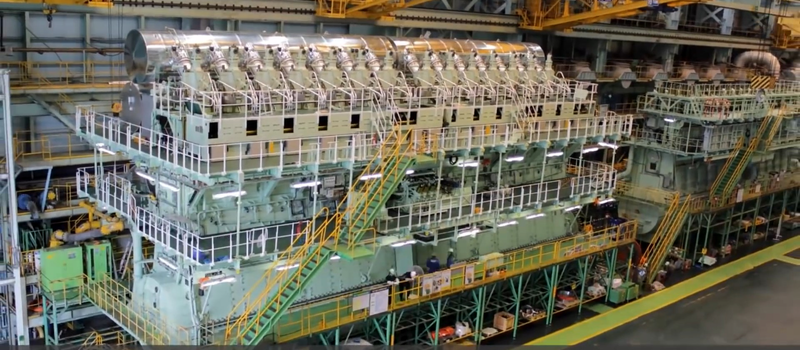
If you think the diesel engine in a heavy-duty pickup is impressive, prepare your eyebrows for takeoff. The most powerful diesel engine is not something you pop into a truck, park in a garage, or casually rev at a stoplight. It is a skyscraper-sized machine built to push giant container ships across oceans while carrying the kind of cargo that makes global shopping carts possible.
The name most often associated with this title is the Wärtsilä-Sulzer RT-flex96C, a massive low-speed, two-stroke marine diesel engine designed for ultra-large container ships. In its famous 14-cylinder version, it entered service with an output of 80,080 kW, or roughly 108,920 brake horsepower, at only 102 rpm. Yes, only 102 rpm. Your blender spins faster, but your blender cannot move a floating city full of sneakers, electronics, furniture, coffee makers, and everyone’s suspiciously urgent online purchases.
What Is the Most Powerful Diesel Engine?
The most powerful diesel engine widely recognized in real-world service is the 14-cylinder Wärtsilä RT-flex96C, also commonly discussed alongside the earlier Wärtsilä-Sulzer RTA96C family. It was developed for large, fast container vessels that needed enormous propulsion power with strong efficiency at low engine speeds.
Official Wärtsilä information from the engine’s entry into service described the 14-cylinder RT-flex96C as the world’s most powerful engine, producing 80,080 kW at 102 rpm. Technical discussions of the broader RT-flex96C and RTA96C family also cite power ranges reaching above 80 MW, depending on configuration and rating. Either way, this machine sits in a league where horsepower numbers stop sounding like automotive specs and start sounding like power plant paperwork.
Why Marine Diesel Engines Get So Huge
Diesel engines are famous for torque, durability, and fuel efficiency under heavy load. In cars and pickups, that means confident towing and long driving range. In locomotives, mining trucks, and ships, it means moving absurd amounts of weight day after day without throwing a mechanical tantrum.
Container ships are especially demanding. They need to move thousands of containers across oceans, often for weeks at a time, while burning fuel as efficiently as possible. A huge slow-speed diesel engine is ideal because it can connect directly to the propeller shaft without needing a complex gearbox. The engine turns slowly, the propeller turns slowly, and the ship gets a deep, steady push through the water.
That slow rotation is part of the magic. A high-performance car engine may scream at 7,000 rpm. The RT-flex96C delivers its power at around 102 rpm. Instead of spinning quickly, it uses gigantic pistons, a long stroke, and immense cylinder pressure to produce mountain-moving torque. It is less “sports car sprint” and more “geological event with a crankshaft.”
Key Specifications of the Wärtsilä RT-flex96C
The numbers behind the most powerful diesel engine are almost comically large, but they are real engineering figures, not something scribbled by a kid designing a spaceship during math class.
Power Output
The best-known 14-cylinder version of the Wärtsilä RT-flex96C produces about 80,080 kW, equal to roughly 108,920 bhp. Many popular references round this to about 107,000 to 109,000 horsepower, depending on conversion method and rating used.
Engine Speed
This engine reaches full rated output at around 102 rpm. That low speed is intentional. Large ship propellers are most efficient when turning slowly, and a low-speed diesel can drive the propeller shaft directly.
Size and Weight
The 14-cylinder version is often described as roughly 13.5 meters high and more than 26 meters long, with a weight of more than 2,300 metric tons. In human terms, it is about the height of a small building and heavy enough to make ordinary cranes develop stage fright.
Bore and Stroke
Each cylinder has a bore of about 960 mm and a stroke of about 2,500 mm. That means each piston travels two and a half meters from top to bottom. A single piston is taller than most people and weighs several tons. This is not a piston you clean on a workbench; this is a piston you schedule meetings around.
Fuel and Application
The RT-flex96C was designed for large container ships and traditionally ran on heavy fuel oil, although modern marine power is increasingly shaped by stricter emissions rules, alternative fuels, and dual-fuel engine development. Its purpose was simple: move enormous ships reliably, efficiently, and continuously across long ocean routes.
How the RT-flex96C Works
The RT-flex96C is a two-stroke, turbocharged, low-speed marine diesel engine. Unlike small two-stroke engines in lawn equipment or motorcycles, this is a highly sophisticated industrial machine. It uses large-scale turbocharging, carefully controlled fuel injection, and advanced exhaust systems to generate huge power with controlled combustion.
One of its major innovations was common-rail technology. Older large marine engines relied more heavily on mechanical camshaft-driven systems. The RT-flex design introduced electronic control that improved flexibility in fuel injection and exhaust valve operation. In practical terms, this helped improve low-speed operation, reduce visible smoke, improve combustion control, and support more efficient running across different loads.
That matters because ships do not always run at one perfect speed. Weather, cargo load, sea conditions, port schedules, and fuel-saving strategies all affect engine operation. A flexible engine can perform better across real-world conditions instead of only looking good on a test stand.
Why Horsepower Is Only Half the Story
When people search for “the most powerful diesel engine,” they usually focus on horsepower. That is understandable because horsepower is the headline number. But in huge marine diesel engines, torque is just as fascinating.
The RT-flex96C produces several million newton-meters of torque. That kind of twisting force is difficult to imagine. A powerful pickup truck may produce around 1,000 lb-ft of torque. A large marine engine produces torque on a scale that makes automotive numbers look like polite handshakes.
The reason is leverage. Huge pistons push on a huge crankshaft through a long stroke. Each combustion event is massive, slow, and controlled. Instead of needing high rpm to make power, the engine produces tremendous force with each rotation. That is exactly what a giant propeller needs.
Comparison With Other Powerful Diesel Engines
The Wärtsilä RT-flex96C may wear the crown, but it is not the only heavyweight in the diesel world. Several other engines deserve respect, even if they are smaller than the marine monster.
MAN B&W Low-Speed Marine Engines
MAN Energy Solutions builds large two-stroke marine engines used in modern container ships, tankers, and bulk carriers. Some MAN B&W engines are designed for ultra-large vessels and can reach extremely high output levels. Modern MAN platforms also include electronically controlled fuel systems and versions designed around alternative fuels such as LNG, methanol, and ammonia-ready concepts.
WinGD X-Series Engines
WinGD, connected historically to the Sulzer and Wärtsilä low-speed engine heritage, offers modern large-bore two-stroke engines for merchant shipping. The X92DF family, for example, is aimed at very large container ships and can produce tens of megawatts of power while supporting dual-fuel operation. These engines show where the industry is heading: still huge, still powerful, but increasingly focused on emissions and fuel flexibility.
Cummins QSK95
The Cummins QSK95 is one of the most powerful high-speed diesel engines used in rail, marine, mining, and power generation applications. Depending on application, it can produce thousands of horsepower from a V16 layout. Compared with a low-speed marine giant, it is compact; compared with normal engines, it is still a mechanical heavyweight with serious shoulders.
Caterpillar C175
The Caterpillar C175 family powers mining trucks, locomotives, and large generator sets. In some configurations, it produces around 4,000 horsepower or more. That is nowhere near 100,000 horsepower, but the C175 is built for brutal duty cycles, harsh environments, and the kind of daily punishment that would make ordinary engines file a complaint with human resources.
EMD 710 Series
The EMD 710 series, used in locomotives and marine applications, has a long reputation for durability. Progress Rail lists EMD 710 engines in 8-, 12-, 16-, and 20-cylinder configurations, with continuous power ratings reaching up to about 5,000 horsepower. These engines are legendary in railroading because they combine high output with serviceability and long working lives.
mtu Series 8000
The mtu Series 8000 from Rolls-Royce Power Systems is a powerful high-speed marine diesel family used in fast vessels such as ferries, patrol boats, and naval support craft. Some versions produce more than 10,000 horsepower. Instead of pushing a slow container ship, these engines are built where speed, compact size, and power density matter.
Why the Most Powerful Diesel Engine Is Built for Ships, Not Trucks
A natural question appears: if this diesel engine is so powerful, why not use it on land? The answer is simple: it is bigger than many buildings, weighs more than an entire fleet of trucks, and would turn any highway into a very expensive apology letter.
Marine engines can be enormous because ships provide the space and structure to support them. A container ship’s engine room is designed around the propulsion plant. The engine is installed as part of the vessel’s core architecture, not dropped in like a replacement alternator.
Land vehicles need compact engines with high power-to-weight ratios. Ships need reliable propulsion over long distances, where efficiency and durability are more important than acceleration. Nobody expects a container ship to do zero to sixty. Frankly, if it did, every port authority on Earth would need a group hug.
Efficiency: The Quiet Superpower
The most powerful diesel engine is not impressive only because it is huge. It is impressive because it turns fuel into useful work efficiently at a massive scale. Large two-stroke marine diesel engines are among the most thermally efficient internal combustion engines ever used commercially.
Efficiency matters because shipping is a cost-sensitive industry. Fuel is one of the biggest operating expenses for ocean carriers. Even a small improvement in fuel consumption can mean significant savings over thousands of operating hours. That is why modern marine engines use advanced fuel injection, turbocharging, electronic controls, waste heat recovery, and optimized propeller matching.
Some large ship systems also recover waste heat from exhaust gases and cooling systems to generate additional power. Instead of letting heat escape uselessly, the ship can use it to support electrical loads or provide extra shaft power. In a world where fuel costs and emissions rules matter more every year, wasted energy is treated like the villain in the engine room.
Environmental Challenges and Modern Marine Diesel Technology
Big diesel engines are powerful and efficient, but they also face serious environmental challenges. Traditional marine fuels can produce carbon dioxide, nitrogen oxides, sulfur oxides, and particulate matter. Over the last two decades, international shipping rules have pushed engine makers and ship operators toward cleaner combustion, lower-sulfur fuels, exhaust aftertreatment, and alternative fuels.
Modern large marine engines increasingly support dual-fuel operation, including LNG and other emerging fuels. Manufacturers are also developing engines that can be adapted for methanol, ammonia, and other lower-carbon fuel pathways. The future of the most powerful diesel engines may still involve piston engines, but the fuel going into them is changing.
This transition is not simple. Ships require global fuel availability, long engine life, strict safety standards, and predictable operating costs. A giant marine engine is not replaced every few years like a smartphone. It is a long-term investment, and the industry must balance performance, emissions, reliability, and infrastructure.
What Makes the RT-flex96C an Engineering Icon?
The RT-flex96C became famous because it represents the outer edge of practical internal combustion engineering. It is not a laboratory stunt or a one-off machine built only for headlines. It was designed to do a real job: push some of the world’s largest commercial ships across oceans.
Its fame comes from three things. First, the scale is unbelievable. Second, the output is enormous. Third, it shows how elegant engineering can be when every part has a purpose. The slow speed, long stroke, huge bore, turbocharging, common-rail control, and direct propeller drive all work together as one system.
In a strange way, it is not just powerful; it is graceful. Not ballerina graceful, of course. More like “elephant in a tuxedo operating a freight elevator” graceful. But graceful all the same.
Real-World Lessons and Experience Around Powerful Diesel Engines
Experiencing a large diesel engine in the real world teaches you something that specification sheets cannot fully explain: power is not always loud, fast, or dramatic. Sometimes power is slow, steady, and almost stubborn. A massive diesel does not need to scream to prove itself. It simply turns, breathes, fires, and moves weight that looks impossible on paper.
People who work around heavy diesel equipment often describe the sound first. A big diesel has a rhythm. It is not the sharp buzz of a small gasoline engine or the wild bark of a race motor. It is deeper, more deliberate, and more physical. You feel it through the floor, through handrails, and sometimes through your ribs. On a ship, the engine room can feel like standing inside the heartbeat of an industrial animal.
The second lesson is respect for maintenance. Powerful diesel engines are not magic boxes. They are machines that depend on clean fuel, correct lubrication, cooling, inspections, and disciplined operating procedures. The bigger the engine, the more important the routine becomes. A tiny neglected part can create a very expensive problem. In heavy industries, preventive maintenance is not boring paperwork; it is the difference between smooth operation and a repair bill that needs its own zip code.
Another practical experience is understanding that torque changes how people think about motion. In cars, drivers often focus on speed and acceleration. Around ships, locomotives, mining trucks, and generators, the conversation shifts to load, duty cycle, heat, fuel rate, reliability, and uptime. A diesel engine’s job is often to keep working when conditions are ugly. Dust, salt air, heavy loads, high temperatures, long hours, and constant vibration are all part of the workplace.
There is also something humbling about scale. A pickup-truck diesel may feel mighty until you see a mining truck engine. A mining truck engine feels enormous until you compare it with a locomotive prime mover. Then a locomotive engine looks almost compact next to a low-speed marine diesel. The RT-flex96C makes even other industrial engines seem like they packed light for vacation.
For enthusiasts, the biggest takeaway is that diesel power is not one single thing. A high-speed marine diesel, a locomotive engine, a standby generator, a mining truck engine, and a slow-speed ship engine all solve different problems. The most powerful diesel engine is not necessarily the most suitable engine for every job. It wins in its own arena: ocean-going propulsion, where slow-speed efficiency, durability, and massive torque matter more than compact size.
That is why the title “most powerful diesel engine” belongs in context. The Wärtsilä RT-flex96C is astonishing because it was built for a world-scale job. It helps move global trade, one slow crankshaft revolution at a time. It is proof that engineering does not always need to be sleek or shiny to be beautiful. Sometimes beauty is a 2,300-ton engine calmly pushing a container ship across the planet while barely breaking 100 rpm.
Conclusion
The most powerful diesel engine is more than a trivia answer. The Wärtsilä-Sulzer RT-flex96C represents the peak of large-scale diesel engineering: huge displacement, extreme torque, low-speed efficiency, and enough horsepower to make ordinary engines quietly leave the room.
Its 14-cylinder version became famous for producing around 80 MW of power in real marine service, helping propel some of the largest container ships ever built. But the deeper story is not just size. It is the way diesel technology scales from trucks and generators to locomotives, mining machines, fast vessels, and finally ocean-crossing ships.
As shipping evolves, the next generation of powerful marine engines will likely focus less on breaking horsepower records and more on cleaner fuels, smarter controls, and lower emissions. Still, the RT-flex96C remains an icon. It is the diesel engine equivalent of a blue whale wearing a hard hat: enormous, purposeful, and impossible to ignore.