The phrase “turn your Qualcomm phone or modem into a cellular sniffer” sounds like something whispered in a hacker basement while a laptop fan screams for mercy. In reality, the useful and legal version is much less cinematic and much more interesting: a Qualcomm-based phone, hotspot, USB modem, or embedded module can sometimes expose diagnostic radio information that helps researchers, network engineers, and curious power users understand how a device talks to the mobile network.
This does not mean turning your phone into a magic spy gadget. Modern cellular networks are encrypted, heavily standardized, and legally protected. A responsible cellular sniffer is not about reading other people’s texts, calls, or private data. It is about observing your own device’s control-plane behavior, signal changes, handovers, registration events, and radio-layer messages in a controlled, consent-based environment. Think of it as giving your modem a stethoscope, not a ski mask.
Qualcomm chipsets are popular in Android phones, LTE routers, 5G hotspots, IoT gateways, industrial modems, and developer boards. Because many Qualcomm platforms include a diagnostic interface used by manufacturers, carriers, and engineers, they have become a favorite playground for legitimate cellular research. With the right permissions, compatible hardware, and ethical boundaries, these devices can help reveal why a connection drops, why a phone jumps between bands, why a modem refuses to attach, or why a supposedly strong signal still behaves like it is powered by a tired potato.
What Is a Cellular Sniffer?
A cellular sniffer is a tool or device used to observe cellular radio communication. In the broadest sense, it can mean anything from a professional protocol analyzer to a software-defined radio testbed, a diagnostic modem, or an app that collects mobile network metadata. In safe consumer-friendly terms, it is a way to inspect the network conversation between your own device and the carrier network.
The word “sniffer” can be misleading because people often associate it with capturing everything in the air. Cellular networks do not work like an old open Wi-Fi network where every packet is casually floating around waiting to be collected. LTE and 5G use complex layers, authentication, encryption, temporary identifiers, scheduling, and network-controlled access. Even when diagnostic messages are available, they usually reveal signaling and metadata related to the device being monitored, not a neighborhood buffet of everyone’s private traffic.
The Useful Version: Diagnostics, Not Surveillance
The practical goal is usually troubleshooting or research. You may want to see attach procedures, cell reselection, handover attempts, radio resource control states, network capability messages, signal measurements, or error events. These details can explain why a modem performs beautifully in one room and collapses dramatically near the window, despite the window clearly doing its best.
Engineers use this type of information for carrier testing, device certification, antenna tuning, roaming analysis, coverage studies, firmware debugging, and mobile security research. Hobbyists use it to learn how cellular networks actually behave outside textbook diagrams. Security researchers use it to evaluate suspicious base-station behavior, unusual network requests, or privacy risks such as identifier exposure.
Why Qualcomm Devices Are Often Used
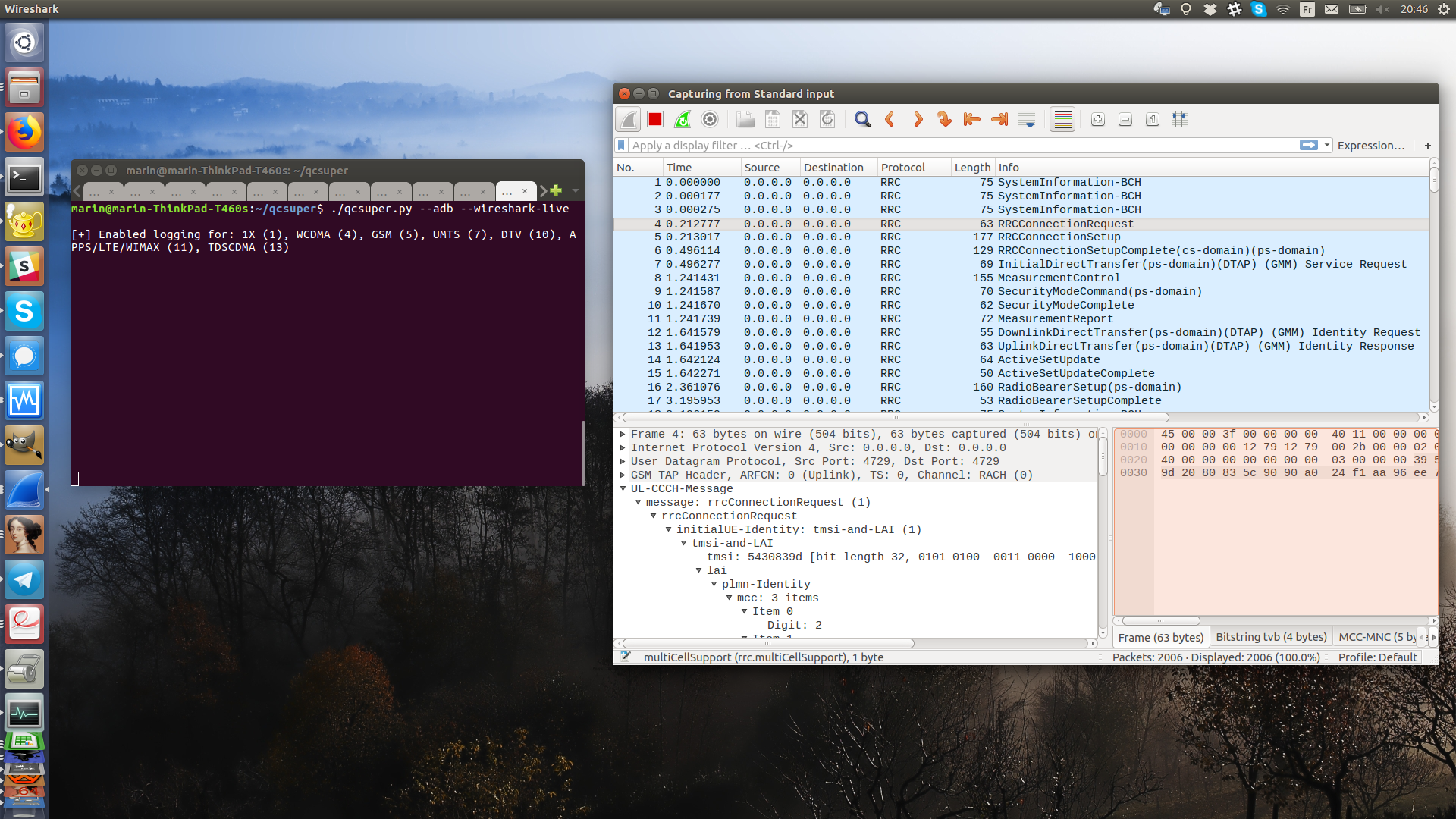
Qualcomm modems have a long history in commercial smartphones and cellular modules. Many of them support a diagnostic channel commonly associated with engineering tools such as Qualcomm Extensible Diagnostic Monitor, better known as QXDM. Open-source projects have also explored Qualcomm diagnostic output for research, allowing certain devices to produce packet captures or structured logs that can be analyzed in tools such as Wireshark.
This is why Qualcomm phones, USB dongles, LTE routers, and mobile hotspots often appear in cellular research discussions. They are widely available, relatively affordable compared with professional telecom test equipment, and capable of exposing valuable radio-layer information when properly configured. In other words, a spare Snapdragon phone can sometimes become a small window into the radio access network, minus the giant suitcase of carrier-grade hardware.
Qualcomm DIAG in Plain English
Qualcomm diagnostic logging is a low-level interface designed for development, testing, and troubleshooting. It may expose modem events, protocol messages, signal measurements, and network state changes. Depending on the device, firmware, operating system, permissions, and carrier configuration, access may be easy, difficult, blocked, unstable, or completely unavailable.
That uncertainty is part of the adventure. Two phones with similar chipsets may behave differently because vendors customize firmware, lock diagnostic ports, change USB modes, restrict root access, or remove useful logging features. A modem module in an industrial router may be easier to inspect than a shiny consumer phone sealed tighter than a submarine sandwich in plastic wrap.
Popular Research Tools and Concepts
Several well-known tools and projects are often mentioned in this space. QXDM is Qualcomm’s professional diagnostic environment. QCSuper is an open-source project focused on capturing radio frames from Qualcomm-based devices for research analysis. MobileInsight provides fine-grained mobile network analytics on end devices. SnoopSnitch has been used to analyze mobile radio data and warn about suspicious mobile network behavior on compatible devices. Wireshark remains the classic packet-analysis workbench, with dissectors for many telecom protocols.
Each tool has a different purpose. Some focus on collection, others on decoding, visualization, or security alerts. None of them magically bypass the law, carrier protections, or physics. The smartest workflow is not “capture everything.” It is “collect only what you are authorized to collect, understand what layer you are looking at, and avoid making dramatic conclusions from one weird log line at 2:00 a.m.”
The Legal and Ethical Boundary
Before touching any cellular analysis tool, draw the legal line in permanent marker. Monitoring your own device for troubleshooting or research is very different from intercepting communications that belong to other people. Unauthorized interception of communications can violate privacy laws, telecom rules, wiretap laws, carrier terms, and basic human decency.
A safe cellular sniffer workflow should follow three rules. First, use hardware you own or have clear permission to test. Second, collect only your own device’s diagnostic information or data from a lawful lab network. Third, do not attempt to impersonate a base station, force devices to connect, capture subscriber identifiers from strangers, or disrupt real networks. The moment a project starts sounding like “what if I trick nearby phones,” it has left the educational lane and driven directly into the legal swamp.
The best mindset is simple: be a network doctor, not a network pickpocket. A doctor examines a consenting patient. A pickpocket says “research” while reaching for someone else’s wallet.
What You Can Learn From Your Own Qualcomm Device
When used responsibly, Qualcomm diagnostic logs can teach a surprising amount about cellular behavior. You may see how the device searches for service, selects a cell, negotiates capabilities, moves between idle and connected states, reacts to weak signal, handles roaming, and switches between LTE and 5G modes. These logs can make invisible network behavior feel almost conversational.
Signal Quality Is More Than Signal Bars
Phone signal bars are famously vague. They are the horoscope of radio engineering: sometimes emotionally comforting, rarely detailed enough for serious decisions. Diagnostic data can expose more useful measurements such as reference signal received power, signal quality, signal-to-noise indicators, serving cell identity, frequency band, bandwidth, and neighbor-cell measurements.
This matters because a phone with three bars can still perform poorly if interference is high, the cell is congested, uplink power is struggling, or the device is stuck on a less suitable band. A modem log can help explain why a speed test looks sad even when the status icon looks cheerful.
Handover and Reselection Behavior
Cellular networks constantly make mobility decisions. A device may move from one cell to another, switch frequency bands, fall back from 5G to LTE, or reselect a more appropriate tower while idle. Diagnostic logs can show when these transitions occur and whether they succeed smoothly.
This is useful for drive testing, rural coverage analysis, home router placement, and debugging mobile IoT deployments. For example, a delivery-tracking modem that disconnects at the same highway curve every day may not be haunted. It may simply be failing during a specific handover region. Ghosts are exciting, but radio logs are usually cheaper.
Qualcomm Phone vs. Qualcomm Modem
A Qualcomm phone and a Qualcomm modem can both be useful, but they serve different personalities. A phone is portable, familiar, and packed with sensors, but it may be locked down by the manufacturer. A USB modem or router module is often easier to integrate into test benches, but it may require more patience, documentation, and adapter cables.
| Device Type | Best For | Main Limitation |
|---|---|---|
| Android phone with Qualcomm chipset | Learning, mobility testing, field observations, app-based analysis | Permissions, rooting limits, vendor restrictions, OS updates |
| USB LTE or 5G modem | Lab testing, router experiments, repeatable capture setups | Firmware variation, driver issues, limited documentation |
| Mobile hotspot | Portable monitoring, security research, controlled travel testing | Restricted interfaces and battery/thermal limits |
| Embedded modem module | IoT, industrial gateways, product development | Requires integration skill and careful power/RF design |
A Safe Conceptual Workflow
A lawful Qualcomm cellular analysis workflow begins with a compatible device and a clear purpose. Maybe you want to compare antenna placement, evaluate a carrier’s band selection, inspect why a modem disconnects, or learn how LTE registration works. The device should be yours, the SIM should be yours or assigned to your organization, and the environment should be legal for testing.
Next comes diagnostic access. Depending on hardware, that may involve official engineering tools, vendor documentation, open-source collectors, or built-in logging features. The details vary widely, so the responsible approach is to follow documentation from the hardware vendor or recognized research tools, while avoiding instructions that involve bypassing protections, violating terms, or interfering with public networks.
Finally, logs are analyzed. Wireshark and telecom-specific analyzers can help decode protocol messages and organize them by layer. The important skill is interpretation. A log file is not a confession letter from the network. It is a technical record that requires context, standards knowledge, and humility. The modem may report a failure because of coverage, policy, firmware, SIM provisioning, roaming restrictions, or the ancient networking law that everything breaks five minutes before dinner.
What a Qualcomm Cellular Sniffer Cannot Do
It is just as important to understand the limits. A diagnostic capture from your phone does not make you the owner of the airwaves. It does not grant permission to monitor strangers. It does not automatically decode encrypted user traffic. It does not replace carrier-grade testing equipment. It does not guarantee full 5G visibility. It does not make every modem compatible.
Modern cellular systems separate many functions across layers. Some messages may be visible, some may be encrypted, some may be vendor-specific, and some may never appear through the diagnostic interface. In 5G, privacy protections such as concealed subscription identifiers are designed to reduce exposure of permanent subscriber identities. That does not make 5G perfect, but it does mean the ecosystem is moving away from the old world where identifiers were easier to expose.
Security Research: The Defensive Value
Defensive cellular research matters because mobile networks are critical infrastructure. Phones carry banking codes, emergency alerts, work logins, family messages, health appointments, and enough food-delivery notifications to reconstruct a person’s emotional timeline. Understanding radio behavior can help researchers identify suspicious network conditions, firmware weaknesses, privacy risks, and unusual base-station behavior.
Detection-focused projects are especially valuable because they help users and researchers notice patterns that may indicate cell-site simulators or abnormal network behavior. The best defensive tools do not encourage people to attack networks. They help document what happened, preserve evidence, and improve public understanding of mobile privacy.
A responsible Qualcomm-based sniffer can therefore support better security awareness. It can help answer questions such as: did the device suddenly expose an identifier? Did it receive an odd request from the network? Did it downgrade unexpectedly? Did a hotspot see behavior consistent with a suspicious cell? These are defensive questions. They are about protecting users, not collecting victims.
Practical Examples of Legitimate Use
Example 1: Finding the Best Router Location
A small business uses a 5G router as backup internet. Speed tests vary wildly. Instead of guessing, the owner compares signal quality and serving-cell behavior in several locations inside the building. The logs reveal that one corner has stronger power but worse quality due to interference, while another spot has cleaner signal and more stable band selection. The router moves, the connection improves, and the office printer still finds a way to be the villain.
Example 2: Debugging an IoT Modem
A logistics company deploys tracking devices that occasionally fail to reconnect after trucks cross state lines. Diagnostic logs show registration rejections tied to roaming behavior and network selection. The team updates carrier provisioning and firmware settings through proper vendor channels. No mystery, no conspiracy, just cellular networks being cellular networks.
Example 3: Learning LTE and 5G Protocols
A student studying wireless security uses a spare compatible device and public documentation to observe lawful diagnostic logs from their own SIM. Instead of memorizing acronyms like RRC, NAS, RSRP, and TAC from a slide deck, they see how those concepts appear in real-world traces. Suddenly the cellular stack feels less like alphabet soup and more like a layered conversation.
Common Mistakes Beginners Make
The first mistake is thinking every Qualcomm device will work the same way. It will not. Hardware revision, Android version, carrier firmware, bootloader policy, and vendor configuration can all change what is available. The second mistake is collecting logs without a question. A giant capture file with no purpose is just digital confetti.
The third mistake is confusing correlation with proof. If your phone disconnects near a government building, that does not automatically mean a secret surveillance van is nearby. It may be congestion, poor coverage, band steering, a temporary outage, or your phone choosing chaos as a lifestyle. Suspicious patterns deserve careful analysis, not instant social media drama.
The fourth mistake is ignoring privacy. Even your own logs may contain sensitive identifiers, location-related information, carrier details, timestamps, and network metadata. Store captures carefully, redact them before sharing, and avoid uploading raw files to random forums. A modem log can be more revealing than it looks.
Best Practices for Responsible Cellular Analysis
Start with a narrow goal. Decide whether you are studying coverage, handover, registration, modem stability, band selection, or security alerts. Use your own SIM and hardware. Keep notes about time, location, device model, firmware version, carrier, and observed symptoms. Without notes, a cellular trace becomes a mystery novel where someone ripped out the first three chapters.
Keep captures small and relevant. Label files clearly. Protect sensitive information. Compare multiple observations before drawing conclusions. When possible, validate findings with official device logs, carrier support, vendor documentation, or a controlled lab setup. If you are doing academic or professional research, follow responsible disclosure norms and institutional policies.
Most importantly, stay passive and lawful. Do not transmit unauthorized signals, impersonate infrastructure, jam frequencies, force downgrades, collect identifiers from bystanders, or interfere with emergency communications. Cellular spectrum is not a sandbox where everyone gets a shovel.
Experience Notes: What It Feels Like to Use a Qualcomm Device as a Cellular Sniffer
The first experience many people have with Qualcomm diagnostic logging is not triumph. It is confusion. The device may not expose the expected interface. The driver may behave differently than the guide describes. The phone may have received an update that changed everything. The modem may produce logs, but the first capture looks like a bowl of technical noodles. This is normal. Cellular analysis has a learning curve, and the curve occasionally wears roller skates.
Once the first clean trace appears, the experience changes. You begin to see the phone as more than a black rectangle with apps. It becomes a constantly negotiating radio computer. It searches. It measures. It reports. It asks for resources. It moves between network states. It listens to the serving cell and watches neighbors. It reacts to signal quality, policy, mobility, and network instructions. The invisible becomes visible, and that is where the fun begins.
A memorable lesson is that cellular performance is rarely explained by one number. Beginners often obsess over signal strength, but real performance depends on a mixture of signal quality, interference, band, bandwidth, network load, device capability, antenna design, carrier aggregation, backhaul, and radio scheduling. A “strong” signal can still deliver weak results, while a modest signal can perform well if the channel is clean and the network is not overloaded.
Another useful experience is testing the same device in different positions. Move a hotspot from a desk to a window and you may see a serving-cell change. Rotate it and signal quality may shift. Place it near metal shelves and the modem may sulk. Take it outside and it may suddenly discover a better band. These changes teach a practical truth: radio waves are not polite straight lines. They bounce, fade, interfere, and generally behave like invisible cats.
Field testing also teaches humility. A trace may show an attach failure, but the cause might be SIM provisioning. A handover may fail because the network made a policy decision, not because the phone is broken. A sudden fallback from 5G to LTE may be normal power management, coverage behavior, or carrier configuration. Diagnostic data is powerful, but it does not remove the need for careful thinking.
The best habit is to build a testing journal. Record the device model, modem firmware, carrier, SIM type, location, time, weather if outdoors, antenna position, and what you were trying to learn. Over time, patterns appear. You may discover that one carrier favors a certain band in your area, that a modem performs better after a firmware update, or that a router location you once trusted is secretly terrible during evening congestion.
The most rewarding part is not “sniffing” in the dramatic sense. It is understanding. A Qualcomm phone or modem can become a learning instrument that makes cellular networks less mysterious. Used responsibly, it can help improve connectivity, support research, detect suspicious behavior, and teach real-world wireless engineering. Used irresponsibly, it becomes a legal and ethical disaster. The tool is not the hero or villain. The operator is.
Conclusion
Turning a Qualcomm phone or modem into a cellular sniffer is best understood as lawful diagnostic analysis, not secret surveillance. With compatible hardware, ethical boundaries, and the right analytical mindset, a device you already own may reveal valuable information about radio conditions, network behavior, mobility, modem stability, and cellular security.
The key is restraint. Use your own equipment. Study your own connection. Protect sensitive logs. Avoid unauthorized interception or interference. Treat cellular networks as critical infrastructure, because they are. When approached responsibly, Qualcomm diagnostic logging can be a fascinating bridge between everyday mobile devices and the deep engineering that keeps modern wireless life running.
Note: This article is for lawful education, troubleshooting, and defensive research only. It does not endorse intercepting other people’s communications, impersonating cellular infrastructure, disrupting networks, or bypassing carrier or device protections.