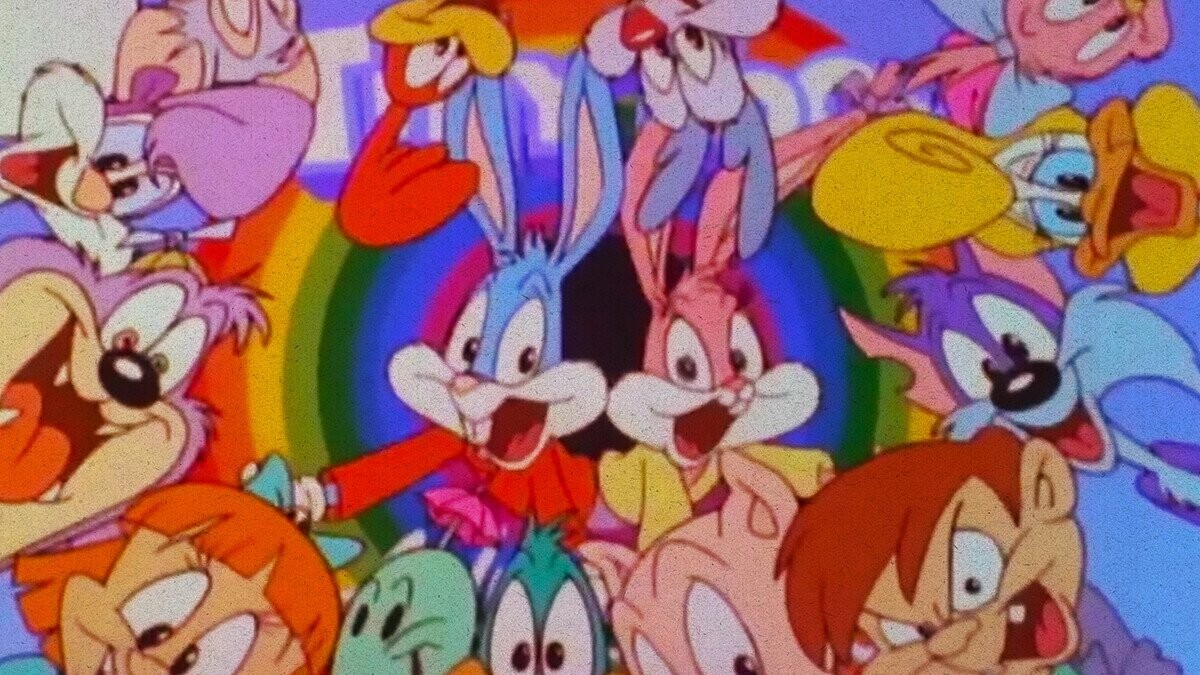
Some cartoons politely ask for your attention. Tiny Toon Adventures kicks down the door, yells “Toon in!” and throws a cream pie at the furniture. Premiering in 1990, the Warner Bros. Animation and Amblin Entertainment series arrived at exactly the right moment: kids wanted speed, jokes, pop culture, and chaos; adults wanted proof that Saturday morning animation could still have brains under the anvil. Somehow, Steven Spielberg, Tom Ruegger, Paul Dini, Sherri Stoner, and a deep bench of animators and voice actors delivered all of that in one very bouncy package.
The show was not simply “Looney Tunes, but smaller.” It was a clever next-generation comedy classroom. Buster Bunny, Babs Bunny, Plucky Duck, Hamton J. Pig, Fifi La Fume, Dizzy Devil, Shirley the Loon, Montana Max, Elmyra Duff, and the rest of the Acme Acres gang attended Acme Looniversity, where classic Warner Bros. legends such as Bugs Bunny, Daffy Duck, Porky Pig, and Elmer Fudd acted as mentors. Imagine film school, but the final exam is surviving a falling safe.
For fans of 1990s cartoons, Tiny Toon Adventures remains a major milestone. It helped revive Warner Bros. television animation, paved the runway for Animaniacs, and proved that kids’ comedy could be fast, self-aware, musical, satirical, and still completely ridiculous. Here are 15 trivia tidbits about Tiny Toon Adventures that explain why we are, scientifically speaking, all a little looney.
1. Steven Spielberg Helped Give Warner Bros. Animation a New Spark
One of the biggest Tiny Toon Adventures facts is right there in the full title often used for the series: Steven Spielberg Presents Tiny Toon Adventures. Spielberg, already a lifelong fan of classic cartoons, joined Warner Bros. Animation through Amblin Entertainment to help create a modern successor to the Golden Age spirit of Bugs Bunny and friends.
The result was not a museum piece. The series borrowed the DNA of Looney Tunes—slapstick timing, wild reactions, verbal cleverness, fourth-wall jokes—and gave it a 1990s engine. That meant faster pacing, pop-culture riffs, celebrity parody, and characters who knew they were starring in a cartoon. Buster Bunny did not merely exist in the show; he often behaved like the show’s tiny blue cruise director.
2. The Show Was Originally Connected to a Movie Idea
Before it became a daily animated TV series, the concept that led to Tiny Toon Adventures was explored as a way to revive Warner Bros. cartoon characters for a new generation. Early ideas reportedly included younger versions or descendants of the classic characters. Eventually, the creative team landed on a smarter solution: new students inspired by the icons, not simple copies.
That decision mattered. Buster could echo Bugs Bunny without being trapped as “Baby Bugs.” Plucky could absorb Daffy Duck’s ego and disaster magnetism without becoming a tiny duplicate. Hamton could reflect Porky Pig’s sweetness while still having his own nervous, lovable personality. It was homage with room to breathe—and occasionally hyperventilate.
3. Buster and Babs Bunny’s Running Joke Was Genius Branding
Few catchphrases from the show are more memorable than Buster and Babs introducing themselves with the clarification: “No relation.” It is such a small gag, but it does a lot of work. It lets the show wink at the audience, prevents confusion, and establishes the pair as co-stars with equal comic energy.
Buster is usually the smoother host: cool, confident, and Bugs-like in his ability to glide through trouble. Babs, voiced with explosive comic range, is a one-bunny variety show. She changes voices, costumes, moods, and plans at the speed of a channel surfer with sugar in the bloodstream. Together, they gave the series its perfect center: one foot in classic cartoon cool, the other on a banana peel.
4. Acme Looniversity Was the Perfect Cartoon Premise
The school setting was more than a cute backdrop. Acme Looniversity gave Tiny Toon Adventures a flexible story machine. Any episode could become a lesson in comedy, fear, greed, friendship, stage fright, satire, or how not to stand under something labeled “ACME.”
The idea that young toons were learning from the old masters also helped bridge generations. Parents recognized Bugs, Daffy, Porky, Sylvester, Tweety, and Elmer. Kids got their own crew of new characters. The show became a handoff between eras, like a cartoon relay race where the baton is dynamite and everyone pretends this is normal.
5. The Voice Cast Was Absolutely Stacked
The voice cast of Tiny Toon Adventures reads like a roll call of animation legends. Charlie Adler, Tress MacNeille, Joe Alaskey, Don Messick, Kath Soucie, Cree Summer, Frank Welker, Rob Paulsen, Maurice LaMarche, Candi Milo, John Kassir, and others helped populate Acme Acres with memorable voices.
What made the show special was not only the famous names, but the flexibility. Characters had to scream, sing, parody celebrities, switch personas, react to impossible physics, and still sound emotionally readable. That is harder than it looks. A bad cartoon scream is just noise. A great cartoon scream has punctuation, rhythm, and possibly dental insurance.
6. Tom Ruegger Was One of the Key Creative Minds
Tom Ruegger, who played a major creative role in Tiny Toon Adventures, became one of the central figures in the Warner Bros. television animation renaissance of the 1990s. His approach helped distinguish the show from the toy-driven cartoons of the previous decade. Instead of building stories around plastic accessories and moral-of-the-week lectures, the creative team emphasized character, jokes, music, and old-school cartoon craft.
That philosophy carried forward into Animaniacs, which arrived a few years later and pushed the same energy even further. In that sense, Tiny Toon Adventures was not just a hit show. It was a proof of concept: animation could be smart, fast, silly, and creator-driven on television.
7. The Series Was Expensive and Ambitious for Its Time
Tiny Toon Adventures was not tossed together like a bargain-bin Saturday morning filler show. Reports from the era describe a major production investment, with a large first-season budget and a sizable animation staff. Episodes required long production timelines, multiple stages of approval, and collaboration across writing, storyboarding, music, voice acting, and animation.
You can see that ambition on screen. The animation is not perfect in every episode—television schedules are hungry beasts—but the show often moves with far more personality than many of its contemporaries. Characters stretch, squash, mug, zip, splat, and recover from disaster with the confidence of performers who know the laws of physics are merely suggestions.
8. The Theme Song Is a Tiny Masterpiece of Cartoon Marketing
The Tiny Toon Adventures theme song does exactly what a great cartoon intro should do: it explains the premise, introduces the cast, sells the tone, and lodges itself permanently in your brain like a cheerful musical woodpecker. It is upbeat, crowded, funny, and efficient.
The line “We’re all a little looney” captures the show’s invitation. The series does not ask viewers to admire cool characters from a distance. It says everyone has a little cartoon madness inside them: the urge to overreact, make a joke, chase a dream, or turn a school hallway into a chase scene. That is why the theme still works. It is not just an opening. It is a permission slip.
9. Plucky Duck Became a Breakout Character
Every ensemble comedy needs a character who thinks he is the star, even when the universe strongly disagrees. In Tiny Toon Adventures, that character is Plucky Duck. Inspired by the ego and volatility associated with Daffy Duck, Plucky is ambitious, dramatic, jealous, cowardly, and weirdly lovable.
Plucky works because his flaws are theatrical. He does not simply want attention; he wants applause, fame, wealth, respect, and possibly a commemorative statue before lunch. His disasters are often self-inflicted, but the show never makes him impossible to like. He is the tiny green mascot for every bad idea that started with “Relax, I know what I’m doing.”
10. Elmyra Duff Was Adorably Terrifying
Elmyra Duff is one of the show’s funniest contradictions. She loves animals passionately, which would be sweet if she did not express that love with the subtlety of a hydraulic press. She hugs, squeezes, chases, names, traps, and cuddles creatures who would very much like to file a restraining order.
The joke is simple, but effective: Elmyra is not a villain in her own mind. She is affectionate. The comedy comes from the gap between intention and impact. That makes her a perfect cartoon character. In real life, respect the pet’s personal space. In Acme Acres, run.
11. The Show Loved Pop Culture Parody
Tiny Toon Adventures did not limit itself to school stories and simple slapstick. It regularly parodied movies, television, music, celebrities, and entertainment trends of the early 1990s. That gave the show replay value for older viewers while still keeping the gags broad enough for kids.
This was one reason the series aged better than many cartoons of its era. Some references are wonderfully dated now, but the confidence behind them remains fun. The writers trusted young audiences to keep up. If a joke flew over a kid’s head, there was usually a visual gag, a funny voice, or a falling object arriving half a second later to keep everyone aboard.
12. ‘Tiny Toon Music Television’ Helped Introduce Kids to They Might Be Giants
One of the most beloved episodes is “Tiny Toon Music Television,” a parody of MTV-style programming. It featured animated music-video segments, including memorable uses of They Might Be Giants songs such as “Istanbul (Not Constantinople)” and “Particle Man.”
For many viewers, this was their first exposure to the band’s wonderfully odd sound. The pairing made sense. They Might Be Giants had the same playful intelligence that Tiny Toon Adventures loved: catchy, strange, clever, and just a little tilted. Plucky in a music video is already funny. Plucky in a surreal mini-epic set to alternative pop? That is premium-grade 1990s cartoon weirdness.
13. ‘How I Spent My Vacation’ Was a Direct-to-Video Landmark
Tiny Toon Adventures: How I Spent My Vacation became one of the most important extensions of the franchise. Released in 1992, the feature-length animated film followed several storylines, including Buster and Babs on a chaotic river trip, Plucky enduring Hamton’s family vacation, and other summer break misadventures.
The movie is often remembered as a key direct-to-video animated feature in the United States. That may sound normal now, but at the time, the idea of a feature-length animated release going straight to home video was far less common. The film proved that a TV animation property could create a substantial home-video event. In other words, Plucky helped predict the future of family entertainment. Please do not tell him. He will become unbearable.
14. ‘Night Ghoulery’ Gave the Gang a Spooky Showcase
The 1995 special Tiny Toons’ Night Ghoulery reunited the characters for a Halloween-themed anthology. It parodied spooky television and horror classics, especially the mood of shows such as Night Gallery and The Twilight Zone. Babs served as host, guiding viewers through a series of eerie, silly, and very toon-friendly segments.
The special is a reminder that Tiny Toon Adventures could work outside the regular classroom format. Put these characters in a horror spoof, a music-video parody, a vacation movie, or a celebrity satire, and the basic engine still runs. The characters are flexible because the show is built on performance, not one rigid formula.
15. The Show Helped Build the Road to ‘Animaniacs’
It is difficult to talk about Tiny Toon Adventures without mentioning Animaniacs. The later series took the Warner/Amblin comedy style—rapid-fire jokes, songs, cultural references, historical parody, and fourth-wall play—and turned the dial even higher. But Tiny Toon Adventures got there first.
The show demonstrated that audiences would respond to a cartoon that respected their intelligence while throwing pies at their eyeballs. It helped make room for the 1990s wave of smarter television animation, from Warner Bros. hits to creator-driven cable cartoons. Not every later show copied its style, but many benefited from the door it helped reopen.
Why ‘Tiny Toon Adventures’ Still Works
The secret of Tiny Toon Adventures is balance. It is nostalgic without being dusty. It is silly without being empty. It is referential without becoming homework. The show knows the Looney Tunes tradition is legendary, but it does not simply bow in front of it. It runs around it, pokes it, borrows its mallet, and uses it to ring the school bell.
Modern viewers may notice some elements that feel very early 1990s. That is part of the charm and part of the historical context. Comedy evolves. Standards change. But the best parts of Tiny Toon Adventures—sharp timing, expressive characters, musical confidence, and creative freedom—remain deeply watchable.
Experience Notes: Watching ‘Tiny Toon Adventures’ as a Cartoon Time Machine
Revisiting Tiny Toon Adventures today feels like opening a lunchbox and finding a tiny portal to the after-school universe. The first thing that hits you is the speed. Modern animation can be fast, of course, but Tiny Toons has a special kind of controlled panic. Scenes move like the writers were racing a stopwatch, the animators were chasing a runaway piano, and the voice actors were happily driving the getaway car.
One of the best experiences is realizing how layered the humor is. As a kid, you may laugh because Plucky gets flattened or because Dizzy Devil turns a room into a furniture smoothie. As an older viewer, you notice the structure: the setup, the reversal, the parody, the musical cue, the way a character’s ego creates the explosion long before the dynamite appears. The show teaches comedy by doing it. Acme Looniversity is fictional, but the lessons are real.
The character dynamics also become more enjoyable with time. Buster and Babs are not funny in the same way, which keeps their partnership fresh. Buster often plays the confident host, the one who knows how the cartoon machinery works. Babs is pure performance electricity. Plucky brings insecurity disguised as confidence. Hamton provides sweetness and worry. Elmyra turns affection into a chase sequence. Montana Max is greed in child-sized formalwear. Together, they create a rhythm where almost any pairing can produce a joke.
Another pleasure is the music. The theme song still has that bright, parade-like energy, but the musical experiments inside the series are even more interesting. The MTV parody episode, especially the They Might Be Giants segments, shows how open the series was to unusual pop-culture combinations. It did not talk down to viewers. It assumed kids could enjoy odd music, old references, genre spoofs, and jokes that might not fully land until years later. That kind of trust creates loyal fans.
Watching the show now also highlights how important it was as a bridge. It connected the classic theatrical-short tradition to the television animation boom of the 1990s. The characters were younger, brighter, and more contemporary, but the bones were old-school: anticipation, exaggeration, timing, impact, and recovery. A character sees the safe falling, holds up a sign, accepts destiny, gets smashed, and pops back into shape. That ancient cartoon grammar still works because it is basically visual jazz with anvils.
For anyone writing about animation, comedy, or 1990s pop culture, Tiny Toon Adventures is more than nostalgia bait. It is a case study in how to update a classic brand without embalming it. The show did not replace Bugs Bunny or Daffy Duck. It built a playground next door and invited a new class to make noise. That is why the series still inspires affection. It reminds viewers that being a little looney is not a flaw. In the right cartoon, it is a graduation requirement.
Conclusion: Class Dismissed, Chaos Continued
Tiny Toon Adventures remains one of the defining animated series of the early 1990s because it understood both inheritance and invention. It honored Looney Tunes without simply shrinking the originals. It created a cast with their own personalities, gave them a brilliant school-based premise, powered them with sharp writing and elastic voice performances, and let them run wild across parodies, songs, specials, and home-video history.
More than three decades later, the show still feels like a cheerful warning label: comedy is contagious, nostalgia is powerful, and no hallway is safe once Plucky Duck has a plan. Whether you remember it from weekday afternoons, VHS tapes, reruns, or later streaming discoveries, Tiny Toon Adventures continues to prove that animation is at its best when it is smart enough to be silly on purpose.