Citing multiple authors in APA can feel a little like trying to introduce a crowded group at a party: you want to give everyone proper credit, but you also do not want your sentence to turn into a roll call. The good news is that APA 7th edition makes multiple-author citations much simpler than older versions. Once you understand when to use an ampersand, when to write “and,” when to use “et al.,” and how many names belong in the reference list, the whole system becomes much less dramatic.
This guide explains 4 ways to cite multiple authors in APA, including in-text citations, parenthetical citations, narrative citations, reference list entries, and tricky cases such as group authors or several sources in the same parentheses. Whether you are writing a psychology paper, education essay, nursing assignment, literature review, or research proposal, these APA citation rules will help your work look polished, credible, and easy to follow.
Why APA Multiple-Author Citations Matter
APA style uses an author-date citation system. That means your reader should be able to see the author and year in the text, then find the full source in the reference list. When a source has multiple authors, correct formatting does more than satisfy your instructor’s checklist. It tells readers who contributed to the research, keeps your sources traceable, and helps avoid accidental plagiarism.
The main challenge is that APA treats two-author sources differently from sources with three or more authors. It also uses different punctuation depending on whether the citation appears inside parentheses or in the flow of your sentence. Do not worry. APA has rules, not riddles. Let’s untangle them one at a time.
Way 1: Cite Two Authors in APA In-Text Citations
When a work has exactly two authors, APA requires you to include both authors’ last names every time you cite the source. This applies whether you are paraphrasing, summarizing, or quoting directly.
Parenthetical Citation for Two Authors
In a parenthetical citation, both author names appear inside parentheses. Use an ampersand between the names.
Example: Students often improve their academic writing when citation rules are taught with clear examples (Miller & Santos, 2022).
The ampersand is important. In APA style, you write & inside parentheses, not the word “and.” Think of the ampersand as the tiny academic handshake between two authors.
Narrative Citation for Two Authors
In a narrative citation, the authors’ names become part of your sentence. In this case, use the word “and” instead of an ampersand.
Example: Miller and Santos (2022) found that students often improve their academic writing when citation rules are taught with clear examples.
The year still appears in parentheses immediately after the authors’ names. If you quote directly, add a page number or another locator.
Example: Miller and Santos (2022) described citation practice as “a skill strengthened through repetition” (p. 41).
Quick Rule to Remember
For two authors, use both names every time. Use & in parenthetical citations and and in narrative citations.
Way 2: Cite Three or More Authors With “Et al.”
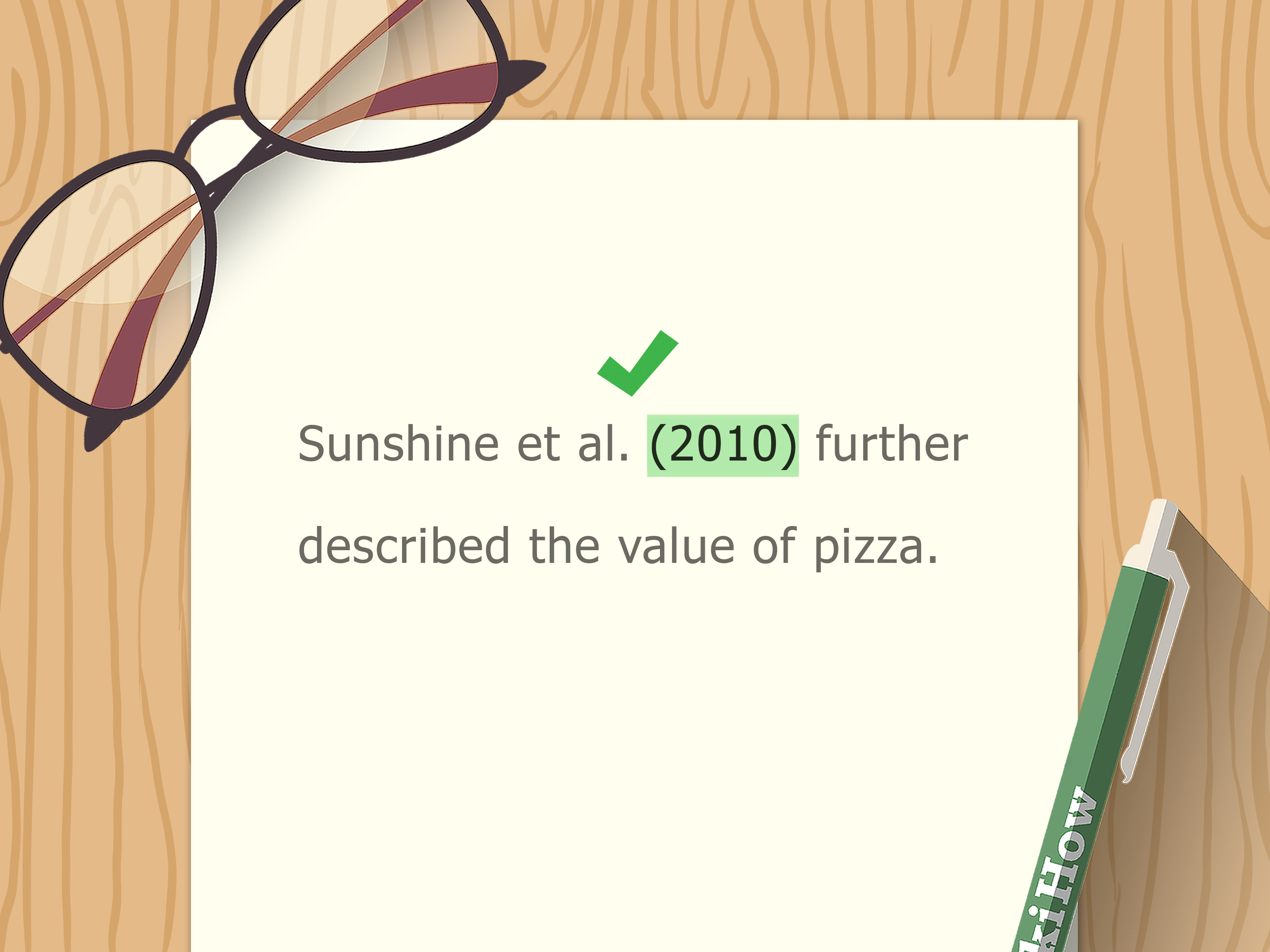
For a source with three or more authors, APA 7th edition uses a shorter format from the first citation onward. Write the first author’s last name followed by et al. and the year.
Parenthetical example: Strong source integration can improve the clarity of research writing (Nguyen et al., 2021).
Narrative example: Nguyen et al. (2021) explained that strong source integration can improve the clarity of research writing.
The phrase et al. means “and others.” In APA style, “et” does not get a period, but “al.” does. Also, do not italicize it in regular APA citations. It may look fancy enough to deserve a tuxedo, but plain text is the correct outfit.
What Changed From APA 6 to APA 7?
In APA 6, writers often listed all authors the first time they cited a source with three to five authors, then shortened later citations with “et al.” APA 7 simplified that rule. Now, for three or more authors, use the first author’s last name plus “et al.” every time, including the first citation.
When “Et al.” Creates Confusion
Sometimes two different sources shorten to the same citation. For example, imagine these two works:
Source A: Garcia, Lee, Patel, and Brown (2020)
Source B: Garcia, Lee, Chen, and Smith (2020)
Both would normally become Garcia et al. (2020), which makes your reader wonder which Garcia squad you mean. In that case, APA allows you to include as many author names as needed to distinguish the sources.
Example: Garcia, Lee, Patel, et al. (2020) argued one point, while Garcia, Lee, Chen, et al. (2020) reached a different conclusion.
This rule keeps citations short without turning them into mystery clues.
Way 3: Format Multiple Authors in the APA Reference List
In-text citations are only half of the job. Every source cited in your paper should have a matching entry in the reference list. For multiple-author sources, APA reference entries follow specific author formatting rules.
Reference List Format for Two Authors
For two authors, list both authors in the order shown on the source. Write each last name first, followed by initials. Place an ampersand before the final author.
Example:
Johnson, R. T., & Blake, M. A. (2023). Academic writing strategies for college students. Learning Press.
Reference List Format for Three to Twenty Authors
For sources with up to 20 authors, APA 7 requires you to include all author names in the reference list. Separate author names with commas, and place an ampersand before the final author.
Example:
Hernandez, L. M., Cooper, J. E., Singh, P., Wallace, T. R., & Kim, S. Y. (2021). Citation confidence and student research habits. Journal of Academic Skills, 14(2), 55–72.
Notice that the in-text citation would be much shorter:
Example: Citation confidence improves when students practice with realistic examples (Hernandez et al., 2021).
Reference List Format for Twenty-One or More Authors
When a source has 21 or more authors, APA does not ask you to list every single person. Instead, include the first 19 authors, insert an ellipsis, and then add the final author’s name. Do not use an ampersand before the final author in this special format.
Simplified example:
Adams, B. C., Baker, R. L., Carter, S. M., Diaz, P. R., Evans, T. K., Flores, A. J., Green, H. P., Hall, M. E., Irwin, D. S., Jones, F. A., Keller, N. L., Lopez, V. R., Martin, W. J., Nelson, C. E., Ortiz, G. M., Parker, L. S., Quinn, J. D., Reed, K. A., Stone, P. L., . . . Young, R. T. (2022). Collaborative research practices in higher education. Research Methods Review, 9(1), 10–29.
This rule matters because large research teams are common in health sciences, psychology, education, and social science research. APA keeps the reference useful without making your reference page look like a phone directory from 1998.
Way 4: Cite Multiple Works and Group Authors Correctly
Sometimes “multiple authors” does not mean one source with several writers. It can also mean several sources in the same citation, or an organization acting as the author. These cases are common in literature reviews, reports, and research-heavy essays.
Citing Several Sources in One Parentheses
When you cite multiple works in the same parentheses, list them alphabetically by the first author’s last name. Separate each source with a semicolon.
Example: Many students find APA easier when they learn citation patterns through examples, checklists, and revision practice (Adams, 2020; Johnson & Blake, 2023; Nguyen et al., 2021).
This format helps you support a broad claim without overloading your sentence. It also lets readers quickly scan the evidence behind your point.
Citing Multiple Works by the Same Author
If you cite more than one work by the same author, list the years in chronological order.
Example: Prior research has connected citation practice with stronger source evaluation skills (Miller, 2019, 2021, 2024).
If the same author published more than one work in the same year, use lowercase letters after the year. These letters must match the reference list entries.
Example: The study design was discussed in earlier research on student writing habits (Taylor, 2022a, 2022b).
Citing Group Authors
A group author is an organization, agency, association, institution, or company credited as the author. Examples include the American Psychological Association, Centers for Disease Control and Prevention, National Institutes of Health, or a university department.
If the group has a well-known abbreviation, write out the full name the first time and include the abbreviation in brackets. After that, you may use the abbreviation.
First citation: The guidelines emphasize clear and consistent scholarly communication (American Psychological Association [APA], 2020).
Later citation: APA (2020) recommends using precise author-date citations to help readers locate sources.
In the reference list, however, spell out the full group author name. Do not use the abbreviation as the author name in the reference entry.
Common APA Multiple-Author Mistakes to Avoid
Mistake 1: Using “and” Inside Parentheses
Incorrect: (Miller and Santos, 2022)
Correct: (Miller & Santos, 2022)
APA wants the ampersand inside parentheses. Save “and” for narrative citations.
Mistake 2: Listing All Authors In-Text for Three or More Authors
Incorrect: (Nguyen, Patel, Rodriguez, and Lee, 2021)
Correct: (Nguyen et al., 2021)
For three or more authors, use the first author’s last name and “et al.” unless more names are needed to avoid confusion.
Mistake 3: Forgetting the Period in “Et al.”
Incorrect: Nguyen et al (2021)
Correct: Nguyen et al. (2021)
The period belongs after “al.” because it is an abbreviation. Tiny dot, big difference.
Mistake 4: Alphabetizing by the Wrong Author
In the reference list, alphabetize sources by the last name of the first author listed on each source. Do not rearrange author order based on who seems more important. The author order in a publication is intentional and should be preserved.
APA Multiple-Author Citation Examples
Two Authors
Parenthetical: (Rivera & Chen, 2020)
Narrative: Rivera and Chen (2020)
Three or More Authors
Parenthetical: (Bennett et al., 2022)
Narrative: Bennett et al. (2022)
Multiple Works in One Citation
Example: Research writing improves when students receive repeated practice and clear feedback (Bennett et al., 2022; Rivera & Chen, 2020; Williams, 2021).
Group Author
First citation: (National Institute of Mental Health [NIMH], 2023)
Later citation: (NIMH, 2023)
Practical Experience: What Students Often Learn the Hard Way
After helping writers polish APA papers, one pattern becomes obvious: most citation errors are not caused by laziness. They happen because students try to memorize too many tiny rules at once. APA looks intimidating when you stare at a reference page full of commas, initials, italics, years, parentheses, and mysterious little ampersands. But once you group the rules into practical habits, citing multiple authors becomes much easier.
The first helpful habit is to separate in-text citations from reference list entries. Many students accidentally mix these two systems. They see five authors in the reference list and assume all five names must appear in the sentence. That is usually not true. In APA 7, a source with three or more authors becomes “First Author et al.” in the text, even though the reference list may include every author up to 20 names. In other words, the in-text citation is the short road sign; the reference entry is the full address.
The second habit is to decide whether your citation is parenthetical or narrative before typing the names. If the citation sits at the end of a sentence, it is probably parenthetical, so two authors need an ampersand: (Lopez & Grant, 2021). If the authors are part of your sentence, use “and”: Lopez and Grant (2021). This small choice prevents one of the most common APA mistakes.
The third habit is to check “et al.” carefully. Many writers forget the period, capitalize it oddly, or add an unnecessary comma after the author name in narrative citations. The clean forms are simple: (Patel et al., 2020) and Patel et al. (2020). Once you type it correctly a few times, your fingers will remember it before your brain finishes complaining.
The fourth habit is to build your reference list slowly instead of saving it for the final hour. Waiting until the night before a deadline to format 18 sources is how perfectly nice students become haunted by commas. Add each source as you use it. Keep author names in the same order as the original source. Use initials, not full first names. Check capitalization for article titles and journal titles. A reference list is much easier to fix when it grows one source at a time.
Another real-world lesson is that citation generators are useful but not magical. They can save time, especially for basic journal articles and books, but they may misread author names, dates, capitalization, or missing information. Treat citation tools like GPS: helpful, but still capable of sending you into a lake if you stop paying attention. Always compare the output with APA rules, especially for sources with many authors.
Finally, remember why citations exist. They are not just academic decorations. They show respect for other researchers, help readers verify your claims, and make your writing more trustworthy. When you cite multiple authors correctly, you are showing that you can join a scholarly conversation without stepping on anyone’s foot. That is a valuable skill in college, graduate school, professional writing, and any field where evidence matters.
Conclusion
Learning how to cite multiple authors in APA is mostly about recognizing patterns. For two authors, include both names every time and switch between “and” and “&” depending on the citation type. For three or more authors, use the first author’s last name followed by “et al.” For reference list entries, include all authors up to 20, and use the special ellipsis rule for 21 or more authors. When citing several sources at once, alphabetize them and separate them with semicolons.
APA citation may never become your favorite hobby, but it does not have to be your academic villain origin story. With a few reliable rules and plenty of examples, you can cite multiple authors clearly, confidently, and correctly.