Note: This article is written as an original, research-based feature inspired by real church architecture, vertical panorama photography, and the global appeal of sacred spaces.
Introduction: Looking Up Changes Everything
Most travelers enter a church the same way they enter a bakery: with good intentions, a wandering eye, and a vague hope that something beautiful will happen. They admire the altar, whisper because everyone else is whispering, take one quick photo, and leave with a crooked image of a pew, a blurry candle, and possibly a stranger’s elbow. But churches were never meant to be understood only at eye level. Their greatest stories often begin above us.
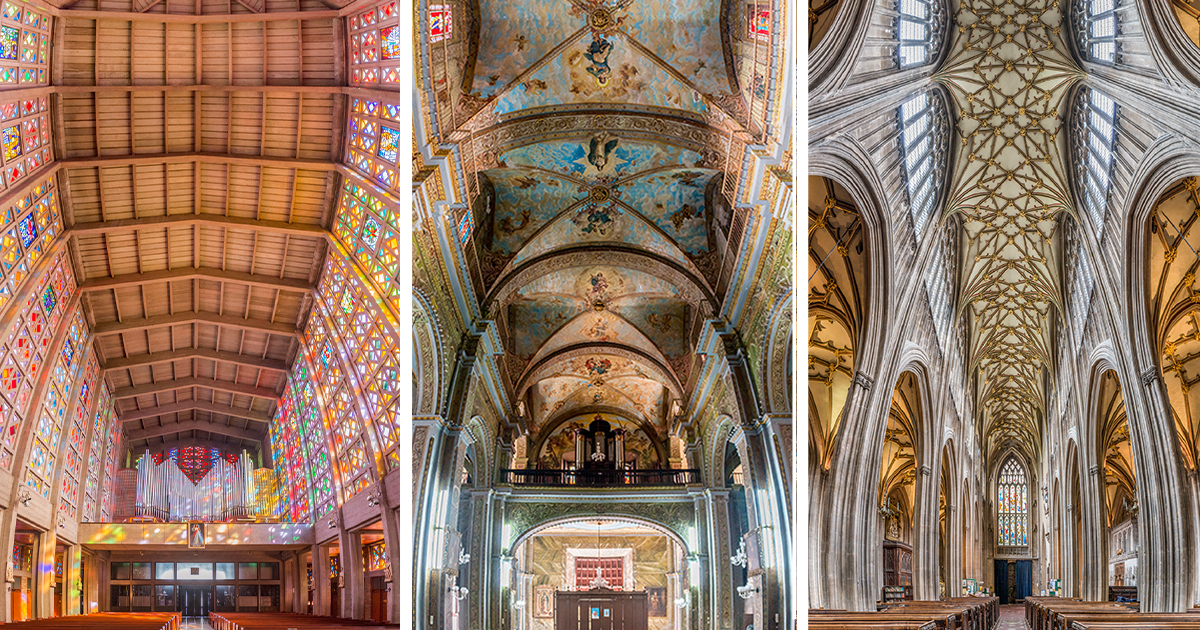
That is the magic behind vertical church photography: it turns the act of looking up into a complete visual experience. Instead of capturing only a wall, a nave, a dome, or a ceiling, a vertical panorama pulls the whole interior into one sweeping frame. The photograph begins near the entrance or pews, rises through columns and arches, passes stained glass and ribs of stone, reaches the ceiling or dome, then returns toward the altar. The result feels almost impossible, like the building has been gently unfolded for the viewer.
Churches around the world are ideal subjects for this approach because so many were designed around height, symmetry, light, and spiritual direction. Gothic cathedrals used pointed arches, ribbed vaults, and flying buttresses to draw the eye upward. Baroque churches wrapped worshippers in theatrical curves, gilded details, and painted heavens. Modern churches often use concrete, steel, glass, and bold geometry to create their own kind of silence. In every era, sacred architecture has asked the same question: how can a building make a human being feel small, lifted, and strangely comforted at the same time?
Photographing churches from the perfect vertical perspective is not just a technical trick. It is a way of reading architecture. It shows how builders, artists, engineers, and communities worked together to turn stone, timber, brick, tile, glass, and faith into spaces that still stop people mid-step centuries later. And yes, it also requires a lot of patience, because nothing says “professional photographer” like standing in the middle of a nave waiting for a tour group to stop taking selfies under the organ loft.
What Makes a Church “Vertical”?
A vertical church photograph is usually created by taking several images from one carefully chosen position and stitching them together into a single tall panorama. The camera moves in an arc: forward, upward, overhead, and back. When done well, the final image reveals what the human eye experiences in fragments but cannot hold all at once.
Architecture Built to Pull the Eye Skyward
The vertical effect begins long before the camera appears. Many historic churches were designed to create a sense of ascent. In Gothic architecture, the pointed arch is not merely decorative; it emphasizes height and directs visual energy upward. Ribbed vaults organize ceilings into elegant skeletal patterns, while flying buttresses move structural pressure outward, allowing walls to rise higher and windows to grow larger. This engineering made buildings feel lighter, brighter, and more heavenly than earlier heavy-walled structures.
Cathedrals such as Chartres, Notre-Dame de Paris, Cologne Cathedral, and Salisbury Cathedral show how verticality became both a structural solution and a spiritual language. Tall naves, stained glass, spires, and layered stonework were not random acts of medieval enthusiasm. They were carefully calculated ways to inspire awe. In modern terms, they were the original “wow factor,” minus the LED strip lighting and influencer wall.
Symmetry, Center Aisles, and the Photographer’s Sweet Spot
The best vertical church images usually begin from the center aisle. This position allows the photographer to align the nave, pews, columns, ceiling, altar, and rear entrance into one balanced composition. Symmetry matters because church interiors often depend on repeated forms: arches following arches, columns marching in pairs, windows echoing one another, ceiling ribs branching like stone trees.
Finding the perfect perspective means searching for the point where all these lines agree. Move a few inches to the left, and the image may feel drunk. Move a few inches to the right, and the altar suddenly looks like it is trying to escape. A successful vertical panorama depends on discipline, patience, and a willingness to look slightly ridiculous while adjusting a tripod in sacred silence.
The Technique Behind Vertical Church Photography
Vertical panoramas may look effortless, but they are built through careful planning. A typical image may combine five to ten photographs, although the exact number depends on the lens, the size of the church, the height of the ceiling, and how much detail the photographer wants to preserve. Wide-angle lenses are helpful, but they can distort lines if used carelessly. The goal is not to make the church look like it is bending through a wormhole. The goal is to honor the building’s structure while revealing its full drama.
Light Is the Blessing and the Problem
Churches are notoriously challenging to photograph because they are often dark and bright at the same time. A candlelit chapel may sit beneath a blazing stained-glass window. A white marble altar may glow while wooden pews disappear into shadow. Sunlight can pour through clerestory windows like liquid gold, then vanish behind clouds five seconds later. The camera has to deal with contrast that the human eye handles naturally.
This is why exposure control is essential. Photographers often shoot multiple frames carefully, sometimes adjusting exposure to protect highlights and recover shadow detail. The stitched result should preserve atmosphere without turning the interior into either a cave or a furniture showroom. Sacred spaces need shadow. Without it, mystery packs its bags and leaves.
Stitching the Story Together
After the shoot, software helps merge the separate frames into one vertical composition. This process can be surprisingly delicate. Repeated arches may confuse the alignment. Curved ceilings can stretch in strange ways. A chandelier may appear to have entered a witness protection program. Successful editing requires restraint: correct the geometry, balance the light, maintain texture, and avoid polishing the image until the church looks less like a historic place and more like a luxury airport lounge.
The final image should feel immersive, not artificial. It should invite the viewer to travel through the space with their eyes, from the floor to the ceiling and back again. When the technique works, the viewer does not think first about the camera. They think, “How did I miss all this when I was standing there?”
Why Churches Around the World Make Perfect Subjects
Churches are among the most photographed buildings on earth, yet many of their interiors still surprise us. That is because sacred architecture combines art forms that are often separated elsewhere: sculpture, painting, engineering, glasswork, wood carving, acoustics, textiles, metalwork, and urban history. A church is not just a building. It is a cultural archive with a roof ambitious enough to challenge gravity.
Europe: The Drama of Stone, Glass, and Height
Europe offers some of the most famous examples of vertical church design. Chartres Cathedral in France is celebrated for its stained glass and Gothic unity. Notre-Dame de Paris, with its ribbed vaults and flying buttresses, demonstrates how medieval engineering could create an interior that feels both massive and weightless. Cologne Cathedral in Germany, one of the great High Gothic monuments, stretches upward with a tower façade that dominates the city skyline.
In England, Salisbury Cathedral provides a different kind of elegance. Its Early English Gothic design is unusually coherent because much of the main structure was built within a relatively short medieval period. Its spire, the tallest in England, reinforces the building’s identity as a vertical landmark. From inside, the long nave and rhythmic vaulting offer a beautiful subject for a vertical panorama: calm, ordered, and quietly spectacular.
Barcelona: Sagrada Família and the Forest of Light
No discussion of vertical church photography is complete without the Basílica de la Sagrada Família in Barcelona. Antoni Gaudí’s masterpiece transforms the interior into something that feels grown rather than assembled. Columns branch like trees. Light enters through stained glass in shifting colors. Geometry, symbolism, and nature-inspired forms create a space that seems to be both a basilica and a living organism.
For a vertical photographer, Sagrada Família is both a dream and a polite architectural ambush. Everywhere you look, something is happening. The challenge is not finding beauty; it is deciding which beauty gets to be in charge. A vertical image can show how the columns rise, split, and support the ceiling like a canopy. It captures the upward movement that defines Gaudí’s vision, turning structure into an experience of wonder.
Reykjavík, Tokyo, and the Modern Sacred Skyline
Vertical churches are not limited to medieval stone cathedrals. Hallgrímskirkja in Reykjavík, Iceland, uses a modern expression inspired by natural forms often associated with basalt landscapes. Its exterior rises in strong, organ-like lines, making it one of the most recognizable landmarks in Iceland. The building proves that vertical sacred architecture can be modern, minimal, and still deeply symbolic.
In Tokyo, St. Mary’s Cathedral by Kenzo Tange offers another powerful example. Completed in the 1960s, it uses sweeping forms, concrete, and stainless steel to create a dramatic modern church. From above, the building’s plan suggests a cross; from inside, light and structure work together to create a solemn atmosphere. A vertical photograph of such a space is very different from one made in a Gothic cathedral. Instead of lace-like stone and stained glass, the image depends on bold geometry, shadow, and modern materiality.
The Emotional Power of Looking Up
Why do vertical church images feel so compelling? Part of the answer is physical. Humans are used to scanning the world horizontally. Streets, screens, desks, highways, and grocery shelves all train us to look across. Churches interrupt that habit. They ask us to tilt our heads back, slow down, and acknowledge space above us.
There is also an emotional reason. Looking up inside a church often produces a feeling of humility. The ceiling is too high to touch. The windows are too detailed to absorb quickly. The columns are too old to treat casually. Whether a viewer is religious, spiritual, curious, or simply fond of good masonry, the experience can feel grounding. It reminds us that people once spent generations building places they knew they might never see completed.
Photography as Preservation
Vertical church photography also has documentary value. Many sacred buildings face threats from age, fire, war, climate, neglect, changing congregations, and urban redevelopment. A carefully made interior photograph preserves more than decoration. It records how a place felt at a particular moment: the arrangement of light, the condition of surfaces, the relationship between ceiling and floor, the atmosphere of use.
Recent history has reminded the world that even the most famous churches are vulnerable. Fires, restoration debates, and structural challenges show that architecture is never frozen. It survives through care. Photography cannot replace conservation, but it can help people notice what deserves saving. Sometimes a photograph is the first step toward public affection, and public affection is often what convinces wallets to open. Heritage preservation may be noble, but let us not pretend scaffolding pays for itself.
How to Photograph Churches Respectfully
Churches are not empty sets. Many are active places of worship, community, mourning, celebration, and daily prayer. A photographer must treat them with respect. That means checking rules, avoiding services unless permission is clear, staying quiet, not blocking aisles, and never treating worshippers as props. The perfect shot is not worth becoming the villain in someone’s baptism story.
Respect also means understanding the building before photographing it. Learn the basic history. Notice the main axis. Identify the architectural style. Watch how light moves. A church photographed with patience will reveal more than one photographed like a tourist sprinting through a checklist.
Practical Tips for Better Vertical Church Images
Start by finding the central line of the nave. Use a tripod when allowed, but be ready to work handheld if rules prohibit it. Keep the camera level and consistent between frames. Shoot more coverage than you think you need, especially near the ceiling and floor. Avoid standing too close to the altar unless permission is given. Watch for people moving through the frame. And most importantly, take a few minutes without the camera. Your eyes are still the best scouting tool ever invented, and they do not require a firmware update.
When editing, aim for natural color and believable contrast. Stained glass should glow, not scream. Stone should have texture, not plastic smoothness. Shadows should remain alive. A strong vertical church photograph balances accuracy with awe. It should feel like memory sharpened by craft.
Specific Examples That Show the Range of Vertical Churches
A project like “Vertical Churches” can move from Gothic cathedrals to modernist sanctuaries, from Europe to Asia, Africa, and the Americas. A cathedral in Johannesburg may offer vivid stained glass and broad interior rhythm. A church in Havana may present color, age, and layered history. A sanctuary in Kraków may reveal painted ceilings and ornamental richness. A church in Mumbai may combine colonial-era forms with local cultural context. Each location changes the visual vocabulary.
That range matters because it prevents church photography from becoming a single-style obsession. Not every sacred building has a Gothic vault. Some have domes. Some have timber ceilings. Some are plain and powerful. Some are so decorated that the camera needs a cup of coffee before continuing. Vertical perspective works because it adapts to the building’s own logic. It does not force every church to look the same; it reveals how each one organizes space, light, and attention.
Why Vertical Church Photography Works So Well Online
From an SEO and visual storytelling perspective, vertical church photography has strong appeal because it combines travel, architecture, history, art, and photography technique. Readers are drawn to the unusual viewpoint. Search engines understand the topic through related terms such as church architecture photography, vertical panorama, cathedral interiors, sacred architecture, Gothic churches, and travel photography. But the real power is emotional. These images make people pause.
In a fast-scrolling world, a vertical church image behaves differently. It encourages the viewer to move through the frame slowly. The eye starts at the bottom, travels upward, notices the details, and reaches the ceiling with a tiny sense of arrival. That movement is almost narrative. The image has a beginning, middle, and end. Not bad for a photograph of a ceiling, which is usually where hotel spiders go to become famous.
Added Experiences: What It Feels Like to Photograph Vertical Churches Around the World
Photographing churches from a vertical perspective is part art project, part travel diary, and part advanced lesson in humility. Every church has its own personality. Some welcome the camera with open arms and perfect light. Others seem to test the photographer immediately: no tripod, dim corners, reflective marble, a choir rehearsal, a wedding florist moving at Olympic speed, and one deeply suspicious caretaker who has seen enough tourists to last three lifetimes.
The first experience that stays with me is the silence. A church may stand in the center of a roaring city, but step inside and the noise changes. Traffic becomes a low murmur. Footsteps soften. Even the camera shutter feels louder than usual. In that atmosphere, composing a vertical panorama becomes almost meditative. I look for the center aisle, then slowly study how the building rises. Where do the columns lead? Where does the light fall? Does the ceiling open like a fan, a web, a forest, or a sky? Each church answers differently.
In Gothic cathedrals, the experience is often about patience and precision. The architecture gives you strong lines, but it also punishes sloppy alignment. If the camera is not centered, the whole image can feel uneasy. I often spend more time finding the right position than actually shooting. The perfect spot may be one step behind the midpoint, slightly lower than expected, or tucked between pews where the view suddenly locks into place. When it happens, you feel it. The arches line up. The vaults balance. The altar settles into the composition. The building seems to say, “There. Finally.”
Modern churches create different challenges. Their beauty may be less decorative but more sculptural. Concrete surfaces, steel ribs, skylights, and abstract forms require attention to tone and shadow. In a place like a modern cathedral, the vertical panorama can feel almost cinematic. Instead of ornate detail, the drama comes from shape, volume, and the way light slices through the interior. These spaces remind me that sacred architecture did not stop evolving after the Middle Ages. It simply changed materials and vocabulary.
Travel adds another layer to the work. Photographing churches across countries means learning local etiquette quickly. In some places, photography is welcomed. In others, it is restricted. Sometimes a small donation is expected. Sometimes permission requires a conversation, a smile, and the universal language of pointing politely at a camera while looking hopeful. The best experiences often come from these interactions. A caretaker may unlock a side chapel. A guide may explain a ceiling fresco. A local visitor may point out a detail I would have missed entirely.
There is also the physical comedy of the process. Vertical church photography looks elegant in the final result, but making the image can involve crouching between pews, craning the neck, checking levels, waiting for people to pass, and pretending not to panic when a tourist stops directly in the center of the frame to review 47 photos of the same candle. The photographer learns patience or chooses a different career, possibly one involving fewer tripods and more snacks.
What keeps the project exciting is that no two churches feel the same through the lens. A small chapel may produce a more intimate photograph than a famous cathedral. A weathered wooden ceiling can be just as moving as a gilded dome. A plain white sanctuary can reveal perfect proportions when photographed from the right angle. The vertical perspective teaches me to look beyond fame. It asks me to respect the quiet buildings too.
After many shoots, I have learned that the best church photographs are not only about height. They are about connection. The floor matters because people stand there. The ceiling matters because it carries imagination. The altar matters because it anchors meaning. The windows matter because they turn daylight into atmosphere. A vertical panorama succeeds when all of these elements appear together, not as separate details but as one complete experience.
That is why I keep returning to churches with a camera. They offer history without needing to shout. They offer beauty that rewards slow attention. They offer architecture designed for the human body and the human spirit at the same time. And when the perspective is just right, the photograph gives viewers something close to the feeling of standing there: feet on stone, head tilted back, eyes climbing toward the ceiling, and the sudden realization that the best view was above them all along.
Conclusion: The Perfect Perspective Is an Invitation
Vertical church photography reveals what ordinary snapshots often miss. It transforms sacred interiors into complete visual journeys, showing how floors, columns, arches, windows, ceilings, domes, and altars work together. It celebrates the engineering of Gothic cathedrals, the imagination of modern churches, the warmth of historic chapels, and the cultural memory held inside places of worship across the world.
The perfect perspective is not simply a camera angle. It is a way of paying attention. It asks the photographer to slow down, respect the space, understand the architecture, and wait for the moment when light, symmetry, and silence cooperate. When that happens, a church becomes more than a landmark. It becomes a vertical story, and the photograph becomes a doorway into wonder.