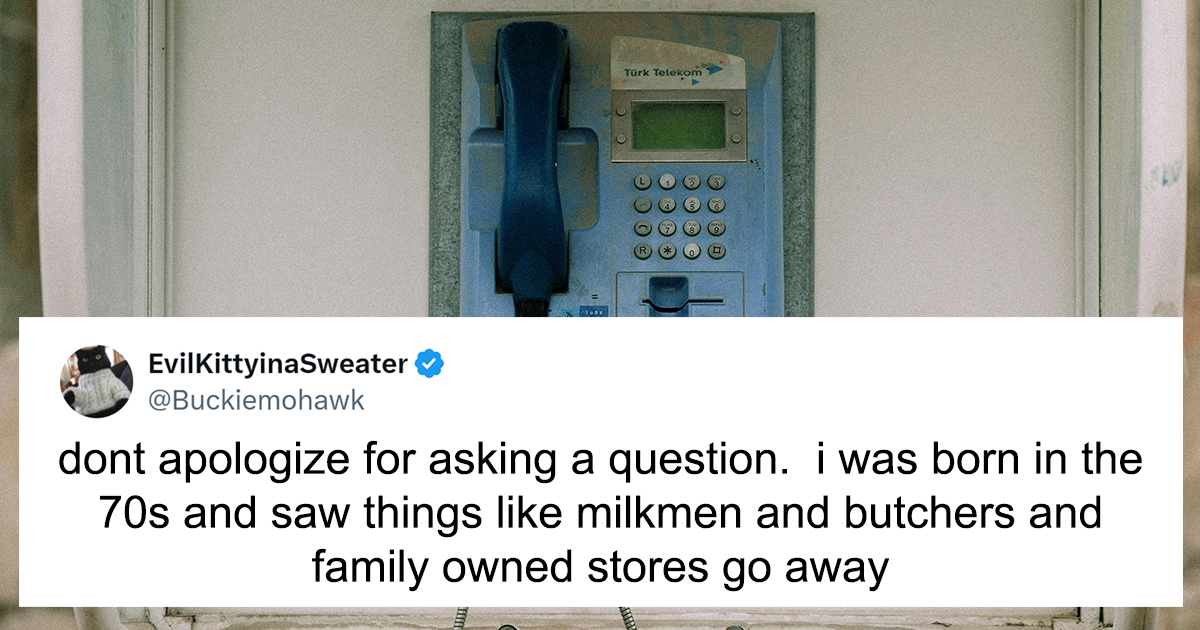
Every generation has a moment when it accidentally makes another generation feel like a museum exhibit. For Millennials and Gen X, that moment may be hearing a young woman ask, with full sincerity, whether pay phones were actually real or just something invented for movies. Somewhere, an old phone booth shed a single dusty tear.
Yes, pay phones were real. Very real. They stood outside gas stations, inside malls, at airports, near diners, in school hallways, on city sidewalks, and in places where the lighting was always just dramatic enough to make you feel like you were in a detective movie. Before smartphones, before “share location,” before texting “here,” people used coins, calling cards, collect calls, memorized numbers, and pure emotional courage to communicate from public places.
The question sounds funny today because modern life has made constant connection feel normal. But not long ago, leaving the house meant becoming temporarily unreachable. If your ride was late, you found a pay phone. If plans changed, you found a pay phone. If you were at the mall and needed your parents to pick you up, you found a pay phone, inserted a coin, and hoped nobody had used gum as a maintenance strategy.
This article is a funny, nostalgic, and surprisingly informative look at why the question “Were pay phones actually a real thing?” hit the internet’s nostalgia button so hard. Below are 31 original responses that capture the spirit of the moment, plus a deeper look at pay phone history, why they disappeared, and why people still remember them with weirdly powerful affection.
Were Pay Phones Actually Real?
Absolutely. Pay phones were public telephones that allowed people to make calls by inserting coins, using a calling card, or dialing collect. The basic idea was simple: you paid for access to a phone because most people did not carry one in their pocket. In the United States, the coin-operated pay phone became part of daily life during the 20th century and grew into a massive public communication network.
At their peak, pay phones were everywhere. They were practical tools, emergency lifelines, social checkpoints, and accidental comedy stages. If you were old enough to use one, you probably remember the sound of coins dropping, the heavy receiver, the metal cord, the tiny instruction sticker, and the pressure of making your call before someone behind you started sighing like a disappointed theater critic.
Why A Simple Question About Pay Phones Went Viral
The question became funny because it exposed a huge technology gap in one sentence. To younger people, pay phones can look like movie props. They appear in superhero scenes, crime thrillers, romantic dramas, and old sitcoms. A character runs into a booth, slams the folding door, makes a mysterious call, and somehow changes the plot. Without real-life memories of using one, it is fair to wonder if they were exaggerated for entertainment.
For older generations, however, pay phones were not cinematic decoration. They were survival equipment. They were how you called home from school, checked in during road trips, got help after car trouble, and navigated social life before mobile phones made everyone trackable, reachable, and mildly impossible to escape.
The comedy comes from the collision of two realities. One group remembers pay phones as a normal part of life. Another group sees them as ancient technology, roughly equivalent to candlelit Wi-Fi. That gap is where the jokes live.
31 Epic Responses To “Were Pay Phones Actually A Real Thing?”
1. “Yes, and we had to pay them actual coins like tiny metal subscription fees.”
Before automatic billing and unlimited plans, communication sometimes required quarters. A pocket full of change could be the difference between getting picked up and becoming part of the mall furniture.
2. “They were real, and somehow every one of them smelled like rain, metal, and bad decisions.”
Pay phones had atmosphere. Not always pleasant atmosphere, but definitely atmosphere.
3. “We used them when we were outside, because phones used to live in places, not people.”
This may be the cleanest explanation of the entire pre-smartphone era. Phones had addresses. You went to the phone; the phone did not go with you.
4. “Yes, and we memorized phone numbers because our brains had storage.”
People once carried dozens of numbers in their heads. Parents, best friends, pizza places, school offices, grandparents, and that one cousin with a truckstored internally, no cloud required.
5. “A pay phone was basically a public smartphone with no screen, no apps, and a suspicious sticky button.”
Technically correct, emotionally upsetting.
6. “We called collect and said our entire message really fast when the operator asked for our name.”
Collect calling became an art form. Instead of paying, you could squeeze “MomPickMeUpAtFive” into the name prompt and hope the household understood the code.
7. “They were so real that Superman used them as changing rooms. That was his locker room subscription.”
The phone booth became iconic partly because pop culture turned it into a symbol of urgent transformation. The irony is that many real booths were too cramped for dignity, let alone heroism.
8. “Yes, and if you forgot your quarter, you were entering side-quest mode.”
No money meant asking a stranger, reversing charges, or walking until you found someone who trusted your story.
9. “Pay phones were the original ‘my battery died.’”
Except the battery was society, and society was mounted to a wall.
10. “They were real, and the cord was built like it had to survive a wrestling match.”
The receivers were heavy, the cords were reinforced, and the whole unit looked designed to survive weather, frustration, and at least one angry commuter per day.
11. “We did not have Find My Friends. We had Find A Pay Phone.”
Coordinating plans required landmarks, timing, patience, and faith. If someone was late, you either waited or began a detective investigation using public telephones.
12. “Yes, and airports had entire walls of them like communication vending machines.”
Airports, bus stations, and train terminals were pay phone kingdoms. Travelers lined up to call home, confirm rides, or explain delays.
13. “They were real, and every teenager knew which one was closest to the movie theater.”
Pay phones were part of teenage logistics. After the movie, you called for a ride and prayed your parent answered before your friends saw you panic.
14. “You could make a call, but you could not scroll while avoiding eye contact. Dark times.”
Public waiting required staring into space, reading posters, or pretending to study a soda machine. Humanity endured.
15. “They existed before everyone decided being reachable 24/7 was a personality trait.”
Pay phones belonged to a world with more gaps. Sometimes nobody could reach you, and somehow civilization continued making casseroles and appointments.
16. “A pay phone was where you learned public speaking under pressure.”
Calling someone while strangers stood nearby created a special type of confidence. You learned to speak clearly, quickly, and without revealing family drama to the entire bus station.
17. “Yes, and the phone book attached to it was either missing, ripped, or had one page hanging on for dear life.”
Some pay phones came with directories. Those directories lived difficult lives.
18. “They were real, and if you dropped your last quarter, the universe became personal.”
Few sounds were more tragic than a coin rolling under a vending machine when you needed to call home.
19. “Pay phones were how we confirmed plans after leaving the house, because plans used to be commitments.”
Before instant updates, people made plans with actual details: time, place, backup plan, and “wait fifteen minutes before leaving.”
20. “They were Google Maps for calling your dad to ask where you were.”
Getting lost often involved finding a pay phone, describing your surroundings badly, and receiving directions that included “turn left where the old hardware store used to be.”
21. “Yes, and some had little shelves so you could write down a number while questioning your life.”
The shelf was tiny, but it made the phone booth feel like an office for emergencies.
22. “They were real, and phone cards were basically prepaid minutes in plastic disguise.”
Calling cards let people make long-distance calls without feeding coins forever. They were especially common for travelers, students, and families calling across states or countries.
23. “A pay phone was the place you went when your car broke down and your confidence left with the tow truck.”
Before roadside assistance apps, a working public phone could turn a bad day into a manageable one.
24. “They were real enough to be out of order exactly when you needed them most.”
The most realistic pay phone memory is finding one, feeling saved, lifting the receiver, and discovering silence.
25. “Yes, and prank calls had cardio because you had to run away afterward.”
Not every pay phone use was noble. Some were used for jokes, dares, and the kind of mischief that now appears as embarrassing digital evidence.
26. “They were social media, but you had to stand outside a laundromat to post.”
Instead of status updates, you delivered one live sentence at a time, usually while balancing a backpack and scanning for your ride.
27. “Pay phones were proof that privacy once came with glass walls and zero comfort.”
A phone booth looked private but rarely felt private. Everyone could see you, and half the street could guess whether the conversation was going well.
28. “They were real, and the hang-up slam had emotional punctuation.”
Ending a call on a pay phone had drama. There was weight, sound, and finality. Tapping a red button does not deliver the same theater.
29. “Yes, and sometimes the only available phone was next to the loudest ice machine in America.”
Gas station pay phones always seemed positioned near traffic, compressors, vending machines, or someone arguing about lottery tickets.
30. “They were real, and they taught us to keep emergency numbers in our wallets.”
Parents wrote numbers on paper, kids kept them in backpacks, and responsible adults carried address books. Losing your contacts meant literally losing them.
31. “Yes, and one day your phone will confuse a kid too. History is undefeated.”
This is the response that stings because it is true. Today’s cutting-edge technology becomes tomorrow’s “Wait, people actually used that?”
A Brief History Of Pay Phones In America
The pay phone story is older than many people realize. The first coin-operated public telephone is commonly associated with William Gray of Hartford, Connecticut, in the late 1880s. Early models were not exactly like the pay phones many Americans remember from the 1970s, 1980s, or 1990s. They evolved over time from supervised public telephones into coin-operated devices that could be used more independently.
As cities grew and telephone networks expanded, public phones became essential infrastructure. Not everyone had a home telephone at first, and even after home phones became common, people still needed ways to call while traveling, shopping, working, or dealing with emergencies away from home. By the late 20th century, pay phones were a familiar part of American life.
They were also incredibly practical. A pay phone did not require a personal device, a charged battery, a data plan, or a software update that arrived at the worst possible time. It just needed a working line, a receiver, and payment. That made pay phones valuable in public places where people needed quick access to communication.
Why Pay Phones Disappeared
The decline of pay phones was not mysterious. Mobile phones became cheaper, smaller, smarter, and more common. Once people carried phones everywhere, the need for public telephones dropped sharply. Maintaining pay phones also cost money. They had to be cleaned, repaired, connected, regulated, and protected from vandalism. When fewer people used them, the business case became harder to justify.
By the 2000s and 2010s, many pay phones had vanished from sidewalks and buildings. Some remained in airports, correctional facilities, rural areas, transit stations, or places where cell service was unreliable. Others were removed, converted, abandoned, or replaced by modern public communication kiosks.
New York City became one of the most symbolic examples. The city removed its last public pay phone from a Midtown Manhattan street in 2022, while continuing to expand newer public technology through LinkNYC kiosks. These kiosks offer modern services such as free Wi-Fi, calling, maps, city information, and device charging. In other words, the public phone did not disappear completely; it evolved into something with a touchscreen and better branding.
Why Pay Phones Still Matter
It is easy to laugh at pay phones as outdated technology, but they also raise serious questions about access. Not everyone owns a smartphone. Not everyone has a charged device, an active plan, or reliable service. Public communication tools can still matter during emergencies, disasters, travel problems, or moments when personal technology fails.
That is one reason some communities and volunteer groups have shown renewed interest in free public phones. The old pay phone model may be fading, but the idea behind it remains important: communication should not depend entirely on owning the newest device.
Pay phones also matter culturally. They remind us of a time when communication required intention. You had to stop, find a phone, dial carefully, and speak in real time. There was no editing a message for seven minutes before sending it. There was no ghosting with read receipts. There was just you, the receiver, and the terrifying possibility that someone’s older sibling would answer.
The Nostalgia Factor: Why People Get So Emotional About Pay Phones
Pay phones are not just remembered because they were useful. They are remembered because they were connected to life events. People used them to call for rides, confess feelings, check on family, report emergencies, make travel plans, and deliver news. Some calls were ordinary. Some were unforgettable.
They also represent a slower style of communication. Today, people can send photos, voice notes, live locations, reactions, and memes in seconds. That convenience is amazing, but it also means communication follows us everywhere. Pay phones belonged to a world where being offline was not a wellness challenge. It was just Tuesday.
The young woman’s question is funny, but it is also understandable. Technology disappears quietly. One day every corner has a pay phone; the next day they are museum pieces, background props, or mysterious metal boxes younger people walk past without recognizing. That is how everyday objects become history.
500-Word Experience Section: What It Felt Like To Actually Use A Pay Phone
Using a pay phone was a small adventure wrapped in metal. First, you had to find one. That might mean walking through a mall, scanning a gas station wall, checking the front of a grocery store, or looking near the restrooms at a restaurant. Pay phones tended to live in places where people were already slightly stressed: airports, bus stations, hospitals, schools, and parking lots. Their natural habitat was “I need to call someone right now.”
Once you found one, the inspection began. Was the receiver attached? Did the cord look normal or like it had survived a raccoon incident? Was there a dial tone? Did the coin slot work? Was the instruction sticker readable? You became a technician, detective, and customer all at once.
Then came the money. Many people carried quarters specifically for calls. A responsible parent might say, “Keep change on you in case you need to call.” That advice sounded boring until the day you actually needed it. If you had no coins, you might call collect, borrow money, or ask a cashier for change with the urgency of someone negotiating international peace.
The call itself felt public and private at the same time. You were speaking into a phone that belonged to everyone and no one. People could walk by. Cars could honk. Someone could stand too close and pretend not to listen. If the phone was outside, weather joined the conversation. Rain, wind, summer heat, and winter cold all had opinions.
There was also pressure. You did not ramble on a pay phone unless you had unlimited coins or supreme confidence. Most calls were direct: “I’m ready.” “The bus is late.” “Can you come get me?” “I’m at the entrance near the food court.” Every sentence had a job. Every pause cost emotional money, even when it did not cost actual money.
For teenagers, pay phones were independence training. You could go places without a personal phone, but you still had a safety net. You learned your home number. You learned where public phones were located. You learned to make plans clearly because changing them later required effort. “Meet me by the fountain at 4:30” was not a casual suggestion; it was a contract.
For travelers, pay phones were lifelines. After landing at an airport, people lined up to call relatives, hotels, taxis, or offices. At roadside stops, a pay phone could rescue someone with car trouble. In cities, it could help a visitor find directions before every pocket contained a map, compass, camera, calculator, flashlight, and restaurant critic.
The strangest part is how ordinary it all felt. Nobody thought, “I am participating in a communication era that future generations will find bizarre.” People simply made calls. They checked in. They got rides. They left messages. They dropped coins into a machine and hoped the person they needed was home.
That is why the question about pay phones makes so many people laugh. It turns an everyday memory into ancient folklore. It makes former pay phone users feel like elders gathered around the digital campfire, saying, “Yes, child, the public telephones were real, and we knew the sacred sound of the dial tone.”
Conclusion: The Pay Phone Was Real, Useful, And Weirdly Legendary
Pay phones were not a movie invention. They were one of the most important public communication tools of the pre-smartphone world. They helped people handle emergencies, coordinate plans, travel, work, date, joke, panic, and get picked up from the mall. They were practical, imperfect, sometimes gross, occasionally broken, and absolutely real.
The best responses to a young woman asking if pay phones existed are funny because they carry truth. Pay phones were simple machines, but they shaped how people moved through the world. They taught patience, preparation, memorization, and the priceless skill of saying what you needed before your coins ran out.
Today, pay phones survive mostly as nostalgia, rare working relics, museum pieces, and design inspiration for modern public kiosks. But the memory remains powerful because these phones belonged to a time when being reachable was not automatic. You had to find connection. Sometimes it was bolted to a wall outside a gas station.
Note: This article uses verified historical context and original humorous responses inspired by the broader online conversation about pay phones. The responses are newly written and not copied from social media posts or other published articles.