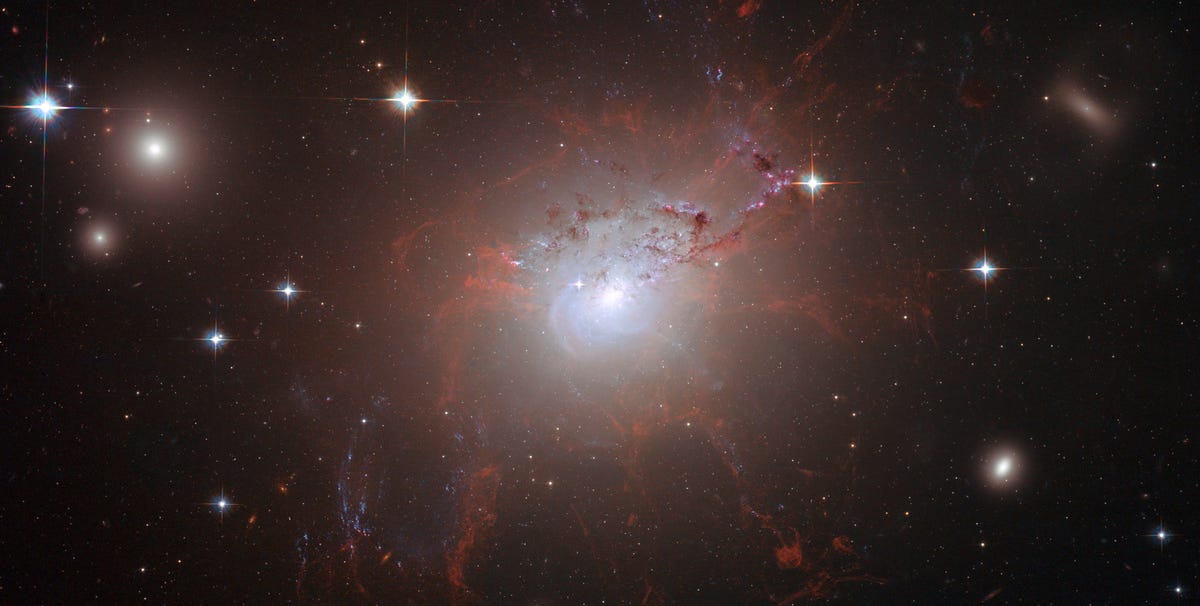
Space has excellent branding. It is mysterious, infinite, sparkly, andaccording to every sci-fi movie ever madeso cold it can turn a person into a human popsicle before they finish saying, “Houston, we have a problem.” But here is the wonderfully bleak twist: space is not cold in the same way your freezer is cold. Space is frigid largely because, in the places between stars and planets, there is almost nothing there to be warm.
That is the nihilistic reason: the universe is not shivering. It is empty. Or at least empty enough that “temperature” gets weird fast.
When people ask, “How cold is space?” the quick answer is about 2.7 kelvin, or roughly -455 degrees Fahrenheit. That temperature comes from the cosmic microwave background, the faint leftover glow from the early universe. But the better answer is more slippery: space is a vacuum, and a vacuum does not behave like air, water, metal, or your bathroom tile at 6 a.m. It does not efficiently steal heat by touch. It does not blow a cold wind. It mostly just sits there, being aggressively indifferent.
So, How Cold Is Space Really?
Deep space, far from stars, planets, warm dust, and other heat sources, is often described as being about 2.7 kelvin. In more familiar terms, that is approximately -454.8 degrees Fahrenheit or -270.4 degrees Celsius. Absolute zerothe theoretical point where thermal motion reaches its minimumis 0 kelvin, or -459.67 degrees Fahrenheit. So deep space is extremely close to the ultimate cosmic “no thanks.”
But that number needs context. A thermometer floating in deep space would not measure “cold air,” because there is no meaningful air. It would measure how it gains and loses energy. If it is exposed to sunlight, it can heat up dramatically. If it is shielded from stars and allowed to radiate its heat away, it can cool toward the background temperature of the universe.
That is why the phrase “temperature of space” can be misleading. Temperature usually describes the average motion of particles in matter. In your kitchen, air molecules bump into your skin and appliances constantly. In interstellar space, particles are so spread out that collisions are rare. There is not enough stuff to transfer heat the way we experience it on Earth.
The Nihilistic Reason Space Is So Frigid: There Is Almost Nothing There
On Earth, cold feels like something attacking you. Wind strips warmth from your face. Ice pulls heat from your hand. Cold water makes your body lose heat rapidly because water conducts heat far better than air. Space does not do that. Space is not a frosty monster. Space is more like a silent roommate who refuses to interact.
The vacuum of space contains particles, but compared with Earth’s atmosphere, it is astonishingly sparse. Because particles are so far apart, they cannot easily pass heat around through collisions. In ordinary life, heat moves in three major ways: conduction, convection, and radiation.
Conduction: Heat by Touch
Conduction happens when heat moves through direct contact. Touch a hot pan, and your hand quickly learns physics. In space, there is usually no surrounding material pressing against an object, so there is very little conduction unless two objects are actually touching.
Convection: Heat by Moving Fluid
Convection happens when a fluid, such as air or water, circulates heat. A room heater warms air; the warm air rises; cooler air sinks; your toes eventually stop filing complaints. In space, there is no thick atmosphere to circulate warmth, so convection is mostly out of the game.
Radiation: Heat by Light
Radiation is the big one in space. Heat can travel as electromagnetic radiation, including infrared light. The Sun warms Earth this way, sending energy across about 93 million miles of vacuum. No air delivery service required.
This is why space can be both brutally cold and intensely hot. An object in direct sunlight can roast. The same object in shadow can cool dramatically because it radiates heat away into the surrounding darkness. Space is not simply “cold”; it is thermally lonely.
Why the Cosmic Microwave Background Sets the Deep-Space Temperature
The universe is not perfectly empty. It is filled with faint radiation left over from the Big Bang, called the cosmic microwave background, or CMB. This radiation is everywhere, coming from every direction, but it has cooled as the universe has expanded. Today, it corresponds to a temperature of about 2.7 kelvin.
Think of the CMB as the universe’s old nightlight: dim, ancient, and not especially useful for warming your soup. It is not “heat” in the cozy fireplace sense. It is a thin bath of microwave radiation that remains from a time when the universe was hot, dense, and dramatically more energetic.
As space expanded, the wavelengths of that radiation stretched. Longer wavelengths mean lower energy, so the radiation cooled. This is one of the grandest examples of cosmic aging: the universe did not just get bigger; it got colder. Very relatable, honestly.
Would You Freeze Instantly in Space?
No, you would not instantly freeze into a glittering statue, despite what dramatic movie scenes suggest. The much more urgent problems would be lack of pressure and lack of oxygen. Human biology is not designed for vacuum exposure. Without a spacesuit, gases in the body would expand, oxygen would run out quickly, and unconsciousness would come before any neat cartoon freezing effect.
Because vacuum is poor at conduction and convection, your body would not lose heat the way it would in icy water or a blizzard. You would radiate heat away, but that process is slower than being surrounded by cold matter. In other words, space is deadly, but not because it politely turns you into frozen lasagna in three seconds.
Why Astronauts Need Thermal Control, Not Just Warm Coats
A spacesuit is not just a puffy jacket with better public relations. It is a personal spacecraft. Astronauts on spacewalks deal with extreme temperature swings depending on whether they are in sunlight or shadow. Sunlit surfaces can become scorching, while shaded areas can plunge far below freezing.
Spacesuits must manage oxygen, pressure, carbon dioxide, moisture, mobility, micrometeoroid protection, and temperature. That last part is tricky because the suit has to handle heat from the astronaut’s body as well as heat from the Sun. Too cold is dangerous. Too hot is also dangerous. Space does not care either way. Space has never once filled out a customer satisfaction survey.
Space Can Be Hot, TooBecause Temperature Is Sneaky
Here is where things get deliciously confusing: some regions of near-space can have very high “temperatures” while still not feeling hot in the ordinary sense. Earth’s thermosphere, where the International Space Station orbits, can reach extremely high temperatures because the few particles there move very fast. But the density is so low that those particles do not transfer much heat to an object.
That is the difference between temperature and heat content. Temperature measures energy per particle. Heat depends on how much energy is available in total. A single fast-moving particle is like one hyperactive toddler in a football stadium: noticeable in theory, but not enough to warm the whole place.
This also explains how NASA’s Parker Solar Probe can fly through the Sun’s outer atmosphere, where particle temperatures can be enormous, while its heat shield handles the actual energy load. The probe survives because the corona is extremely thin and because the spacecraft is engineered to reflect, absorb, and radiate heat carefully.
Sunlight vs. Shadow: The Real Temperature Drama
Space is not evenly cold. The temperature of an object depends on where it is, what it is made of, whether it is spinning, whether it has an atmosphere, and whether it is exposed to sunlight.
Mercury is a classic example. It is the closest planet to the Sun, so its daytime surface can become extremely hot. But because it has almost no atmosphere to redistribute heat, its nighttime side becomes brutally cold. The Moon behaves similarly. Lunar daylight can bake the surface, while lunar night and permanently shadowed polar craters can become some of the coldest places in the solar system.
In deep craters near the Moon’s poles, sunlight may never reach the floor. These regions act as cold traps, preserving water ice and other volatile materials for long periods. That is not because the Moon is farther from the Sun than Earth. It is because shadow plus vacuum plus poor heat circulation creates a cosmic freezer with no brand name and terrible accessibility.
Why the James Webb Space Telescope Loves the Cold
The James Webb Space Telescope offers a perfect example of how cold can be useful. Webb observes the universe primarily in infrared light. Warm objects glow in infrared, so if the telescope itself were too warm, it would interfere with its own observations. That would be like trying to stargaze while holding a flashlight directly in your face.
Webb uses a large sunshield to separate its warm, Sun-facing side from its cold observing side. The shield allows the telescope’s instruments to remain extremely cold, improving their ability to detect faint infrared signals from distant galaxies, star-forming regions, and exoplanet atmospheres.
In short, cold space is not just a hazard. It is also a tool. Astronomers use the darkness and low temperatures of space to see things that would otherwise be drowned out by heat.
Why Space Is Not Absolute Zero
If space is so empty and so cold, why is it not absolute zero? Because there is still radiation. The cosmic microwave background fills the universe. Stars shine. Dust absorbs and emits energy. Cosmic rays zip around being dramatic. Even in the loneliest regions, the universe is not truly nothing.
Absolute zero is a theoretical lower limit. Reaching it exactly is not physically achievable by ordinary cooling processes. Deep space gets close by human standards, but it is still warmed by the faint afterglow of creation itself. That is poetic, scientifically accurate, and mildly inconvenient for anyone hoping the universe would commit fully to the void aesthetic.
How Scientists Measure Cold in Space
Scientists do not simply stick a giant thermometer out the window of a rocket and say, “Yep, chilly.” They measure radiation, particle motion, and the behavior of materials and instruments. Microwave telescopes measure the cosmic microwave background. Infrared sensors measure how surfaces emit heat. Spacecraft instruments monitor thermal conditions so engineers can keep electronics and scientific equipment alive.
Kelvin is the preferred scale because it starts at absolute zero. That makes it ideal for physics. Instead of saying deep space is about -455 degrees Fahrenheit, scientists can say it is about 2.7 kelvin. Much cleaner. Also, it sounds more like something a robot would whisper before shutting down.
Common Myths About the Temperature of Space
Myth 1: Space Is Cold Like Antarctica
Antarctica is cold because air, ice, and wind remove heat from your body. Space is cold because there is very little matter to give you heat in the first place. The experience and physics are completely different.
Myth 2: Everything in Space Freezes Immediately
Objects cool by radiation unless they are touching something or interacting with particles. That can take time. A spacecraft, astronaut, or tool in sunlight may even overheat instead of freeze.
Myth 3: The Farther From the Sun, the Colder Everything Gets
Distance matters, but it is not the only factor. Atmospheres, rotation, internal heat, surface composition, and sunlight exposure all affect temperature. A shadowed crater near Earth can be colder than some distant worlds.
Myth 4: Space Has One Temperature
There is no single practical temperature for all of space. Deep intergalactic regions, molecular clouds, planetary surfaces, star-facing spacecraft, and shaded telescope instruments all have different thermal realities.
The Big Picture: A Universe Cooling Down
The coldness of space tells a story about cosmic history. The early universe was hot and dense. Over billions of years, expansion stretched light, diluted matter, and lowered the background temperature. The universe became larger, darker, and colder.
That may sound bleak, but it is also why structure could form. Atoms, stars, planets, galaxies, chemistry, and eventually curious primates with Wi-Fi all emerged from a universe that cooled enough for complexity to exist. If the cosmos had stayed too hot, there would be no planets, no oceans, no coffee, and no one asking why space is cold while procrastinating at midnight.
Experience Notes: Understanding Space Cold Through Everyday Life
Space is hard to imagine because human senses evolved inside an atmosphere. We understand cold through touch, wind, water, and weather. That is why the vacuum of space feels so counterintuitive. Still, a few everyday experiences can help make the idea click.
Think about standing outside on a clear winter night. Even when the air temperature is not dangerously low, you may feel colder under an open sky than under a tree, porch roof, or blanket. Part of that feeling comes from your body radiating heat toward the cold sky. The clearer the sky, the more efficiently surfaces on Earth can radiate heat upward. Farmers, campers, and hikers know this effect well: clear nights can bring frost even when the day felt mild. Now remove almost all the air and clouds, and you begin to approach the logic of space.
Another useful comparison is a thermos bottle. A vacuum-insulated bottle keeps coffee hot because the vacuum between its walls reduces heat transfer by conduction and convection. That is the same basic reason space does not instantly suck heat away by touch. Vacuum is an insulator in some ways. The coffee still cools eventually, mostly through radiation and small remaining paths of heat transfer, but it does not cool the way it would if surrounded by cold water.
Now picture sitting in sunlight on a cold day. Your face can feel warm while the air remains chilly. Step into shade, and the warmth vanishes. Space exaggerates that experience. Sunlight can heat an exposed surface intensely, while shade can allow the same surface to radiate heat away into darkness. This is why spacecraft designers obsess over orientation, reflective coatings, insulation, radiators, and sunshields. A spacecraft is not just “in cold space.” It is constantly balancing incoming sunlight, internal electronics heat, reflected planetary radiation, and its own ability to dump heat away.
Even your freezer offers a partial lesson, though it is not a perfect model. A freezer is full of cold air, and that air transfers heat from food. Space has no freezer air. So while deep space is far colder by temperature scale, it does not chill things in the familiar kitchen-appliance way. The freezer is pushy. Space is passive-aggressive.
The most humbling experience may be looking at the night sky itself. Every star you see is a furnace, yet the darkness between stars dominates the view. That darkness is not empty in an absolute sense, but it is empty enough that warmth is rare, local, and precious. Earth is comfortable because it has the right distance from the Sun, an atmosphere, oceans, clouds, and a planetary system that redistributes heat. Space, by comparison, is the default setting: sparse, silent, and wildly inconvenient for mammals.
So the next time someone asks how cold space is, the best answer is both scientific and slightly rude: deep space is about 2.7 kelvin, but the real reason it is so frigid is that there is almost nothing there to hold, share, or deliver heat. The universe is not freezing you with icy hands. It is simply not offering a hand at all.
Conclusion
Space is cold, but not in the simple way people usually imagine. Deep space sits near 2.7 kelvin because of the cosmic microwave background, the ancient radiation left from the Big Bang. Yet the vacuum of space has so few particles that temperature becomes a question of radiation, sunlight, shadow, and heat balance rather than cold air. Objects in sunlight can overheat. Objects in darkness can cool toward the background of the universe. Astronauts need spacesuits not because space is a snowy landscape, but because vacuum, radiation, pressure loss, and temperature swings create a lethal environment.
The nihilistic reason space is so frigid is also the simplest: most of it is nearly nothing. No cozy atmosphere. No warm breeze. No convenient blanket of molecules. Just radiation, distance, darkness, and the faint microwave whisper of the early cosmos. Chilly? Absolutely. Empty? Almost. Fascinating? Annoyingly, magnificently yes.
Note: This article synthesizes established astronomy, NASA mission science, atmospheric physics, spacecraft thermal-control principles, and public science reporting from reputable U.S. science and space sources. Source links are intentionally not included in the body for clean web publishing.