Editor’s note: Space launch schedules are famously flexible. A rocket can be ready, the crew can be smiling, the webcast can be counting downand then Florida weather strolls in wearing flip-flops and says, “Not today.” As of June 1, 2026, NASA’s public launch schedule lists NASA’s SpaceX Crew-13 no earlier than mid-September 2026, while SpaceX’s current upcoming launch page shows Falcon 9 Starlink missions rather than a Crew Dragon liftoff today. Always confirm the official schedule before planning your snacks, your viewing party, or your “I saw history happen live” social post.
Still, if you searched for SpaceX launch live or how to watch SpaceX Crew Dragon launch today, you are in the right orbit. This guide explains where to watch a Crew Dragon launch live, how to check whether today’s mission is really happening, what the broadcast timeline usually looks like, and how to enjoy the show without refreshing the wrong page like a confused satellite.
Is SpaceX Crew Dragon Launching Today?
The first rule of watching a SpaceX Crew Dragon launch is simple: verify the mission status before you commit your entire afternoon. Crew Dragon launches are part of NASA’s Commercial Crew Program, which sends astronauts to and from the International Space Station using SpaceX’s Falcon 9 rocket and Dragon spacecraft. These missions involve NASA, SpaceX, international partners, range safety teams, weather officers, recovery teams, and the astronauts themselves. In other words, it is not quite like ordering pizza.
Launch dates can shift because of weather, technical checks, range availability, sea conditions for recovery zones, ISS traffic, or mission readiness reviews. A “targeted” launch date is not the same as a guaranteed launch date. When NASA or SpaceX uses phrases such as “targeting,” “no earlier than,” or “pending readiness,” read them as polite space-language for “keep checking.”
For the most accurate information, check NASA’s launch schedule, NASA’s Commercial Crew mission pages, SpaceX’s official launch page, and the live broadcast listing. If a Crew Dragon launch is happening today, those official channels will usually show the mission name, launch time, launch site, webcast start time, crew members, rocket, spacecraft, and destination.
Where to Watch SpaceX Crew Dragon Launch Live
The good news: watching a Crew Dragon launch online is easier than explaining orbital mechanics at a dinner party. NASA and SpaceX typically make crewed launch coverage widely available, and many streams are free.
1. NASA+
NASA+ is NASA’s free streaming platform. It carries live mission coverage, launch events, spacewalks, documentaries, and special programming. For Crew Dragon launches, NASA+ is often the cleanest option because the broadcast usually includes mission commentary, astronaut audio when available, timeline explanations, and expert context. It is the stream to choose if you want the “why this matters” alongside the “wow, that rocket is leaving Earth very quickly.”
2. The NASA App
The NASA App is useful for viewers who want launch coverage on a phone, tablet, or streaming device. It also gives access to NASA news, images, videos, podcasts, and NASA+ content. If you are watching away from home, install the app before the countdown begins. Nothing ruins a launch vibe like downloading an app at T-minus two minutes while your Wi-Fi acts like it has stage fright.
3. NASA YouTube and Social Channels
NASA often streams major crewed missions on YouTube and social platforms. YouTube is especially convenient because it works almost everywhere: smart TVs, browsers, phones, tablets, and game consoles. It also makes it easy to rewind if you blink during liftoffwhich is understandable, because the rocket does not politely pause for dramatic effect.
4. SpaceX Webcast
SpaceX typically hosts a mission webcast through its official launch page and social video channels. SpaceX coverage is great for clean visuals, countdown audio, rocket telemetry, stage separation views, booster landing attempts, and the kind of minimalist production style that says, “We are casually sending humans to orbit.”
5. Third-Party Streaming Platforms
NASA has expanded access to live programming through multiple streaming platforms. Depending on the mission and current distribution options, coverage may also appear on services such as Amazon Prime, Netflix, Roku, Apple TV, Fire TV, and other platforms. Availability can change, so treat third-party platforms as helpful extrasnot your only lifeline to liftoff.
What Is SpaceX Crew Dragon?
Crew Dragon is SpaceX’s human-rated spacecraft designed to carry astronauts to low-Earth orbit and the International Space Station. It launches on a Falcon 9 rocket and can dock autonomously with the ISS. The capsule includes life-support systems, touchscreen controls, emergency abort capability, parachutes for return, and enough futuristic design energy to make old science-fiction movies look slightly underdressed.
NASA’s Commercial Crew Program was created to provide safe, reliable, and cost-effective astronaut transportation from the United States. SpaceX’s Crew Dragon became the first commercially built and operated spacecraft to carry NASA astronauts to the ISS from American soil, restoring U.S. human orbital launch capability after the Space Shuttle era.
For viewers, Crew Dragon missions are exciting because they combine rocket engineering, human spaceflight, international cooperation, and real-time drama. A satellite launch is impressive. A crewed launch is different. There are people on top of that rocket. Suddenly every checklist, weather update, and calm voice on the broadcast feels a little more intense.
What Happens During a Crew Dragon Launch Broadcast?
A typical SpaceX Crew Dragon live broadcast begins hours before liftoff, especially for NASA missions. The stream may show the astronauts suiting up, walking out to vehicles, traveling to the launch pad, riding the elevator, crossing the crew access arm, and entering Dragon. This is the part where everyone watching at home becomes emotionally invested in gloves, helmets, and seat straps.
Suit-Up and Walkout
The crew puts on SpaceX pressure suits, completes checks, and says goodbye to support teams. The walkout is one of the most human moments of the day. The astronauts wave, smile, and look impressively calm for people about to ride a controlled explosion into orbit.
Pad Arrival and Ingress
After arriving at the launch pad, astronauts take an elevator up the tower and enter the spacecraft through the crew access arm. Once inside, teams help them strap into their seats and connect communication and suit systems.
Leak Checks and System Checks
Before fueling begins, teams verify spacecraft systems, suit pressure, communications, hatch closure, and other safety-critical items. These checks can sound slow on the broadcast, but they are the reason human spaceflight works. Space is not forgiving. It does not offer store credit.
Fueling the Falcon 9
Falcon 9 fueling happens relatively close to liftoff. The rocket is loaded with propellants, including super-chilled liquid oxygen. Viewers often see white vapor around the vehicle as the countdown gets serious. At this point, the broadcast energy usually shifts from “educational program” to “everybody sit up straight.”
Liftoff
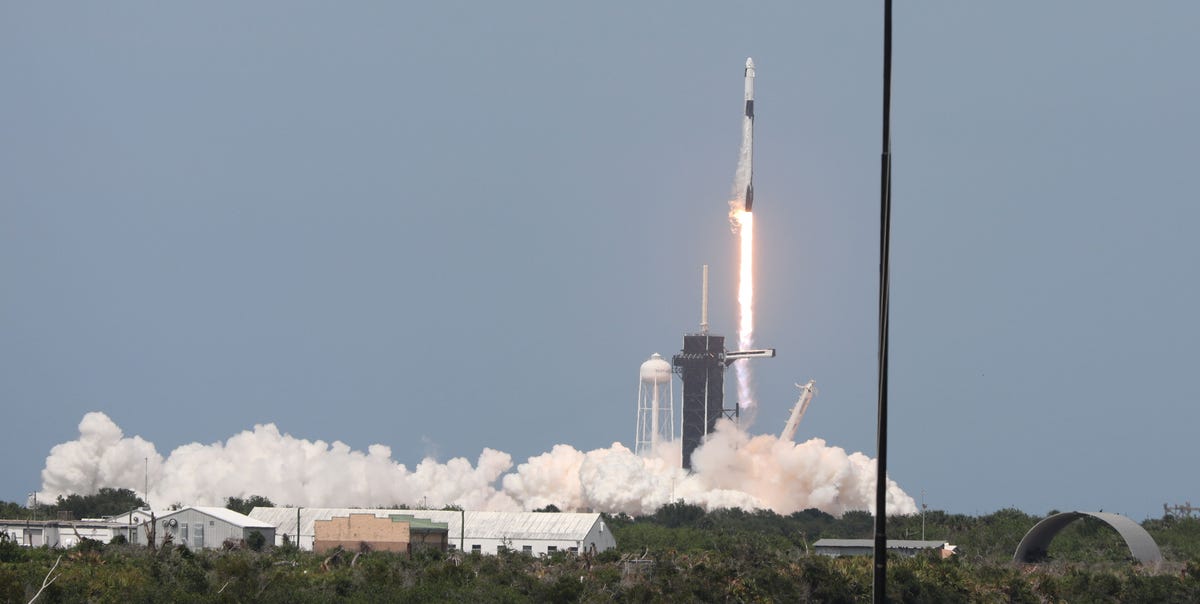
At T-minus zero, Falcon 9’s engines ignite, computers verify performance, and the rocket lifts off if all systems are go. The first seconds are surprisingly graceful. Then the rocket climbs, clears the tower, and quickly becomes a bright needle pushing through the sky.
Max Q, Stage Separation, and Dragon Separation
After liftoff, the rocket passes through Max Q, the period of maximum aerodynamic pressure. Later, the first and second stages separate. The first stage may attempt a landing on a drone ship or landing zone, while the second stage continues pushing Dragon toward orbit. Eventually, Dragon separates from the second stage and begins its journey toward the ISS.
How to Check the Launch Time in Your Time Zone
Most NASA launch coverage uses U.S. Eastern Time because Florida launches take place at Kennedy Space Center or Cape Canaveral Space Force Station. If you are outside the Eastern Time Zone, convert carefully. A morning launch in Florida may be late evening in Asia, overnight in Europe, or breakfast-time on the U.S. West Coast.
Use the official NASA event page, your device’s calendar conversion, or a trusted time zone converter. Also check whether the webcast start time is different from the liftoff time. NASA coverage often begins hours before launch, while SpaceX coverage may start closer to liftoff. If you only care about the rocket leaving the pad, tune in near launch. If you want the full astronaut story, join early.
Best Tips for Watching a SpaceX Launch Live Online
Start Early
Open the stream at least 15 to 30 minutes before liftoff. For crewed launches, earlier is better. You will catch the final polls, weather updates, mission overview, and possibly the moment when the broadcast team explains exactly why the launch is delayed by a boat, cloud, sensor, or mysterious acronym.
Use a Reliable Internet Connection
A rocket launch is not the time to test your neighbor’s Wi-Fi from the balcony. Use a stable connection, close unnecessary tabs, and stream on a device that will not suddenly demand an operating system update at T-minus one minute.
Keep a Backup Stream Ready
Open NASA+ and SpaceX’s webcast in separate tabs if possible. If one stream buffers, switch to the other. This is not paranoia; this is responsible launch-day behavior.
Follow the Mission Blog
NASA mission blogs and official social accounts often post written updates during launch day. These are helpful if you cannot watch with sound or if you want quick confirmation of milestones such as fueling, liftoff, stage separation, orbital insertion, docking, and hatch opening.
Can You Watch a Crew Dragon Launch in Person?
Yes, but planning matters. SpaceX Crew Dragon missions usually launch from Florida, either from Kennedy Space Center or Cape Canaveral Space Force Station. Kennedy Space Center Visitor Complex offers launch viewing opportunities for selected launches, often with commentary, bleacher seating, and access to exhibits. Availability depends on the launch date, time, mission, security needs, and visitor operations.
If you plan to watch in person, arrive early, expect traffic, bring water, check weather, and have a backup plan in case the launch scrubs. A scrub is not failure; it is the spaceflight version of “better safe than spectacularly sorry.” Many veteran launch watchers treat scrub risk as part of the adventure. Bring patience. Maybe bring snacks. Definitely bring sunscreen.
Why SpaceX Crew Dragon Launches Matter
Crew Dragon launches are not just cool fire-in-the-sky events, although they are absolutely that. They support continuous human presence aboard the International Space Station, where astronauts conduct research in microgravity, test technologies, study human health in space, and prepare for future missions to the Moon and Mars.
Each crew rotation helps maintain station operations. Astronauts perform science experiments, repair equipment, support cargo missions, conduct spacewalk preparations, and keep the orbital laboratory running. The ISS is basically the world’s most complicated shared office, except the commute involves orbital mechanics and the coffee floats away if you are not careful.
SpaceX’s role also changed the rhythm of U.S. human spaceflight. Instead of NASA owning every part of the transportation system, the Commercial Crew model allows NASA to buy astronaut transportation services from commercial providers. That gives NASA more flexibility to focus on deep-space exploration while still supporting low-Earth orbit research.
Common Reasons a Crew Dragon Launch Gets Delayed
If the launch does not happen today, do not panic. Delays are normal in spaceflight. Common reasons include unfavorable weather at the launch site, poor conditions in emergency splashdown zones, technical issues with the rocket or spacecraft, range conflicts, ISS scheduling, or extra time needed for data review.
For crewed missions, weather is not only about the launch pad. Teams also evaluate conditions along the flight path and in potential abort recovery areas. If Dragon had to separate from Falcon 9 during an emergency, recovery teams would need safe conditions to reach the capsule. That is why a sunny sky over Florida does not always mean launch is guaranteed.
Experience Section: What It Feels Like to Watch a SpaceX Crew Dragon Launch Live
Watching a SpaceX Crew Dragon launch live is one of those modern experiences that feels both futuristic and oddly cozy. You might be sitting on your couch in socks, eating cereal, and yet your screen is showing astronauts preparing to leave the planet. It is casual and monumental at the same time, which is a strange combination. Humanity has somehow made orbital launches streamable, and we still cannot always make video calls start without someone saying, “Can you hear me?”
The best experience begins before liftoff. Open the stream early and let the countdown become part of the room. You hear mission controllers, see the rocket standing at the pad, and watch the clock move from abstract numbers to real tension. At first, it feels like a documentary. Then the astronauts are strapped in, the hatch is closed, the access arm retracts, and suddenly it feels very real.
If you are watching with family or friends, Crew Dragon launches are surprisingly easy to turn into a mini event. Put the stream on the biggest screen available. Keep a phone nearby for mission updates. Make snacks with ridiculous names: “orbital nachos,” “Falcon fries,” “Dragon dip.” Children usually love the countdown, adults pretend they are only mildly excited, and then everyone goes quiet when the engines ignite.
The moment of liftoff is the hook. Even through a screen, it delivers. The rocket rises slowly at first, almost like it is thinking about it, and then it accelerates with astonishing confidence. The plume expands, the camera shakes, and the announcer confirms liftoff. It is hard not to grin. It is also hard not to imagine what the crew is feeling as the vehicle climbs through the thick lower atmosphere.
One of the underrated joys of watching live is learning the mission language. You start the broadcast knowing “rocket go up.” By the end, you are nodding seriously at phrases like “nominal trajectory,” “Max Q,” “MECO,” and “Dragon separation.” You may not become an aerospace engineer in two hours, but you will gain enough vocabulary to sound dangerous at brunch.
The booster landing attempt is another crowd-pleaser. SpaceX has made first-stage landings feel almost routine, which is wild because the booster is essentially falling back from the edge of space and trying to land upright on a target. When it works, it still looks like science fiction. When it does not happen because of mission requirements, fuel margins, or sea conditions, the launch is still a success if Dragon reaches orbit safely.
The emotional peak often comes after Dragon separates from the second stage. The spacecraft is in orbit, the crew is safely on the way, and the broadcast shifts from fiery drama to orbital calm. The astronauts may speak from Dragon, mission control confirms milestones, and the Earth curves quietly below. That is when the launch stops feeling like a show and starts feeling like a shared human achievement.
For the best personal experience, do not only watch the final ten seconds. Watch enough of the coverage to understand the stakes. Learn the crew names. Notice the international partnerships. Pay attention to the safety checks. A Crew Dragon launch is not just a rocket launch; it is a carefully choreographed handoff between engineering, weather science, human courage, and thousands of people doing their jobs correctly.
Conclusion
If you want to watch a SpaceX Crew Dragon launch live today, start with the official schedule, confirm the mission status, and choose a trusted stream such as NASA+, the NASA App, NASA YouTube, or SpaceX’s webcast. Remember that launch times can change quickly, especially for crewed missions where weather, safety, and recovery conditions matter just as much as rocket readiness.
The smartest approach is simple: verify the launch, tune in early, keep a backup stream open, and enjoy the countdown. Whether the mission lifts off today or moves to another date, watching Crew Dragon launch is still one of the most accessible ways to experience human spaceflight in real time. No spacesuit required. Pajamas are acceptable.