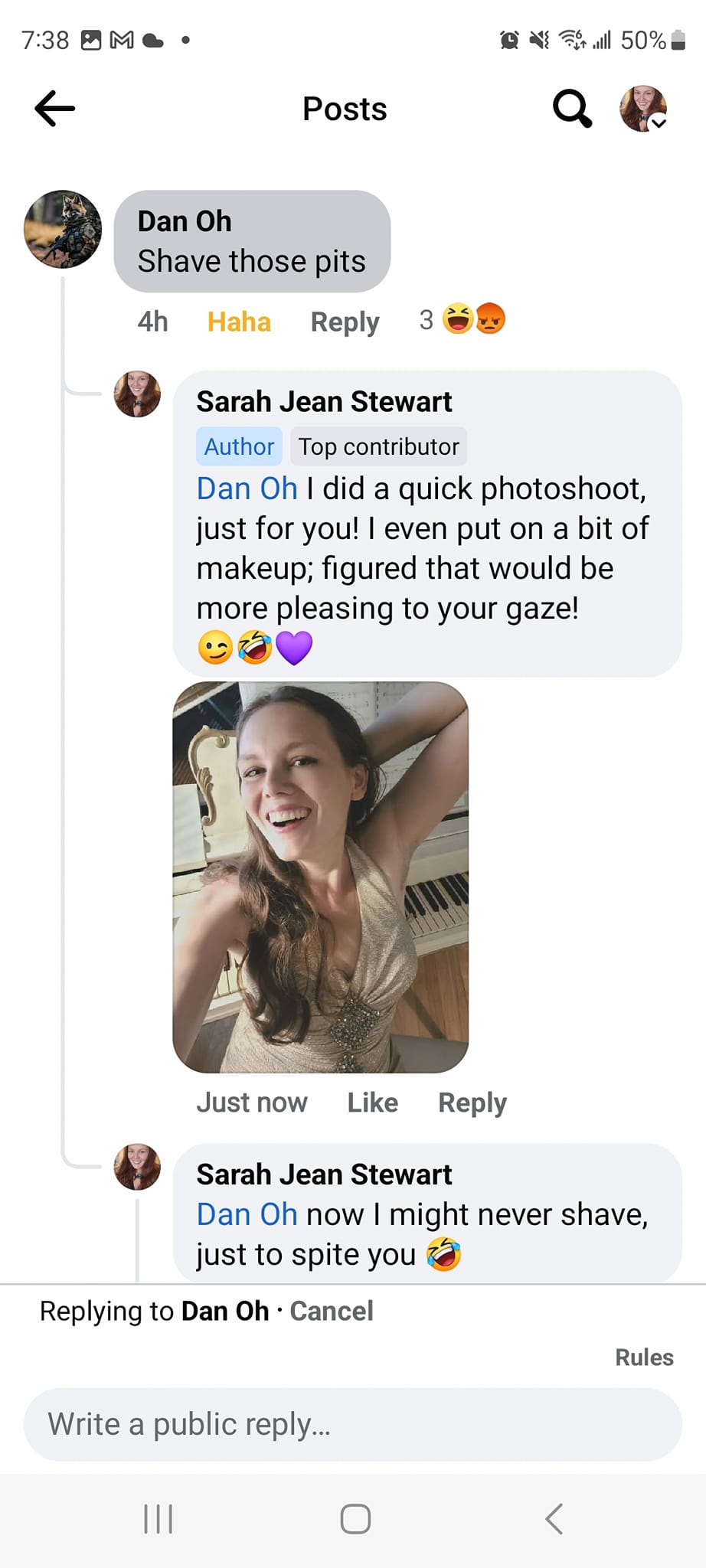
There are few things more confident than a stranger on the internet believing his opinion is an emergency. Somewhere between the comment section, the gym selfie, the summer dress photo, and the harmless “just existing with arms” moment, a woman posts a picture. Then it arrives: “Shave your pits.” Not “nice photo,” not “cool lighting,” not even a humble scroll past. No, this man has spotted underarm hair and decided civilization itself is wobbling.
The funny thing is, armpit hair is not a plot twist. It is not a malfunction. It is not breaking news. It is a normal part of the human body, and yet women’s body hair still manages to spark online debate as if someone released a bear into a brunch café. The reaction says less about hygiene and more about gender norms, beauty standards, body autonomy, and the strange confidence some people feel when typing from behind a profile picture of a truck, a fish, or sunglasses worn indoors.
This article is not really about whether women should shave. Some women like shaving. Some love waxing. Some trim. Some grow it out. Some dye their armpit hair purple because life is short and drugstore hair dye exists. The point is choice. The issue begins when grooming stops being personal and becomes public property, especially when men on the internet treat women’s bodies like comment-enabled customer service desks.
The Internet Did Not Invent Body Policing, But It Gave It Wi-Fi
Women have been told what to do with their bodies for centuries: cover more, show less, smile bigger, eat smaller, age slower, look natural but not too natural, be confident but not “too much.” The internet simply put all of those contradictions on fast-forward.
Online spaces reward instant reaction. A photo that once might have been seen by a few friends can now reach thousands of strangers, including people who believe every visible body part is open for review. A single image of a woman lifting her arm can become a courtroom where commenters debate femininity, cleanliness, attractiveness, politics, and somehow the future of society. All because of hair. Hair, which grows without a committee meeting.
Research on online harassment shows that women, especially younger women, experience appearance-based comments and gendered hostility at high rates. Pew Research Center has reported that many Americans have experienced online harassment, and younger women are especially likely to face sexualized or gendered abuse. Separate research on teens has found that physical appearance is a common reason young people are targeted online. In other words, the “shave your pits” comment is not just one rude sentence. It belongs to a larger culture of appearance surveillance.
Why Women’s Armpit Hair Became Such a Big Deal
Here is the part that makes the whole argument wobble in high heels: the expectation that women should remove underarm hair is not some ancient universal truth carved into a mountain. In the United States, women’s underarm and leg shaving became heavily normalized in the early twentieth century, as sleeveless fashion, mass-market magazines, and razor advertising worked together to sell the idea of “smooth” femininity.
Smithsonian materials on hair removal explain how advertising avoided the word “shaving” for women because it sounded too masculine at the time. Instead, campaigns promoted “smooth” underarms and legs. That marketing language mattered. It did not merely sell razors; it sold a new rule. Female body hair, once ordinary, was reframed as embarrassing, unfeminine, and in need of correction.
This is how beauty standards often work. They do not walk into the room wearing a name tag that says, “Hello, I am a profitable insecurity.” They arrive as a whisper: “Everyone does this.” Then they become a routine. Then they become a requirement. Finally, they become so normal that when someone chooses differently, strangers act shocked, as though the woman has rejected gravity.
Hair Is Not a Hygiene Emergency
One of the most common arguments against women’s armpit hair is hygiene. The claim usually sounds like this: “It’s gross.” Short, confident, and scientifically underdressed.
Let’s be clear: hygiene is about washing, not whether a follicle has been allowed to complete its tiny destiny. Underarm hair can hold sweat and odor, yes, but so can clothing, gym bags, hats, socks, and that one couch pillow nobody has washed since 2019. The solution is basic cleanliness: bathing, using deodorant if desired, wearing clean clothes, and taking care of skin. Shaving is a grooming preference, not a moral certificate.
Dermatology sources also point out that hair removal can come with skin issues. Shaving, waxing, and tweezing may cause irritation, razor burn, ingrown hairs, bumps, or inflammation, especially for people with sensitive skin or curly hair textures. The American Academy of Dermatology recommends shaving with cream or gel, using clean blades, shaving in the direction of hair growth, and replacing razors regularly to reduce irritation. Mayo Clinic and Cleveland Clinic also note that ingrown hairs can happen after hair removal when the hair grows back into the skin.
So when a stranger demands that a woman shave, he is not just making an aesthetic request. He is also assuming that his personal preference should outrank her comfort, skin health, time, money, and bodily autonomy. That is a lot of entitlement for a sentence typed next to a laughing emoji.
The Double Standard Is Doing Olympic-Level Gymnastics
When a man has visible armpit hair, the world generally survives. Nobody calls a press conference. Nobody says, “Sir, your masculinity is showing in an unapproved texture.” In many cultures, male body hair is treated as natural, rugged, or simply irrelevant. But when women have the same kind of hair in the same kind of place, suddenly it is a debate.
This double standard is why the comment “shave your pits” lands differently when directed at women. It is not neutral advice. It carries the weight of a long-running rule: women are expected to be edited. Smoothed. Polished. Softened. Made visually convenient.
The irony is that the same culture often claims to love “natural beauty.” But “natural,” in this context, can mean makeup that looks invisible, hair that looks effortless after forty minutes of styling, skin that appears poreless, and a body that has been maintained to look untouched by biology. Real naturalnesstexture, hair, sweat, scars, wrinkles, asymmetryoften receives far less applause.
Body Autonomy Means the Choice Goes Both Ways
Supporting women who do not shave does not mean criticizing women who do. That would simply replace one rule with another, and nobody needs a new grooming dictatorship. Body autonomy means a woman can shave because she likes the feel of smooth skin. She can wax because she prefers it. She can stop shaving because she is tired of razor burn. She can trim. She can forget. She can decide seasonally, emotionally, financially, or randomly on a Tuesday.
The keyword is “decide.” A personal grooming choice becomes a problem only when it is demanded, mocked, or used to measure someone’s worth. A woman’s armpit hair does not determine whether she is clean, attractive, professional, feminine, confident, lazy, rebellious, or “making a statement.” Sometimes the statement is simply: “I had other things to do.”
And honestly, that is deeply relatable. Laundry exists. Emails exist. Dinner needs making. Life is already full of tasks. If a woman chooses not to add “remove perfectly normal hair because strangers may faint” to the list, that is not a crisis. That is time management.
Why Men’s Online Comments Feel Bigger Than They Look
Some people may say, “It’s just a comment. Ignore it.” Sometimes ignoring is the best option. But repeated comments about appearance can wear people down, especially when they target something as personal as the body. Online body shaming does not happen in isolation. It stacks.
One comment says shave. Another says smile. Another says lose weight. Another says wear makeup. Another says do not wear too much makeup. Another says dress modestly. Another says dress better. The result is a digital environment where women are constantly reminded that their bodies are being watched, rated, and corrected.
Psychology and public health research has repeatedly linked social media exposure, appearance comparison, and body dissatisfaction. The American Psychological Association has highlighted research showing that reducing social media use can improve how teens and young adults feel about their appearance. Harvard public health experts have also discussed how image-heavy platforms can contribute to body dissatisfaction among teen girls. The National Eating Disorders Association notes that body dissatisfaction is a known contributor to eating disorder risk and maintenance.
That does not mean every rude comment causes deep harm. It means comments exist inside a broader pressure system. A single raindrop is not a flood, but enough raindrops can ruin the carpet.
What “Shave Your Pits” Really Means
On the surface, the phrase sounds like grooming advice. Underneath, it often means something else:
- “Your body should match what I am used to seeing.”
- “My attraction should be your responsibility.”
- “Women’s bodies are public topics.”
- “Different choices make me uncomfortable.”
- “I have mistaken my preference for a universal law.”
That last one is especially common. Preferences are fine. Everyone has them. The problem is when a preference turns into a command. You can prefer shaved underarms. You can also prefer pineapple-free pizza, quiet elevators, or people who do not clap when planes land. But a preference does not give anyone authority over another person’s body.
How Women Respond: Humor, Boundaries, and the Block Button
There are many ways to respond to unwanted grooming advice. Some women use humor: “Thanks, I’ll bring this up at the next board meeting of my armpits.” Some go direct: “Do not comment on my body.” Some ignore it. Some block. Some post another photo with both arms raised like a victorious tennis champion. All are valid.
The best response depends on safety, mood, platform, and energy level. Nobody is obligated to educate every stranger who wanders into the comments carrying a dusty opinion. Boundaries can be short. “No.” “Unnecessary.” “My body is not up for review.” These are complete sentences, even if the commenter ordered a debate buffet.
For people watching from the sidelines, support matters. A simple comment like “She looks great” or “Her body, her choice” can shift the tone. Online spaces are shaped not only by trolls but also by bystanders. Silence lets body shaming feel normal. Pushback reminds everyone that it is not.
Brands, Celebrities, and the Return of Visible Body Hair
In recent years, more celebrities, influencers, models, and everyday users have shown visible body hair in photos, campaigns, and red-carpet moments. Some do it as a feminist statement. Some do it because shaving is annoying. Some probably do it because they forgot, looked at the photo, and decided the world could cope.
This visibility matters because beauty norms change when people see alternatives often enough. The first time a woman appears in public with unshaved underarms, headlines may treat it like an event. The tenth time, it becomes a trend. The thousandth time, it becomes ordinary. That is how cultural oxygen works: repetition makes room.
Still, representation should not become another performance requirement. Women should not have to be brave, political, glamorous, or celebrity-level confident to exist with body hair. The goal is not to turn armpit hair into a brand strategy. The goal is to make it boring. Beautiful, ugly, neutral, shaved, unshavednone of it should require a public referendum.
For Men Who Feel Tempted to Comment
Before typing “shave,” try a quick three-step test.
1. Was your opinion requested?
If not, place it gently back inside your head, where many opinions live long, healthy lives without disturbing strangers.
2. Is the comment about someone’s body?
If yes, proceed with caution. Compliments can be kind, but corrections are usually unnecessary unless someone has spinach in their teeth or is standing near actual danger.
3. Would you say it to a man with the same body hair?
If the answer is no, congratulations. You have found the double standard. Please recycle it responsibly.
Men do not need to love women’s armpit hair. They do not need to date someone with grooming preferences different from theirs. They simply need to understand that attraction is personal, while respect is basic.
Experiences Related to “When A Man On The Internet Tells A Woman To Shave Her Pits…”
The experience often begins innocently. A woman posts a vacation photo. Maybe she is wearing a tank top at the beach, holding a coconut drink that costs $18 and tastes mostly like optimism. Her arm is lifted. Her underarm hair is visible. She likes the photo because the light is good, her smile is real, and for once nobody blinked. Then the comments appear.
At first, she may laugh. Not because the comment is clever, but because it is predictable. There is always someone who thinks a woman’s body needs a maintenance memo. “Shave.” “That’s nasty.” “No man wants that.” The comments pretend to be about beauty, but they reveal something deeper: some people are uncomfortable when women stop organizing themselves around approval.
Another common experience happens at the gym. A woman reaches for a pull-up bar, adjusts a machine, or stretches after a workout. She notices someone lookingnot just glancing, but studying. The look says, “I have discovered a violation.” In that moment, she may become suddenly aware of her body in a way she was not before. She came to move, breathe, sweat, get stronger, or clear her head. Now she is thinking about whether strangers are judging her grooming choices. That is the exhausting part. The hair is not heavy. The gaze is.
There is also the family version. A woman visits relatives, wears a sleeveless shirt, and hears, “You forgot to shave?” The word “forgot” is doing acrobatics. It assumes shaving is automatic, like locking the front door or paying the electric bill. She may answer, “No, I didn’t forget.” Then comes the awkward silence, because many people are prepared for embarrassment but not for confidence.
Some women describe a small internal shift when they stop shaving. At first, it can feel rebellious, even when no rebellion was intended. They may worry about work, dates, photos, swimming pools, or weddings. Then, slowly, the choice becomes normal. The world does not end. Friends adjust. Some people do not notice. Some people notice and survive. A few strangers complain, but strangers also complain about fonts, soup, and the weather. Their range is broad but not always useful.
Others try not shaving and decide they prefer shaving after all. That experience matters too. The point of body autonomy is not to arrive at the “correct” feminist grooming routine. It is to separate preference from pressure. A woman might shave because she likes smooth skin against clean sheets. She might stop because she hates razor bumps. She might switch back and forth depending on the season, her schedule, her skin, or whether she remembered to buy razors. The freedom is in not needing a courtroom defense for any of it.
One of the most powerful experiences is realizing that confidence does not always arrive before the choice. Sometimes confidence follows action. A woman may wear the sleeveless top while feeling nervous. She may post the photo while expecting comments. She may feel awkward the first time she raises her arms in public. But each ordinary moment teaches the nervous system a new lesson: nothing terrible happened. Her body remained hers. The sky did not crack. The group chat moved on.
There is humor in it, too. Women have responded to online body-hair critics with jokes sharp enough to shave with: “Thank you for your concern; my armpits are currently accepting no outside investors.” Or, “I’ll consult the committee.” Humor works because it shrinks the critic back to size. A man yelling “shave” online may imagine himself as a guardian of beauty standards, but sometimes he is just a person losing an argument to keratin.
The deeper lesson is simple: women’s bodies are not community projects. A woman with unshaved pits is not asking for a vote. She is not failing femininity. She is not attacking anyone’s lifestyle. She is existing in a body that grows hair, which is one of the least shocking things a body can do. If the internet has room for conspiracy threads, dance trends, three-hour video essays, and people arguing about sandwich definitions, it can survive a woman with armpit hair.
Conclusion: The Real Problem Was Never the Hair
When a man on the internet tells a woman to shave her pits, the issue is not grooming. It is entitlement. It is the belief that women’s bodies are open for correction, that femininity must be maintained for public comfort, and that personal preference can be dressed up as objective truth.
Women do not owe the internet smooth underarms. They do not owe strangers visual comfort. They do not owe anyone a performance of femininity that requires irritation, money, time, or silent compliance. Shaving can be lovely if chosen freely. Not shaving can be lovely too. The radical idea is that both are allowed.
So the next time someone types, “Shave your pits,” the best answer may be silence, a block, a joke, or a raised arm in excellent lighting. Because body autonomy is not a debate topic. It is the baseline. And if a little armpit hair is enough to ruin someone’s day, perhaps the hair is not the thing that needs trimming.